Institut für Chemie und Biochemie, Freie Universität Berlin, Fabeckstr. 34/36, 14195, Berlin, Germany.
Institut für Chemie, Otto-von-Guericke-Universität Magdeburg, Universitätsplatz 2, 39106, Magdeburg, Germany.
Chemistry. 2021 Feb 15;27(10):3273-3277. doi: 10.1002/chem.202004594. Epub 2021 Jan 22.
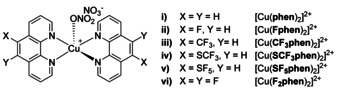
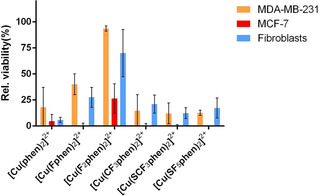
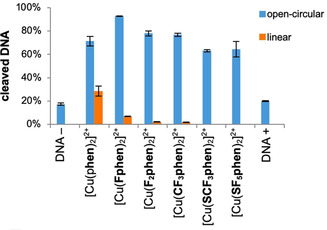
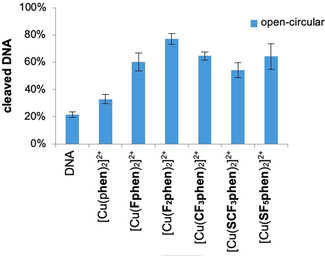
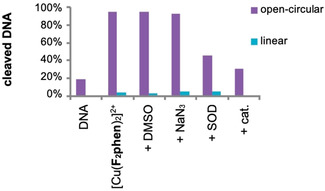
[Cu(phen) ] (phen=1,10-phenanthroline) is the first and still one of the most efficient artificial nucleases. In general, when the phen ligand is modified, the nucleolytic activity of its Cu complex is significantly reduced. This is most likely due to higher steric bulk of such ligands and thus lower affinity to DNA. Cu complexes with phen ligands having fluorinated substituents (F, CF , SF , SCF ) surprisingly showed excellent DNA cleavage activity-in contrast to the unsubstituted [Cu(phen) ] -in the absence of the otherwise required classical, bioabundant external reducing agents like thiols or ascorbate. This nucleolytic activity correlates well with the half-wave potentials E of the complexes. Cancer cell studies show cytotoxic effects of all complexes with fluorinated ligands in the low μm range, whereas they were less toxic towards healthy cells (fibroblasts).
[Cu(phen)](phen=1,10-菲咯啉)是第一个也是最有效的人工核酸酶之一。一般来说,当 phen 配体被修饰时,其 Cu 配合物的核酸酶活性会显著降低。这很可能是由于此类配体的空间位阻更大,因此与 DNA 的亲和力更低。令人惊讶的是,具有氟取代基(F、CF3、SF、SCF3)的 phen 配体的 Cu 配合物在没有其他必需的经典、生物丰富的外部还原剂(如硫醇或抗坏血酸)的情况下,显示出优异的 DNA 切割活性,与未取代的 [Cu(phen)]形成对比。这种核酸酶活性与配合物的半波电位 E 很好地相关。癌细胞研究表明,所有带有氟代配体的配合物在低 μM 范围内均具有细胞毒性,而对健康细胞(成纤维细胞)的毒性较小。