Department of Chemistry, The University of Kentucky, 505 Rose St, Lexington, KY 40506, USA.
Department of Chemistry, The University of Kentucky, 505 Rose St, Lexington, KY 40506, USA.
Curr Opin Chem Biol. 2021 Apr;61:191-202. doi: 10.1016/j.cbpa.2021.01.016. Epub 2021 Mar 30.
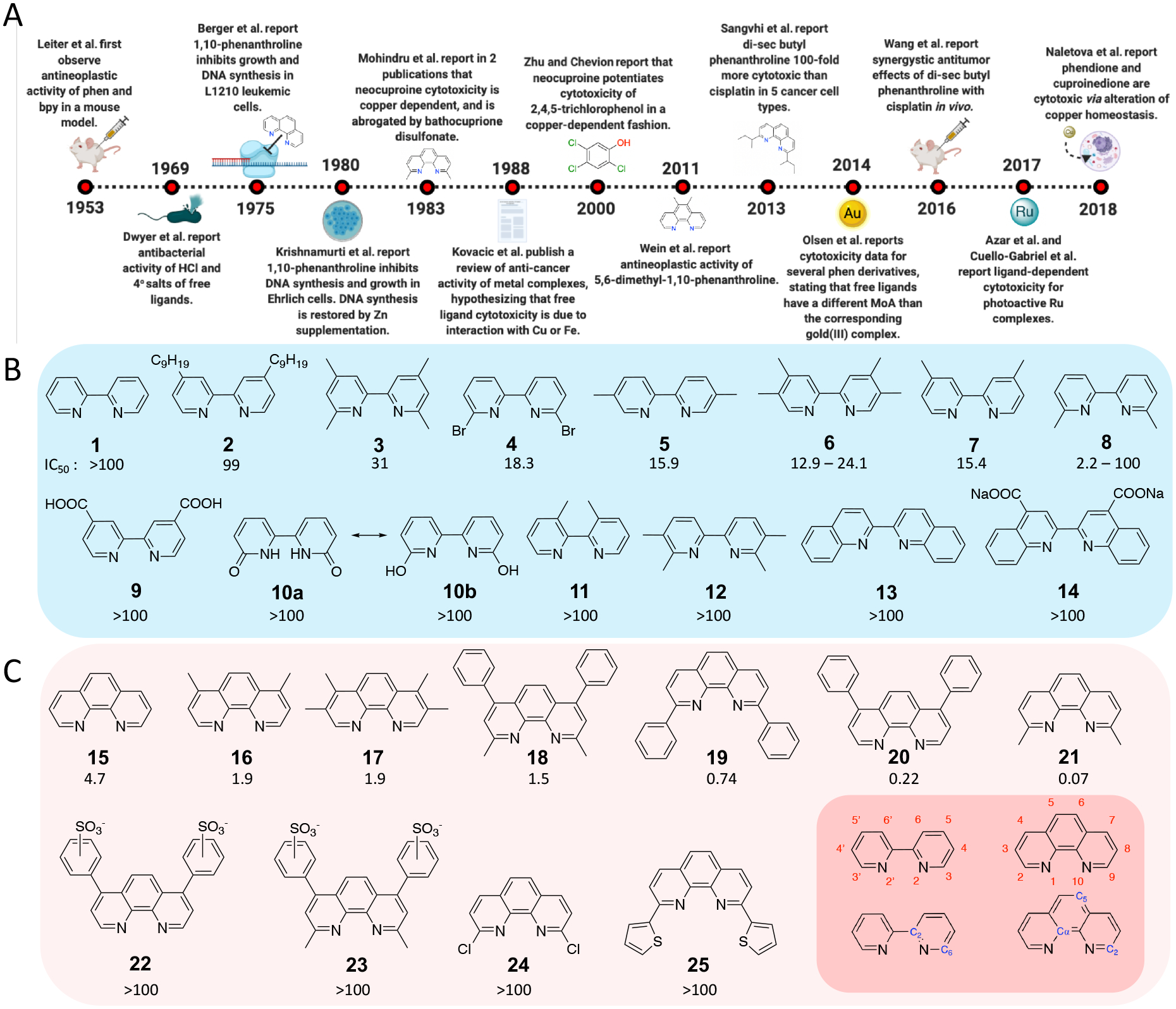
Polypyridyl coordinating ligands are common in metal complexes used in medicinal inorganic chemistry. These ligands possess intrinsic cytotoxicity, but detailed data on this phenomenon are sparse, and cytotoxicity values vary widely and are often irreproducible. To provide new insights into the biological effects of bipyridyl-type ligands and structurally related metal-binding systems, reports of free ligand cytotoxicity were reviewed. The cytotoxicity of 25 derivatives of 2,2'-bipyridine and 1,10-phenanthroline demonstrates that there is no correlation between IC values and ligand properties such as pKa, log D, polarizability volume, and electron density, as indicated by NMR shifts. As a result of these observations, as well as the various reported mechanisms of action of polypyridyl ligands, we offer the hypothesis that biological effects are governed by the availability of and affinity for specific metal ions within the experimental model.
多吡啶配位体在用于医学无机化学的金属配合物中很常见。这些配体具有内在的细胞毒性,但关于这种现象的详细数据很少,而且细胞毒性值差异很大,且常常不可重现。为了深入了解联吡啶型配体和结构相关的金属结合系统的生物学效应,综述了游离配体细胞毒性的报告。25 种 2,2'-联吡啶和 1,10-菲咯啉衍生物的细胞毒性表明,IC 值与配体性质(如 pKa、log D、极化率体积和电子密度)之间没有相关性,这可以通过 NMR 位移来证明。基于这些观察结果以及多吡啶配体的各种报道的作用机制,我们提出假说,即生物效应受实验模型中特定金属离子的可用性和亲和力控制。