Department of Psychology, University of Southampton, Southampton, UK.
Research Center for Future Design, Kochi University of Technology, Kochi, Japan.
Hum Brain Mapp. 2021 Apr 1;42(5):1328-1342. doi: 10.1002/hbm.25296. Epub 2020 Nov 27.
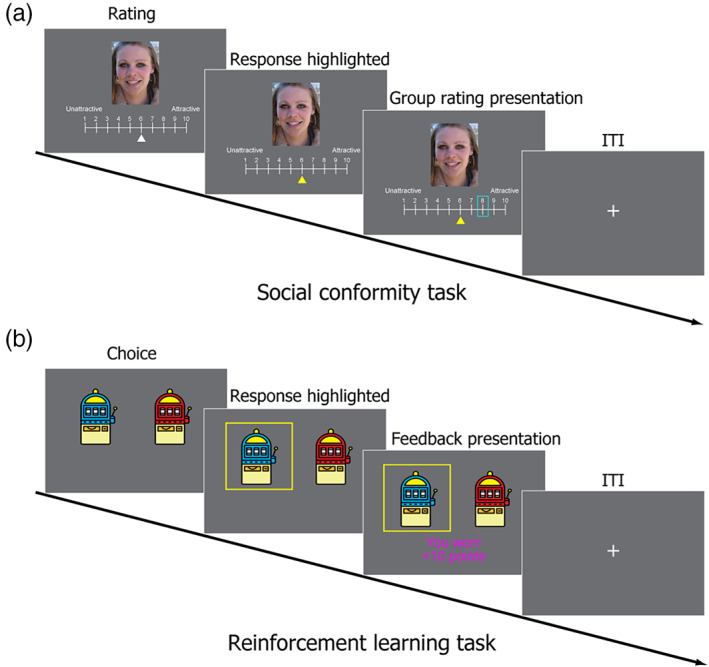
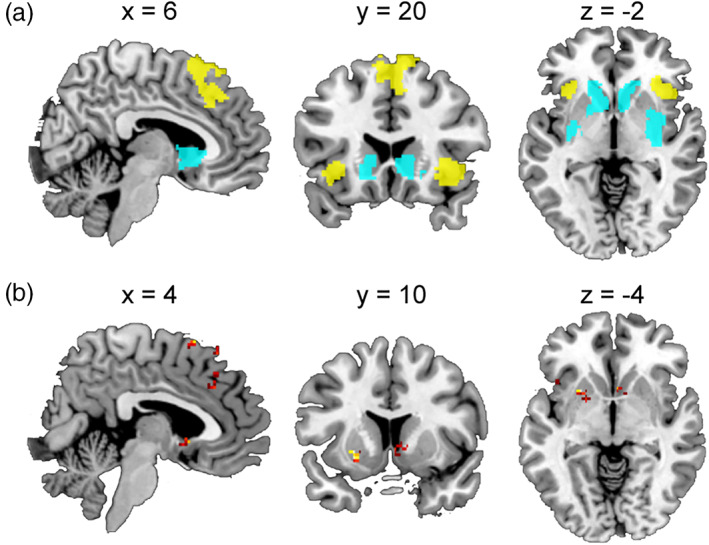
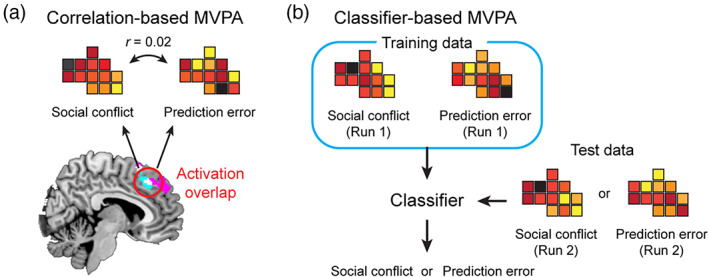
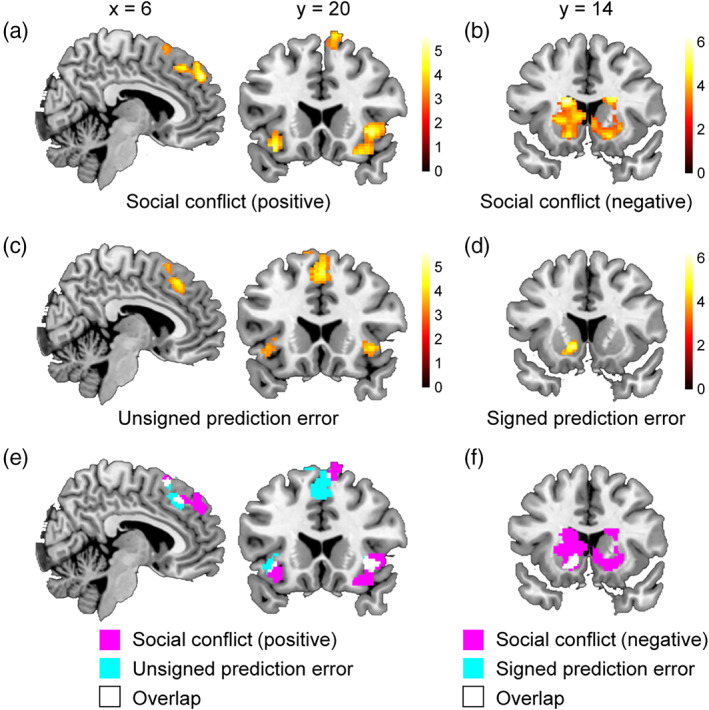
Our preferences are influenced by the opinions of others. The past human neuroimaging studies on social conformity have identified a network of brain regions related to social conformity that includes the posterior medial frontal cortex (pMFC), anterior insula, and striatum. Since these brain regions are also known to play important roles in reinforcement learning (i.e., processing prediction error), it was previously hypothesized that social conformity and reinforcement learning have a common neural mechanism. However, although this view is currently widely accepted, these two processes have never been directly compared; therefore, the extent to which they shared a common neural mechanism had remained unclear. This study aimed to formally test the hypothesis. The same group of participants (n = 25) performed social conformity and reinforcement learning tasks inside a functional magnetic resonance imaging (fMRI) scanner. Univariate fMRI data analyses revealed activation overlaps in the pMFC and bilateral insula between social conflict and unsigned prediction error and in the striatum between social conflict and signed prediction error. We further conducted multivoxel pattern analysis (MVPA) for more direct evidence of a shared neural mechanism. MVPA did not reveal any evidence to support the hypothesis in any of these regions but found that activation patterns between social conflict and prediction error in these regions were largely distinct. Taken together, the present study provides no clear evidence of a common neural mechanism between social conformity and reinforcement learning.
我们的偏好受到他人意见的影响。过去关于社会从众的人类神经影像学研究已经确定了一个与社会从众相关的大脑区域网络,包括后内侧前额皮质(pMFC)、前岛叶和纹状体。由于这些大脑区域也被认为在强化学习(即处理预测误差)中起着重要作用,因此之前假设社会从众和强化学习具有共同的神经机制。然而,尽管这种观点目前被广泛接受,但这两个过程从未被直接比较过;因此,它们共享共同神经机制的程度尚不清楚。本研究旨在正式检验这一假设。同一组参与者(n=25)在功能磁共振成像(fMRI)扫描仪内完成了社会从众和强化学习任务。单变量 fMRI 数据分析显示,在 pMFC 和双侧岛叶中,社会冲突与未签名预测误差之间以及纹状体中,社会冲突与签名预测误差之间存在激活重叠。我们进一步进行了多体素模式分析(MVPA),以获得更直接的共享神经机制证据。MVPA 在这些区域均未发现任何支持该假设的证据,但发现这些区域中社会冲突与预测误差之间的激活模式在很大程度上是不同的。总之,本研究没有提供明确的证据表明社会从众和强化学习之间存在共同的神经机制。