Epidemiology, Biostatistics, and Prevention Institute, University of Zurich, Zurich, Switzerland.
J Med Internet Res. 2020 Nov 27;22(11):e18889. doi: 10.2196/18889.
The availability and use of health apps continues to increase, revolutionizing the way mobile health interventions are delivered. Apps are increasingly used to prevent disease, improve well-being, and promote healthy behavior. On a similar rise is the incidence of skin cancers. Much of the underlying risk can be prevented through behavior change and adequate sun protection. Self-monitoring apps have the potential to facilitate prevention by measuring risk (eg, sun intensity) and encouraging protective behavior (eg, seeking shade).
Our aim was to assess health care consumer preferences for sun protection with a self-monitoring app that tracks the duration and intensity of sun exposure and provides feedback on when and how to protect the skin.
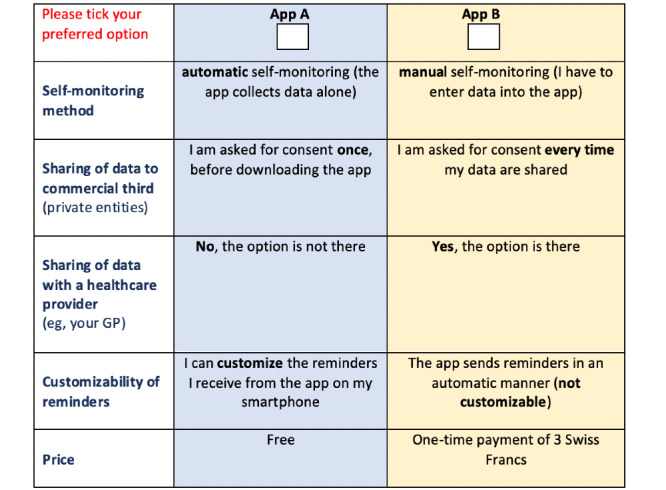
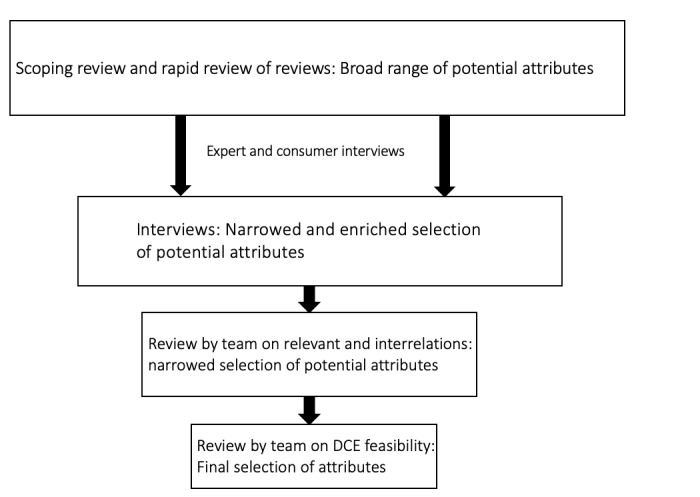
We conducted an unlabeled discrete choice experiment with 8 unique choice tasks, in which participants chose among 2 app alternatives, consisting of 5 preidentified 2-level attributes (self-monitoring method, privacy control, data sharing with health care provides, reminder customizability, and costs) that were the result of a multistep and multistakeholder qualitative approach. Participant preferences, and thus, the relative importance of attributes and their levels were estimated using conditional logit modeling. Analyses consisted of 200 usable surveys, yielding 3196 observations.
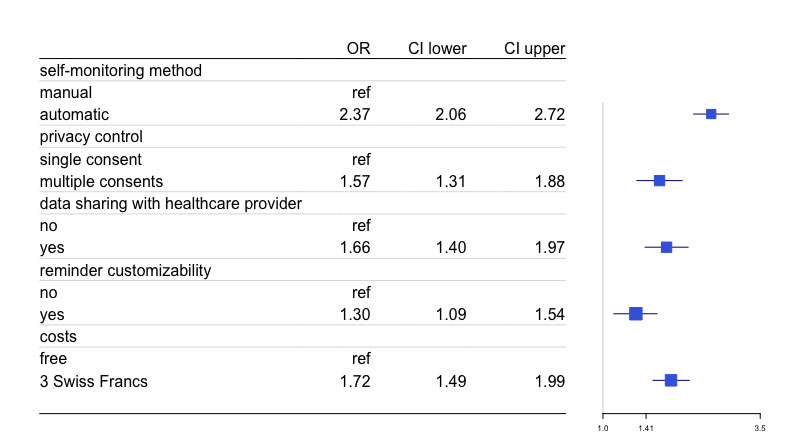
Our respondents strongly preferred automatic over manually operated self-monitoring (odds ratio [OR] 2.37, 95% CI 2.06-2.72) and no cost over a single payment of 3 Swiss francs (OR 1.72, 95% CI 1.49-1.99). They also preferred having over not having the option of sharing their data with a health care provider of their choice (OR 1.66, 95% CI 1.40-1.97), repeated over single user consents, whenever app data are shared with commercial thirds (OR 1.57, 95% CI 1.31-1.88), and customizable over noncustomizable reminders (OR 1.30, 95% CI 1.09-1.54). While most participants favored thorough privacy infrastructures, the attribute of privacy control was a relatively weak driver of app choice. The attribute of self-monitoring method significantly interacted with gender and perceived personal usefulness of health apps, suggesting that female gender and lower perceived usefulness are associated with relatively weaker preferences for automatic self-monitoring.
Based on the preferences of our respondents, we found that the utility of a self-monitoring sun protection app can be increased if the app is simple and adjustable; requires minimal effort, time, or expense; and has an interoperable design and thorough privacy infrastructure. Similar features might be desirable for preventive health apps in other areas, paving the way for future discrete choice experiments. Nonetheless, to fully understand these preference dynamics, further qualitative or mixed method research on mobile self-monitoring-based sun protection and broader preventive mobile self-monitoring is required.
INTERNATIONAL REGISTERED REPORT IDENTIFIER (IRRID): RR2-10.2196/16087.
健康类应用的可及性和使用量持续增加,正在彻底改变移动健康干预的提供方式。应用程序越来越多地被用于预防疾病、改善健康和促进健康行为。与此同时,皮肤癌的发病率也在上升。通过行为改变和充分的防晒措施,可以预防很多潜在风险。自我监测应用程序具有通过测量风险(例如阳光强度)并鼓励保护行为(例如寻找阴凉处)来促进预防的潜力。
我们旨在评估健康消费者对可跟踪日晒时长和强度并提供防晒建议的自我监测应用程序的防晒偏好。
我们进行了一项无标签离散选择实验,共 8 个独特的选择任务,参与者在 2 种应用程序备选方案之间进行选择,这两种方案由 5 个预先确定的 2 级属性(自我监测方法、隐私控制、与医疗保健提供者共享数据、提醒自定义和成本)组成,这些属性是通过多步骤和多利益相关者定性方法确定的。使用条件逻辑回归模型估计参与者的偏好,从而估计属性及其水平的相对重要性。分析包括 200 份可用的调查问卷,产生了 3196 个观测值。
我们的受访者强烈倾向于自动监测而非手动操作监测(优势比 [OR] 2.37,95%置信区间 [CI] 2.06-2.72),并且更愿意选择无成本而不是支付 3 瑞士法郎的单一费用(OR 1.72,95% CI 1.49-1.99)。他们还更愿意选择能够选择与自己选择的医疗保健提供者共享数据(OR 1.66,95% CI 1.40-1.97),而不是选择单次用户同意,并且只要应用程序数据与商业第三方共享,就能够选择重复共享(OR 1.57,95% CI 1.31-1.88),而不是非自定义提醒(OR 1.30,95% CI 1.09-1.54)。虽然大多数参与者都支持彻底的隐私基础设施,但隐私控制属性是应用程序选择的一个相对较弱的驱动因素。自我监测方法属性与性别和对健康应用程序的感知有用性显著交互,表明女性性别和较低的感知有用性与对自动自我监测的相对较弱偏好相关。
根据受访者的偏好,我们发现,如果应用程序简单且可调节、需要最少的精力、时间或费用,并且具有互操作性设计和完善的隐私基础设施,那么自我监测防晒应用程序的实用性就可以提高。在其他领域的预防性健康应用程序中,类似的功能可能是可取的,为未来的离散选择实验铺平了道路。然而,为了充分了解这些偏好动态,需要对基于移动自我监测的防晒和更广泛的预防性移动自我监测进行进一步的定性或混合方法研究。