Kozlov Elissa, Bantum Erin, Pagano Ian, Walser Robyn, Ramsey Kelly, Taylor Katherine, Jaworski Beth, Owen Jason
Institute for Health, Health Policy and Aging Research, Rutgers University, New Brunswick, NJ, United States.
School of Public Health, Rutgers University, New Brunswick, NJ, United States.
JMIR Ment Health. 2020 Nov 27;7(11):e23377. doi: 10.2196/23377.
As smartphones are now used by most Americans, it is increasingly possible for mental health mobile apps to be disseminated to the general public. However, little is known about how mobile mental health apps are used by the general population outside of a controlled research design.
Our objective is to describe how the general population engages with Mindfulness Coach, an iOS- and Android-based app designed to deliver a mindfulness training course.
Using anonymous download and analytics data, we characterized the reach, usage, retention, and impact of Mindfulness Coach. We included mobile analytics data from all unique downloads of Mindfulness Coach between August 1, 2018, and April 8, 2019 (N=104,067) as well as starred reviews from all Mindfulness Coach users who provided reviews of the app as of March 1, 2020. Mindfulness characteristics were measured by an in-app assessment using the Five-Facet Mindfulness Questionnaire-Short Form (FFMQ-SF).
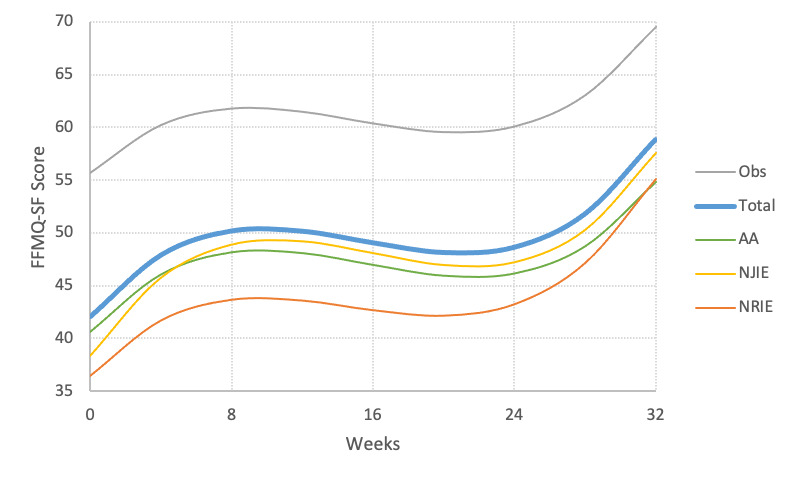
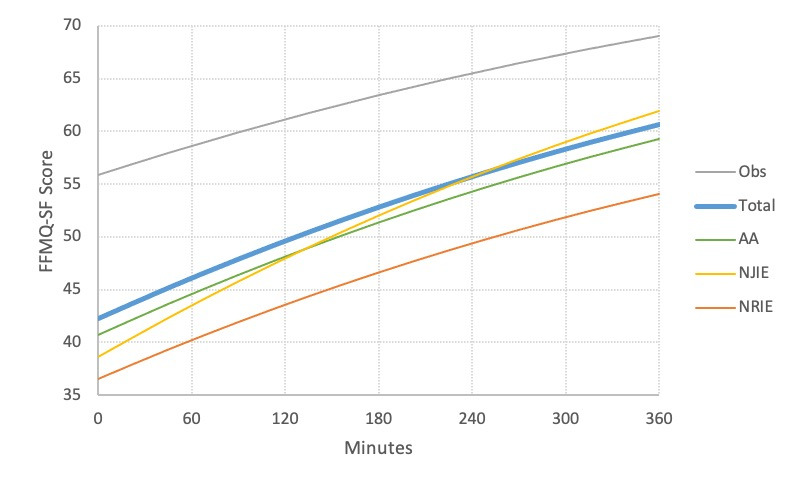
Users engaged, on average, in 4.3 visits to the app (SD 8.8; median 2; 90th percentile 8) and associated with an average total of 49.2 interactions with the app (ie, clicks within the app) (SD 113.8; median 19; 90th percentile 105). Users spent an average of 16.2 minutes (SD 63.1) engaged with the app over the full study time period. There were strong linear effects of app engagement on total FFMQ-SF scores. For example, FFMQ-SF scores were associated with more time spent engaged with the app (R=.23; P<.001). Mindfulness Coach has been reviewed in the Google Play Store 3415 times, with an average rating of 4.7 out of 5 stars, and over 2000 times in the Apple App Store, with an average rating of 4.8 out of 5 stars.
These findings suggest that Mindfulness Coach has achieved substantial and sustained reach in the general population; however, it was used less frequently by many downloaders than researchers and designers intended. There was a subpopulation of users who engaged in the app regularly over an extended period of time, and there was a clear relationship between app use and improvements in mindfulness. To strengthen Mindfulness Coach's public health impact, more research is needed to understand who is using the app and how, and to design strategies to increase user engagement in order for users to receive a larger dose of mindfulness treatment.
由于现在大多数美国人都使用智能手机,心理健康移动应用程序越来越有可能传播到普通大众中。然而,在受控研究设计之外,普通人群如何使用移动心理健康应用程序却鲜为人知。
我们的目的是描述普通人群如何使用正念教练(Mindfulness Coach),这是一款基于iOS和安卓系统的应用程序,旨在提供正念训练课程。
我们使用匿名下载和分析数据,对正念教练的覆盖范围、使用情况、留存率和影响进行了描述。我们纳入了2018年8月1日至2019年4月8日期间正念教练所有独特下载的移动分析数据(N = 104,067),以及截至2020年3月1日对该应用程序进行评价的所有正念教练用户的星级评价。正念特征通过使用五因素正念问卷简表(FFMQ-SF)的应用内评估来衡量。
用户平均访问该应用程序4.3次(标准差8.8;中位数2;第90百分位数8),与该应用程序的平均总交互次数为49.2次(即应用内点击次数)(标准差113.8;中位数19;第90百分位数105)。在整个研究时间段内,用户使用该应用程序的平均时间为16.2分钟(标准差63.1)。应用程序使用与FFMQ-SF总分之间存在强烈的线性效应。例如,FFMQ-SF得分与使用该应用程序的时间更长相关(R = 0.23;P <.001)。正念教练在谷歌应用商店被评价3415次,平均评分4.7星(满分5星),在苹果应用商店被评价超过2000次,平均评分4.8星(满分5星)。
这些发现表明,正念教练在普通人群中已获得广泛且持续的覆盖;然而,许多下载者的使用频率低于研究人员和设计者的预期。有一部分用户在较长时间内定期使用该应用程序,并且应用程序的使用与正念的改善之间存在明显的关系。为了增强正念教练对公共卫生的影响,需要更多的研究来了解谁在使用该应用程序以及如何使用,并设计策略来提高用户参与度,以便用户能够接受更大剂量的正念治疗。