Department of Medicine, Division of Endocrinology, Leiden University Medical Center, ZA Leiden, the Netherlands.
Center for Innovative Pituitary Care and Cranial Base Surgery, Leiden University Medical Center, ZA Leiden, the Netherlands.
J Clin Endocrinol Metab. 2021 Jan 23;106(2):577-587. doi: 10.1210/clinem/dgaa868.
Whereas biochemical response is often used as a primary study outcome, improvement in symptoms and health-related quality of life (HRQoL) is the relevant goal for patients to consider treatment successful. We performed a systematic review and meta-analysis to assess the effect of treatment on symptoms and HRQoL in acromegaly.
Seven electronic databases were searched for longitudinal studies assessing patient-reported symptoms or HRQoL in acromegaly. Meta-analyses were performed to assess differences during treatment for the Acromegaly Quality of Life Questionnaire (AcroQoL) and Patient-Assessed Acromegaly Symptom Questionnaire (PASQ), and standardized mean difference (SMD) for individual symptoms (interpretation: 0.2 small, 0.5 moderate, and 0.8 large effect). Treatment-naive and previously treated patients were assessed separately.
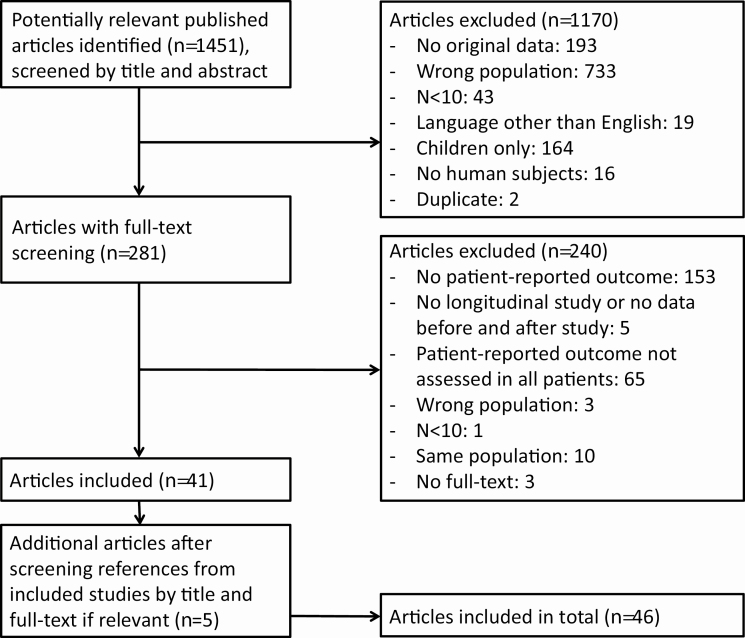
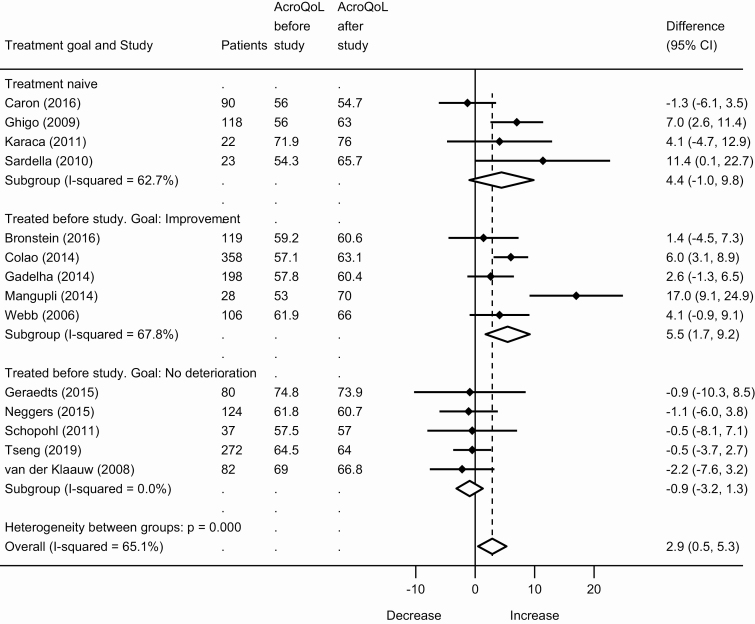
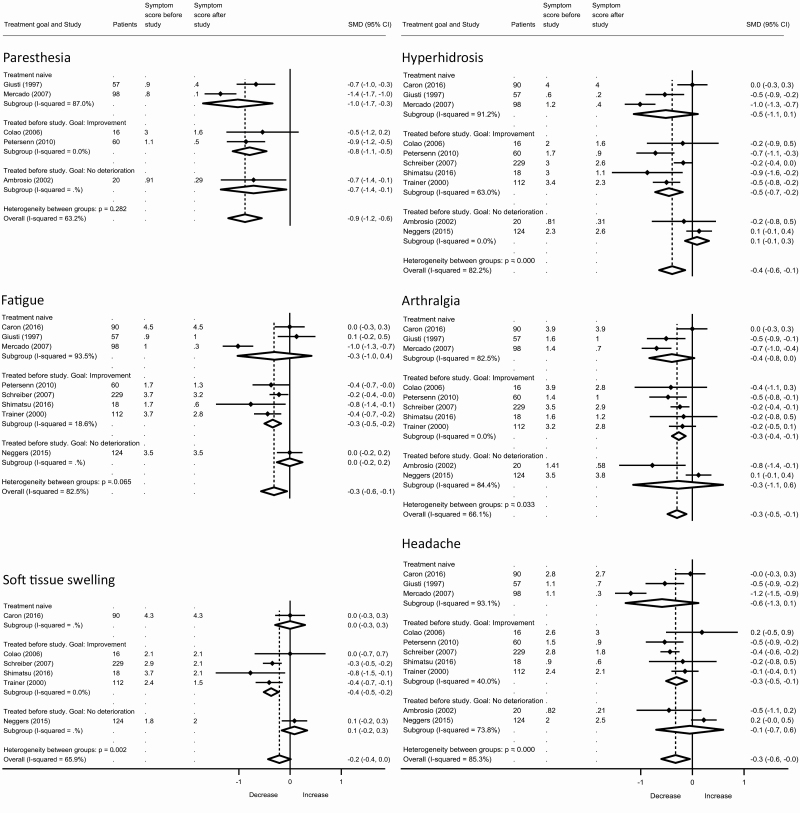
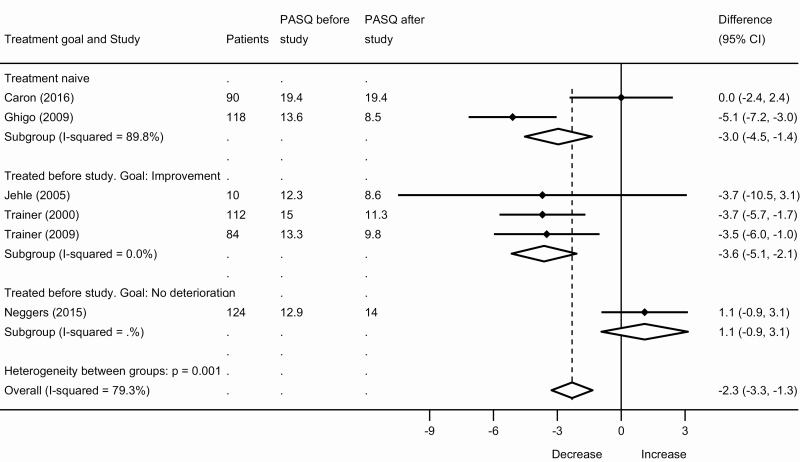
Forty-six studies with 3301 patients were included; 24 contributed to quantitative analyses. Thirty-six studies used medication as main treatment, 1 transsphenoidal adenomectomy, and 9 various treatments. Symptoms and HRQoL both improved: AcroQoL increased 2.9 points (95% CI, 0.5 to 5.3 points), PASQ decreased -2.3 points (95% CI, -1.3 to -3.3 points), and individual symptom scores decreased for paresthesia -0.9 (95% CI, -0.6 to -1.2), hyperhidrosis -0.4 (95% CI, -0.1 to -0.6), fatigue -0.3 (95% CI, -0.1 to -0.6), arthralgia -0.3 (95% CI, -0.1 to -0.5), headache -0.3 (95% CI, 0.0 to -0.6), and soft-tissue swelling -0.2 (95% CI, 0.0 to -0.4).
Symptoms and HRQoL improved during acromegaly treatment. Consensus is needed on which symptoms should be included in a potential core outcome set, taking into account symptom frequency, severity, and sensitivity to change, which can be used in clinical practice and as outcome in trials.
尽管生化反应常被用作主要的研究结果,但改善症状和健康相关生活质量(HRQoL)是患者考虑治疗成功的相关目标。我们进行了系统评价和荟萃分析,以评估治疗对肢端肥大症患者症状和 HRQoL 的影响。
检索了七个电子数据库,以评估肢端肥大症患者报告的症状或 HRQoL 的纵向研究。进行荟萃分析以评估治疗期间 AcroQoL 和 PASQ 的差异,以及单个症状的标准化均数差(SMD)(解释:0.2 为小,0.5 为中,0.8 为大)。分别评估治疗初治和经治患者。
共纳入 46 项研究 3301 例患者,其中 24 项研究进行了定量分析。36 项研究采用药物作为主要治疗方法,1 项研究采用经蝶窦腺瘤切除术,9 项研究采用各种治疗方法。症状和 HRQoL 均得到改善:AcroQoL 增加 2.9 分(95%CI,0.5 至 5.3 分),PASQ 降低-2.3 分(95%CI,-1.3 至-3.3 分),单个症状评分降低:感觉异常-0.9(95%CI,-0.6 至-1.2),多汗症-0.4(95%CI,-0.1 至-0.6),疲劳-0.3(95%CI,-0.1 至-0.6),关节痛-0.3(95%CI,-0.1 至-0.5),头痛-0.3(95%CI,0.0 至-0.6),软组织肿胀-0.2(95%CI,0.0 至-0.4)。
在肢端肥大症治疗期间,症状和 HRQoL 得到改善。需要就哪些症状应纳入潜在的核心结局集达成共识,要考虑到症状的频率、严重程度和对变化的敏感性,这可以在临床实践中使用,并作为试验的结局。