Department of Molecular Biology and Biotechnology, Florey Institute, University of Sheffield, Sheffield, UK.
Department of Molecular Biology, Princeton University, Princeton, NJ, USA.
Microb Genom. 2021 Jan;7(1). doi: 10.1099/mgen.0.000482. Epub 2020 Nov 27.
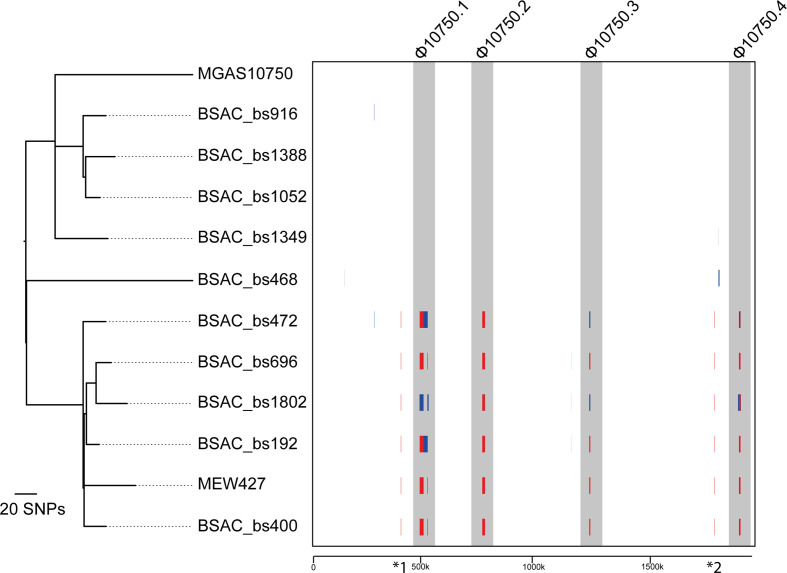
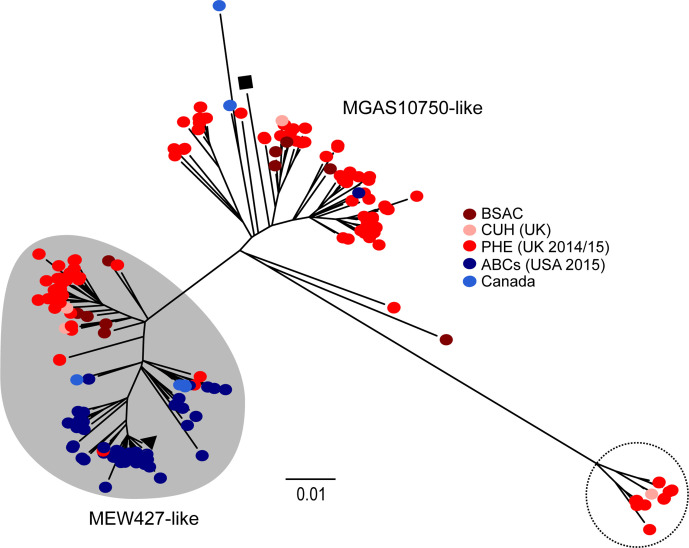
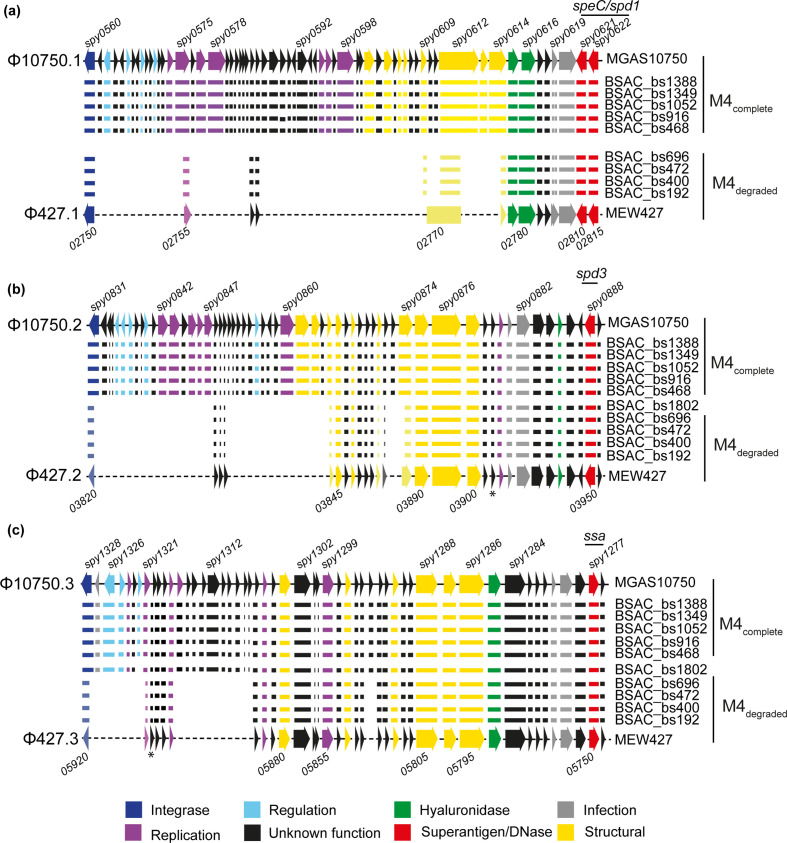
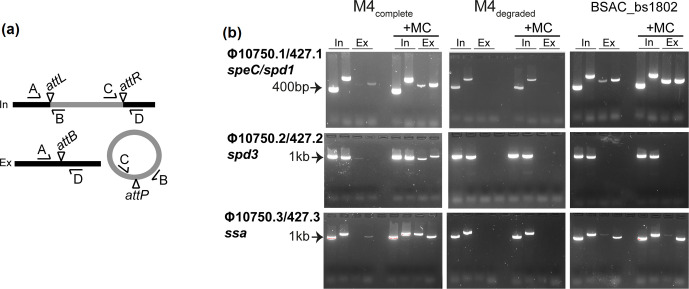
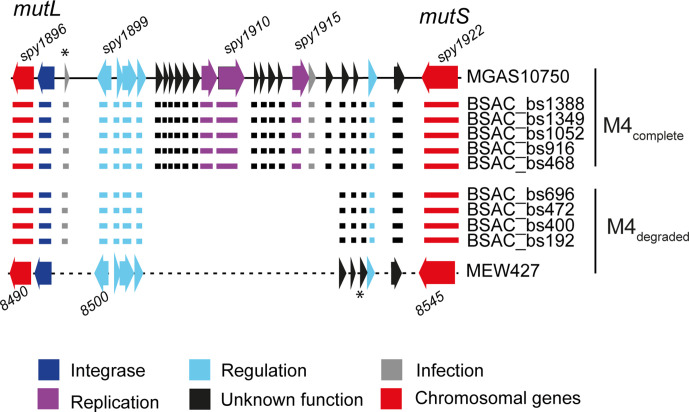
The major human pathogen shares an intimate evolutionary history with mobile genetic elements, which in many cases carry genes encoding bacterial virulence factors. During recent whole-genome sequencing of a longitudinal sample of isolates in England, we identified a lineage within 4 that clustered with the reference genome MEW427. Like MEW427, this lineage was characterized by substantial gene loss within all three prophage regions, compared to MGAS10750 and isolates outside of the MEW427-like lineage. Gene loss primarily affected lysogeny, replicative and regulatory modules, and to a lesser and more variable extent, structural genes. Importantly, prophage-encoded superantigen and DNase genes were retained in all isolates. In isolates where the prophage elements were complete, like MGAS10750, they could be induced experimentally, but not in MEW427-like isolates with degraded prophages. We also found gene loss within the chromosomal island SpyCIM4 of MEW427-like isolates, although surprisingly, the SpyCIM4 element could not be experimentally induced in either MGAS10750-like or MEW427-like isolates. This did not, however, appear to abolish expression of the mismatch repair operon, within which this element resides. The inclusion of further 4 genomes in our analyses ratified our observations and revealed an international 4 lineage characterized by prophage degradation. Intriguingly, the USA population of 4 appeared to constitute predominantly MEW427-like isolates, whereas the UK population comprised both MEW427-like and MGAS10750-like isolates. The degraded and cryptic nature of these elements may have important phenotypic and fitness ramifications for 4 , and the geographical distribution of this lineage raises interesting questions on the population dynamics of the genotype.
主要的人类病原体与移动遗传元件有着密切的进化史,这些元件在许多情况下携带编码细菌毒力因子的基因。在最近对英国 4 株分离株的纵向样本进行全基因组测序时,我们在 4 中发现了一个与参考基因组 MEW427 聚类的谱系。与 MEW427 一样,与 MGAS10750 和 MEW427 样谱系之外的分离株相比,该谱系在所有三个噬菌体区域内都有大量基因缺失。基因缺失主要影响溶原性、复制和调节模块,在较小程度上和更多变的程度上影响结构基因。重要的是,噬菌体编码的超抗原和 DNase 基因在所有分离株中都保留了下来。在 MGAS10750 等具有完整噬菌体元件的分离株中,它们可以通过实验诱导,但在 MEW427 样分离株中,由于噬菌体降解,它们不能被诱导。我们还在 MEW427 样分离株的染色体岛 SpyCIM4 中发现了基因缺失,尽管令人惊讶的是,无论是在 MGAS10750 样还是 MEW427 样分离株中,都不能通过实验诱导 SpyCIM4 元件。然而,这似乎并没有废除该元件所在的错配修复操纵子的表达。在我们的分析中纳入了另外 4 个基因组,证实了我们的观察结果,并揭示了一个以噬菌体降解为特征的国际 4 谱系。有趣的是,4 的美国人群似乎主要由 MEW427 样分离株组成,而英国人群则由 MEW427 样和 MGAS10750 样分离株组成。这些元件的降解和隐匿性质可能对 4 具有重要的表型和适应性影响,而该谱系的地理分布对该基因型的种群动态提出了有趣的问题。