Internal Medicine, University of Texas Southwestern Medical Center at Dallas, Dallas, Texas, USA.
Hypertension Section, Internal Medicine, University of Texas Southwestern Medical Center, Dallas, Texas, United States.
BMJ Open. 2020 Nov 27;10(11):e039940. doi: 10.1136/bmjopen-2020-039940.
Previous studies have implicated therapeutic drug monitoring (TDM), by measuring serum or urine drug levels, as a highly reliable technique for detecting medication non-adherence but the attitudes of patients and physicians toward TDM have not been evaluated previously. Accordingly, we solicited input from patients with uncontrolled hypertension and their physicians about their views on TDM.
Prospective analysis of responses to a set of questions during semistructured interviews.
Outpatient clinics in an integrated health system which provides care for a low-income, uninsured population.
Patients with uncontrolled hypertension with either systolic blood pressure of at least 130 mm Hg or diastolic blood pressure of at least 80 mm Hg despite antihypertensive drugs and providers in the general cardiology and internal medicine clinics.
Attitudes towards TDM and the potential impact on physician-patient relationship.
We interviewed 11 patients and 10 providers and discussed the findings with 13 community advisory panel (CAP) members. Of the patients interviewed, 91% (10 of 11) and all 10 providers thought TDM was a good idea and should be used regularly to better understand the reasons for poorly controlled hypertension. However, 63% (7 of 11) of patients and 20% of providers expressed reservations that TDM could negatively impact the physician-patient relationship. Despite some concerns, the majority of patients, providers and CAP members believed that if test results are communicated without blaming patients, the potential benefits of TDM in identifying suboptimal adherence and eliciting barriers to adherence outweighed the risks.
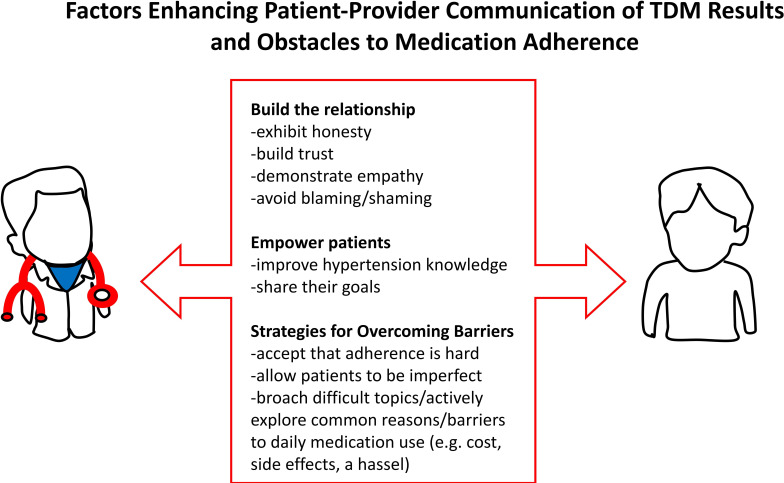
The idea of TDM is well accepted by patients and their providers. TDM information if delivered in a non-judgmental manner, to encourage an honest conversation between patients and physicians, has the potential to reduce patient-physician communication obstacles and to identify barriers to adherence which, when overcome, can improve health outcomes.
先前的研究表明,通过测量血清或尿液中的药物水平来进行治疗药物监测(TDM)是一种非常可靠的技术,可以检测药物的不依从性,但患者和医生对 TDM 的态度以前并未得到评估。因此,我们向未得到控制的高血压患者及其医生征求了他们对 TDM 的看法。
对一系列问题进行半结构化访谈的前瞻性分析。
为低收入、无保险人群提供服务的综合卫生系统中的门诊诊所。
血压控制不佳的高血压患者,其收缩压至少为 130mmHg,或舒张压至少为 80mmHg,尽管使用了抗高血压药物,但仍有医生在普通心脏病学和内科诊所就诊。
对 TDM 的态度以及对医患关系的潜在影响。
我们采访了 11 名患者和 10 名医生,并与 13 名社区咨询小组(CAP)成员讨论了调查结果。在接受采访的患者中,91%(11 人中的 10 人)和所有 10 名医生都认为 TDM 是个好主意,应该定期使用以更好地了解控制不佳的高血压的原因。然而,63%(11 人中的 7 人)的患者和 20%的医生表示保留意见,认为 TDM 可能会对医患关系产生负面影响。尽管存在一些担忧,但大多数患者、医生和 CAP 成员认为,如果不指责患者而传递测试结果,TDM 在确定不适当的依从性和发现依从性障碍方面的潜在好处超过了风险。
患者及其医生接受 TDM 的想法。如果以非评判的方式提供 TDM 信息,以鼓励患者和医生之间进行诚实的对话,那么 TDM 有可能减少医患沟通障碍,并发现依从性障碍,当克服这些障碍时,就可以改善健康结果。