Department of Animal Science and Technology, Chung-Ang University, Anseong-si, Gyeonggi-do 17546, Republic of Korea.
Department of Animal Science and Technology, Chung-Ang University, Anseong-si, Gyeonggi-do 17546, Republic of Korea.
Poult Sci. 2020 Dec;99(12):6462-6473. doi: 10.1016/j.psj.2020.08.061. Epub 2020 Sep 12.
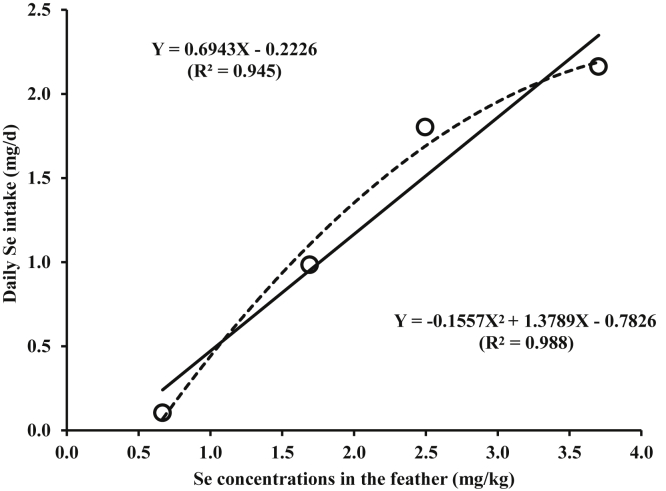
The present experiment aimed to compare toxic effects of dietary organic or inorganic selenium (Se) and to predict of Se intake and tissue Se concentrations in broiler chickens based on feather Se concentrations. A total of four hundred twenty 7-day-old Ross 308 male broiler chicks were allotted to 1 of 7 dietary treatments in a completely randomized design. Each treatment had 6 replicates with 10 birds per replicate. Organic Se (selenium yeast) or inorganic Se (sodium selenite) was added to the basal diet at the levels of 5, 10, or 15 mg/kg Se. All experimental diets were fed to birds on an ad libitum basis for 28 d. Results indicated that a significant interaction (P < 0.01) was observed between Se sources and inclusion levels for the BW gain and feed intake of broiler chickens with inorganic Se at 15 mg/kg in diets showing a greatest negative effect. Increasing inclusion levels of Se in diets increased (linear, P < 0.01) plasma concentrations of uric acid. Increasing inclusion levels of Se in diets increased (linear, P < 0.01) relative liver weight. No significant interactions were observed between Se sources and inclusion levels in diets on hepatic antioxidant capacity. Increasing inclusion levels of Se in diets increased (linear, P < 0.01) Se concentrations in the liver, breast, and feather. The concentrations of Se in the breast, liver, and feather were greater (P < 0.05) for organic Se than for inorganic Se in diets. The toxic levels of organic or inorganic Se in broiler diets were near 7 or 9 mg/kg based on the BW gain, respectively. The prediction equations indicate that feather Se concentrations in broiler chickens can be used to predict both daily Se intake and Se concentrations in the liver and breast.
本实验旨在比较有机硒或无机硒(Se)的毒性作用,并根据羽毛 Se 浓度预测肉鸡的 Se 摄入量和组织 Se 浓度。将 420 只 7 日龄 Ross 308 雄性肉鸡随机分为 7 种日粮处理组,每组 6 个重复,每个重复 10 只鸡。在基础日粮中添加 5、10 或 15 mg/kg Se 的有机硒(酵母硒)或无机硒(亚硒酸钠)。所有实验日粮均以自由采食的方式喂养肉鸡 28 d。结果表明,Se 源与添加水平对肉鸡 BW 增重和采食量存在显著互作(P < 0.01),日粮中添加 15 mg/kg 无机 Se 时,效果最差。日粮中 Se 水平线性增加(P < 0.01),肉鸡血浆尿酸浓度升高。日粮中 Se 水平线性增加(P < 0.01),肝脏相对重量增加。日粮中 Se 源与添加水平对肝脏抗氧化能力无显著互作。日粮中 Se 水平线性增加(P < 0.01),肝脏、胸部和羽毛中的 Se 浓度增加。日粮中有机 Se 比无机 Se 使胸部、肝脏和羽毛中的 Se 浓度更高(P < 0.05)。基于 BW 增重,肉鸡日粮中有机或无机 Se 的毒性水平接近 7 或 9 mg/kg。预测方程表明,肉鸡羽毛 Se 浓度可用于预测每日 Se 摄入量和肝脏、胸部组织中的 Se 浓度。