Centre for Infectious Disease Control, National Institute for Public Health and the Environment, Bilthoven, The Netherlands.
Department of Epidemiology and Data Science, Amsterdam University Medical Center, location VUmc, Amsterdam, The Netherlands.
Clin Infect Dis. 2021 Mar 1;72(5):e103-e111. doi: 10.1093/cid/ciaa1770.
Human papillomavirus (HPV) vaccination programs achieve substantial population-level impact, with effects extending beyond protection of vaccinated individuals. We assessed trends in HPV prevalence up to 8 years postvaccination among men and women in the Netherlands, where bivalent HPV vaccination, targeting HPV types 16/18, has been offered to (pre)adolescent girls since 2009 with moderate vaccination coverage.
We used data from the PASSYON study, a survey initiated in 2009 (prevaccination) and repeated biennially among 16- to 24-year-old visitors of sexual health centers. We studied genital HPV positivity from 2009 to 2017 among women, heterosexual men, and unvaccinated women using Poisson generalized estimating equation models, adjusted for individual- and population-level confounders. Trends were studied for 25 HPV types detected by the SPF10-LiPA25 platform.
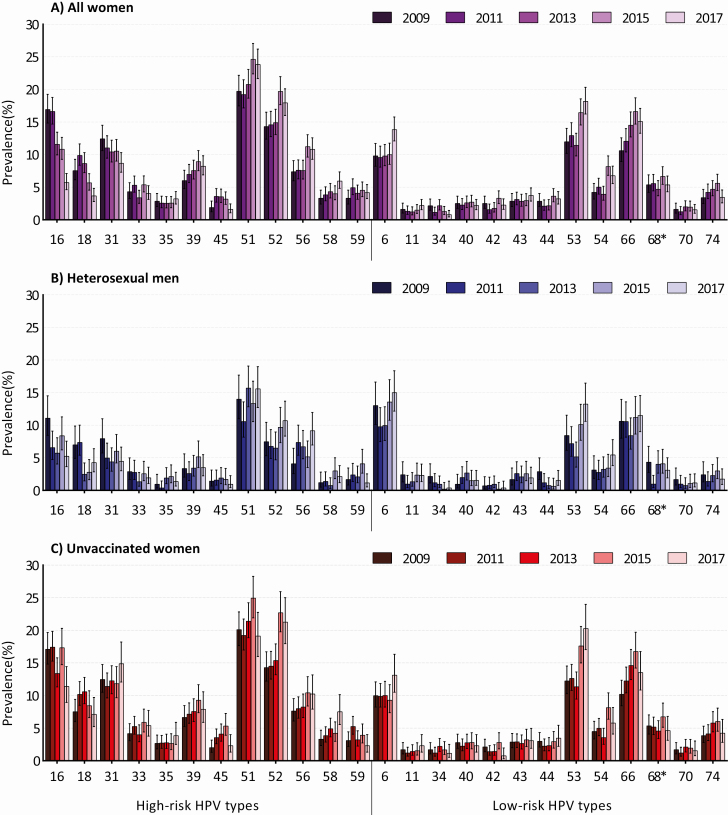
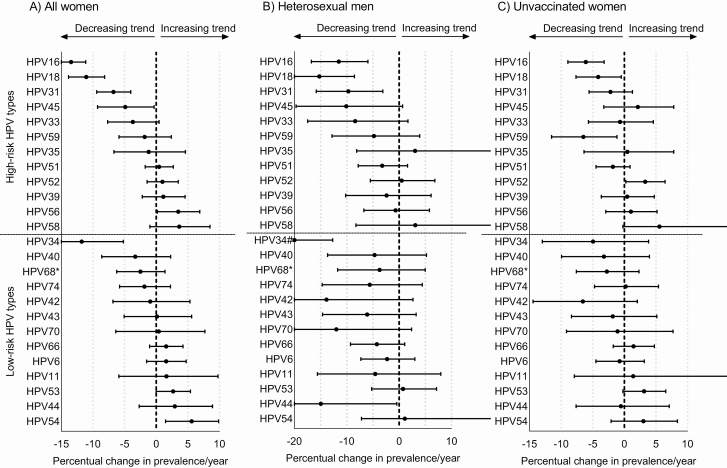
A total of 6354 women (64.7% self-reported unvaccinated) and 2414 heterosexual men were included. Percentual declines in vaccine types HPV-16/18 were observed for all women (12.6% per year [95% confidence interval {CI}, 10.6-14.5]), heterosexual men (13.0% per year [95% CI, 8.3-17.5]), and unvaccinated women (5.4% per year [95% CI, 2.9-7.8]). We observed significant declines in HPV-31 (all women and heterosexual men), HPV-45 (all women), and in all high-risk HPV types pooled (all women and heterosexual men). Significant increases were observed for HPV-56 (all women) and HPV-52 (unvaccinated women).
Our results provide evidence for first-order herd effects among heterosexual men against HPV-16/18 and cross-protective types. Additionally, we show second-order herd effects against vaccine types among unvaccinated women. These results are promising regarding population-level and clinical impact of girls-only bivalent HPV vaccination in a country with moderate vaccine uptake.
人乳头瘤病毒(HPV)疫苗接种计划在人群中产生了实质性的影响,其效果不仅局限于保护接种个体。我们评估了荷兰在 HPV 疫苗接种后 8 年内男性和女性 HPV 流行率的趋势,该国自 2009 年以来为(青春期前)少女提供了针对 HPV 类型 16/18 的二价 HPV 疫苗接种,疫苗接种覆盖率中等。
我们使用了 PASSYON 研究的数据,该研究于 2009 年(疫苗接种前)启动,并在性健康中心的 16 至 24 岁访客中每两年重复一次。我们使用泊松广义估计方程模型,针对个体和人群水平的混杂因素进行调整,研究了 2009 年至 2017 年期间女性、异性恋男性和未接种疫苗的女性中 HPV 阳性率。研究了 SPF10-LiPA25 平台检测到的 25 种 HPV 类型的趋势。
共纳入 6354 名女性(64.7%自我报告未接种疫苗)和 2414 名异性恋男性。所有女性(每年 12.6%[95%置信区间 {CI},10.6-14.5])、异性恋男性(每年 13.0%[95% CI,8.3-17.5])和未接种疫苗的女性(每年 5.4%[95% CI,2.9-7.8%])中 HPV-16/18 疫苗类型的百分比均有所下降。我们观察到 HPV-31(所有女性和异性恋男性)、HPV-45(所有女性)和所有高危 HPV 类型(所有女性和异性恋男性)的显著下降。HPV-56(所有女性)和 HPV-52(未接种疫苗的女性)的感染率显著增加。
我们的结果提供了证据表明,在 HPV 疫苗接种覆盖率中等的国家,异性恋男性对 HPV-16/18 和交叉保护类型具有一级群体效应。此外,我们还发现了未接种疫苗的女性对疫苗类型的二级群体效应。这些结果表明,在 HPV 疫苗接种仅针对女孩的国家,该疫苗在人群和临床方面具有显著效果。