Ebel Roy, Müller Johannes, Ramm Till, Hipsley Christy, Amson Eli
Museum für Naturkunde, Leibniz Institute for Evolution and Biodiversity Science, Berlin, Germany.
Institute for Biology, Faculty of Life Sciences, Humboldt-Universität zu Berlin, Berlin, Germany.
BMC Biol. 2020 Nov 30;18(1):185. doi: 10.1186/s12915-020-00908-y.
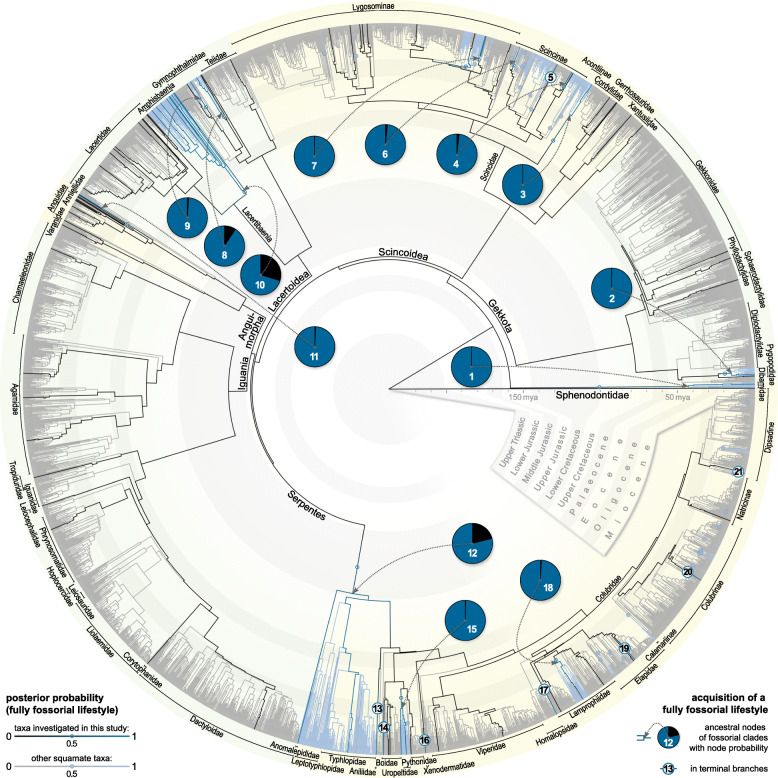
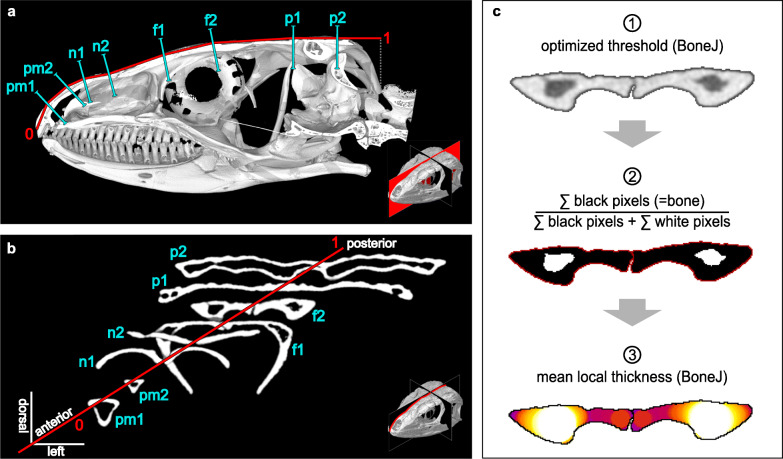
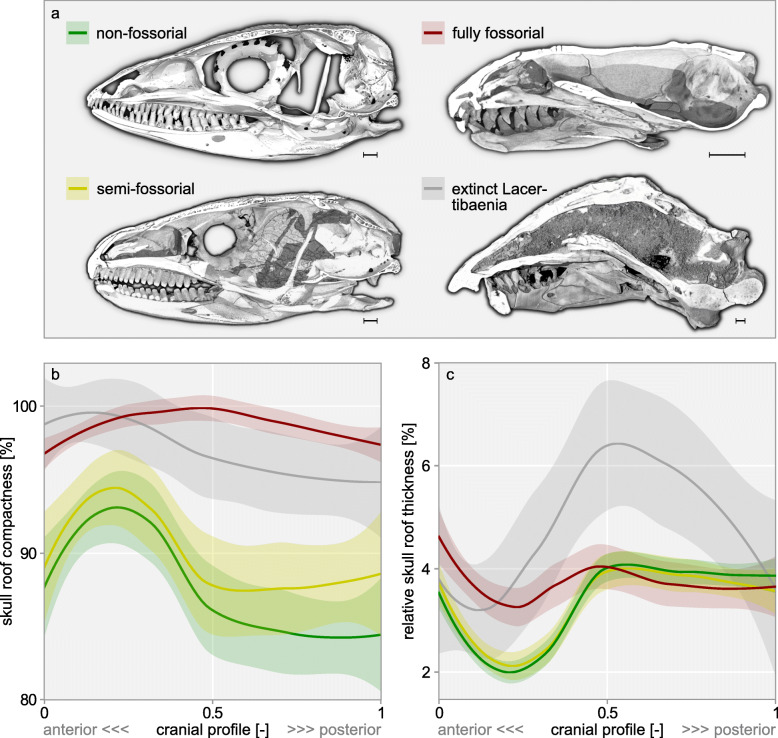
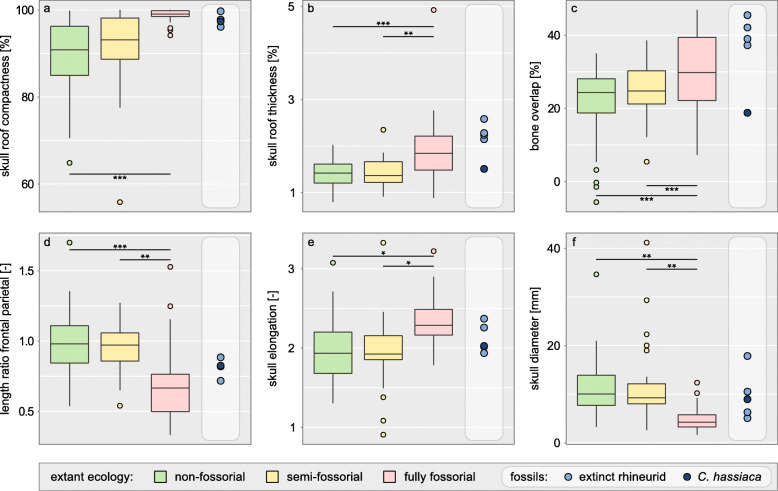
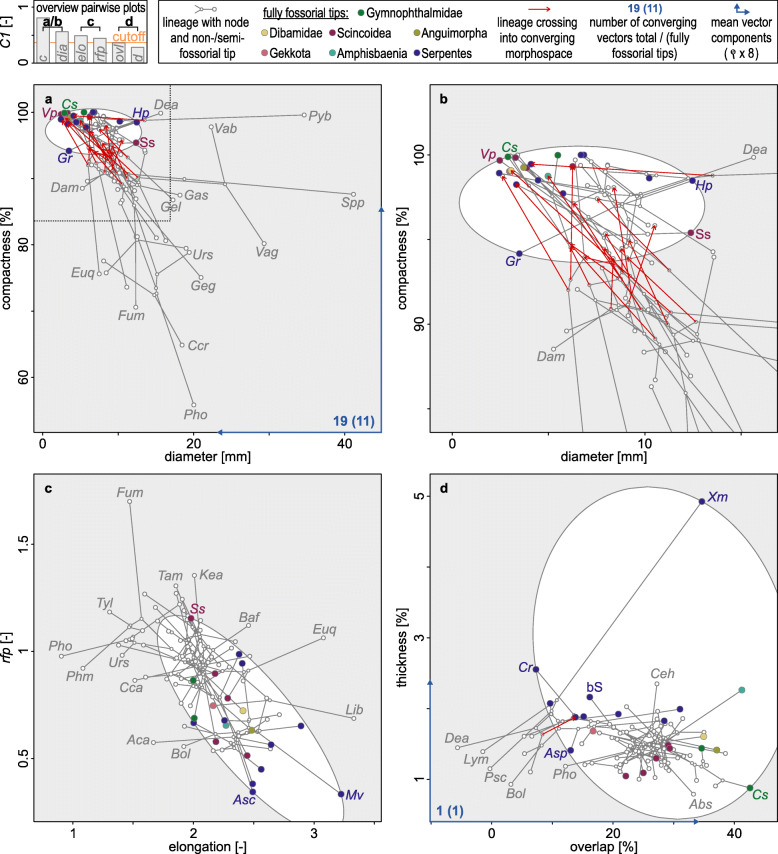
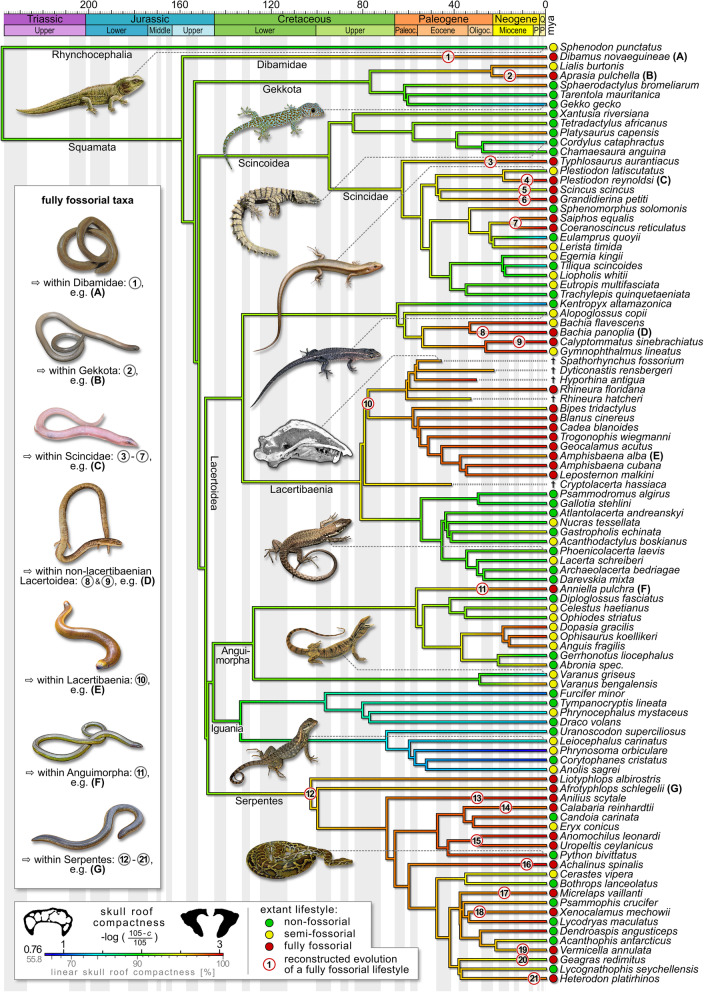
The study of convergently acquired adaptations allows fundamental insight into life's evolutionary history. Within lepidosaur reptiles-i.e. lizards, tuatara, and snakes-a fully fossorial ('burrowing') lifestyle has independently evolved in most major clades. However, despite their consistent use of the skull as a digging tool, cranial modifications common to all these lineages are yet to be found. In particular, bone microanatomy, although highly diagnostic for lifestyle, remains unexplored in the lepidosaur cranium. This constitutes a key gap in our understanding of their complexly interwoven ecology, morphology, and evolution. In order to bridge this gap, we reconstructed the acquisition of a fossorial lifestyle in 2813 lepidosaurs and assessed the skull roof compactness from microCT cross-sections in a representative subset (n = 99). We tested this and five macroscopic morphological traits for their convergent evolution.
We found that fossoriality evolved independently in 54 lepidosaur lineages. Furthermore, a highly compact skull roof, small skull diameter, elongate cranium, and low length ratio of frontal and parietal were repeatedly acquired in concert with a fossorial lifestyle.
We report a novel case of convergence that concerns lepidosaur diversity as a whole. Our findings further indicate an early evolution of fossorial modifications in the amphisbaenian 'worm-lizards' and support a fossorial origin for snakes. Nonetheless, our results suggest distinct evolutionary pathways between fossorial lizards and snakes through different contingencies. We thus provide novel insights into the evolutionary mechanisms and constraints underlying amniote diversity and a powerful tool for the reconstruction of extinct reptile ecology.
对趋同获得的适应性进行研究有助于深入了解生命的进化历史。在鳞龙类爬行动物(即蜥蜴、楔齿蜥和蛇)中,大多数主要类群都独立进化出了完全穴居(“挖掘”)的生活方式。然而,尽管它们都一致地将头骨用作挖掘工具,但尚未发现所有这些谱系共有的颅骨形态变化。特别是,骨微解剖学虽然对生活方式具有高度诊断性,但在鳞龙类颅骨中仍未得到探索。这构成了我们理解它们复杂交织的生态、形态和进化的关键空白。为了填补这一空白,我们重建了2813种鳞龙类动物穴居生活方式的获得过程,并通过微计算机断层扫描(microCT)横截面评估了一个代表性子集(n = 99)的颅顶致密性。我们测试了这一特征以及其他五个宏观形态特征的趋同进化情况。
我们发现穴居性在54个鳞龙类谱系中独立进化。此外,高度致密的颅顶、较小的头骨直径、细长的颅骨以及较低的额骨和顶骨长度比与穴居生活方式一致地反复出现。
我们报告了一个涉及整个鳞龙类多样性的新趋同案例。我们的发现进一步表明蚓蜥类“蚓蜥”的穴居形态变化进化较早,并支持蛇类的穴居起源。尽管如此,我们的结果表明穴居蜥蜴和蛇类通过不同的偶然因素有着不同的进化途径。因此,我们为羊膜动物多样性背后的进化机制和限制提供了新的见解,并为重建已灭绝爬行动物的生态提供了一个有力工具。