Division of Molecular Pathology, National Cancer Center Research Institute, Tokyo, Japan.
Department of Analytical Pathology, National Cancer Center Research Institute, Tokyo, Japan.
PLoS One. 2020 Nov 30;15(11):e0242851. doi: 10.1371/journal.pone.0242851. eCollection 2020.
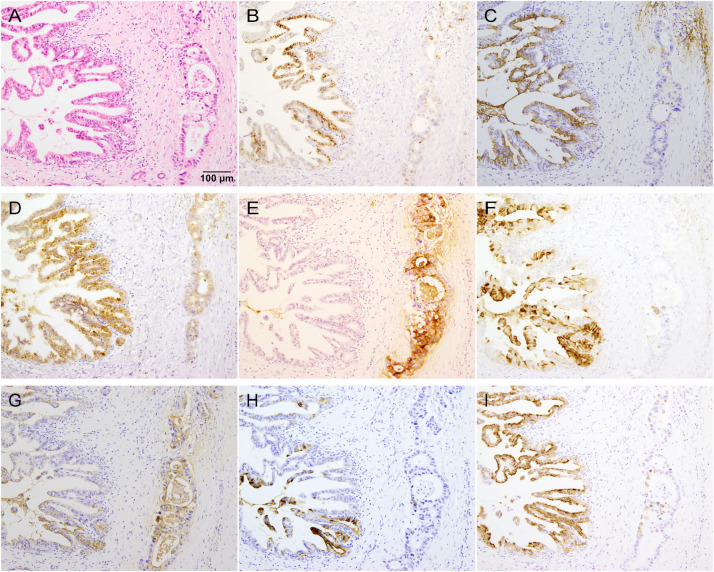
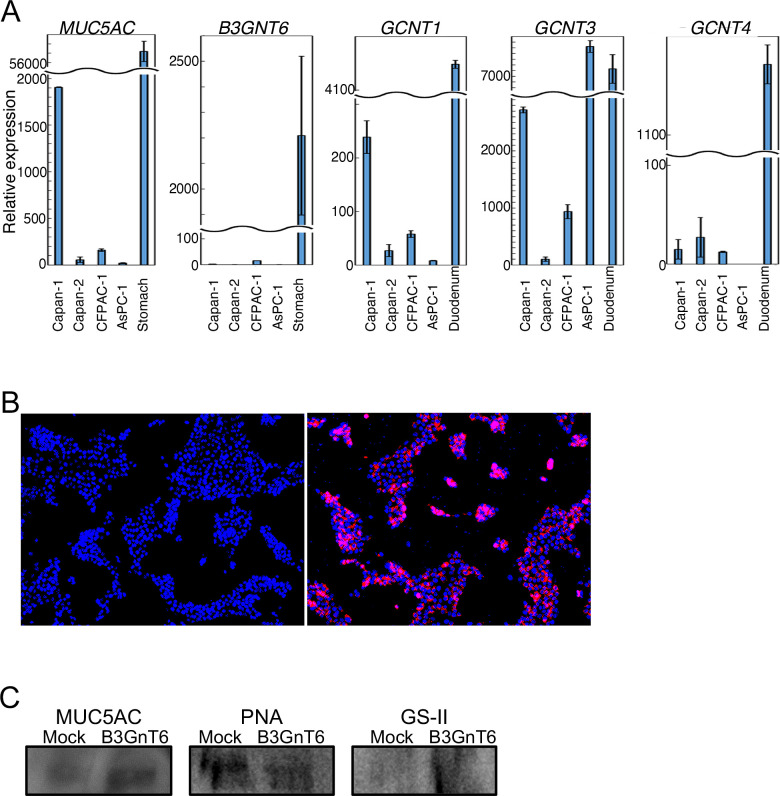
Mucin-type O-glycans are involved in cancer initiation and progression, although details of their biological and clinicopathological roles remain unclear. The aim of this study was to investigate the clinicopathological significance of β1,3-N-acetylglucosaminyltransferase 6 (β3Gn-T6), an essential enzyme for the synthesis of core 3 O-glycan and several other O-glycans in pancreatic ductal adenocarcinoma (PDAC). We performed immunohistochemical and lectin-histochemical analyses to detect the expression of β3Gn-T6 and several O-glycans in 156 cases of PDAC with pancreatic intraepithelial neoplasias (PanINs) and corresponding normal tissue samples. The T antigen, Tn antigen, sialyl Lewis X (sLeX) antigen, and sLeX on core 2 O-glycan were more highly expressed in PDAC cells than in normal pancreatic duct epithelial cells (NPDEs). Conversely, the expression of 6-sulfo N-acetyllactosamine on extended core 1 O-glycan was found in NPDEs and was low in PDAC cells. These glycan expression levels were not associated with patient outcomes. β3Gn-T6 was expressed in ~20% of PDAC cases and 30-40% of PanINs but not in NPDEs. Higher expression of β3Gn-T6 was found in PDAC cells in more differentiated adenocarcinoma cases showing significantly longer disease-free survival in both univariate and multivariate analyses. In addition, the expression of β3Gn-T6 in PDAC cells and PanINs significantly correlated with the expression of MUC5AC in these cells, suggesting that β3Gn-T6 expression is related to cellular differentiation status of the gastric foveolar phenotype. Thus, it is likely that β3Gn-T6 expression in PDAC cells is a favorable prognostic factor in PDAC patients, and that the expression of β3Gn-T6 correlates with the gastric foveolar phenotype in pancreatic carcinogenesis.
粘蛋白型 O-聚糖参与癌症的发生和发展,尽管其生物学和临床病理作用的细节尚不清楚。本研究旨在探讨β1,3-N-乙酰氨基葡萄糖基转移酶 6(β3Gn-T6)在胰腺导管腺癌(PDAC)中的临床病理意义,β3Gn-T6 是合成核心 3 O-聚糖和其他几种 O-聚糖的必需酶。我们对 156 例 PDAC 及其相应的正常组织样本进行了免疫组织化学和凝集素组织化学分析,以检测β3Gn-T6 和几种 O-聚糖的表达。与正常胰腺导管上皮细胞(NPDEs)相比,T 抗原、Tn 抗原、唾液酸化 Lewis X(sLeX)抗原和核心 2 O-聚糖上的 sLeX 在 PDAC 细胞中表达更高。相反,扩展核心 1 O-聚糖上的 6-硫酸 N-乙酰乳糖胺在 NPDEs 中表达,而在 PDAC 细胞中表达较低。这些糖基化表达水平与患者预后无关。β3Gn-T6 在约 20%的 PDAC 病例和 30-40%的 PanINs 中表达,但在 NPDEs 中不表达。在分化程度更高的腺癌病例中,β3Gn-T6 在 PDAC 细胞中的表达更高,在单变量和多变量分析中均显示出显著更长的无病生存期。此外,β3Gn-T6 在 PDAC 细胞和 PanINs 中的表达与这些细胞中 MUC5AC 的表达显著相关,表明β3Gn-T6 的表达与胃窝状表型的细胞分化状态有关。因此,β3Gn-T6 在 PDAC 细胞中的表达可能是 PDAC 患者的有利预后因素,并且β3Gn-T6 的表达与胰腺发生中的胃窝状表型相关。