Usher Institute, University of Edinburgh, Edinburgh, United Kingdom.
Centre for Immunity, Infection and Evolution, School of Biological Sciences, University of Edinburgh, United Kingdom.
PLoS Pathog. 2020 Nov 30;16(11):e1009079. doi: 10.1371/journal.ppat.1009079. eCollection 2020 Nov.
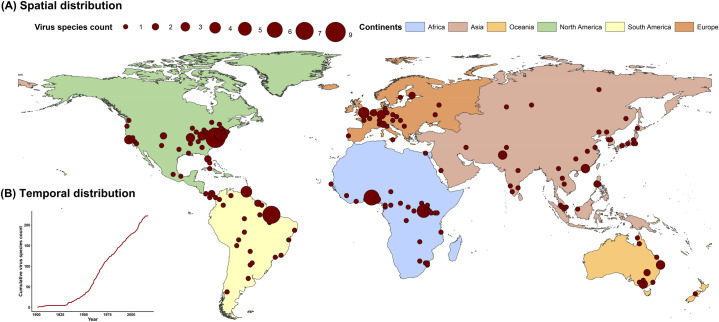
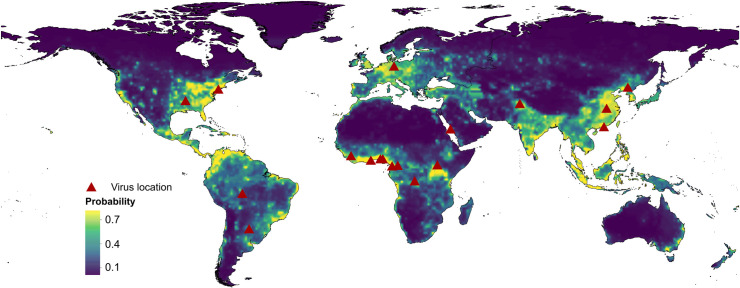
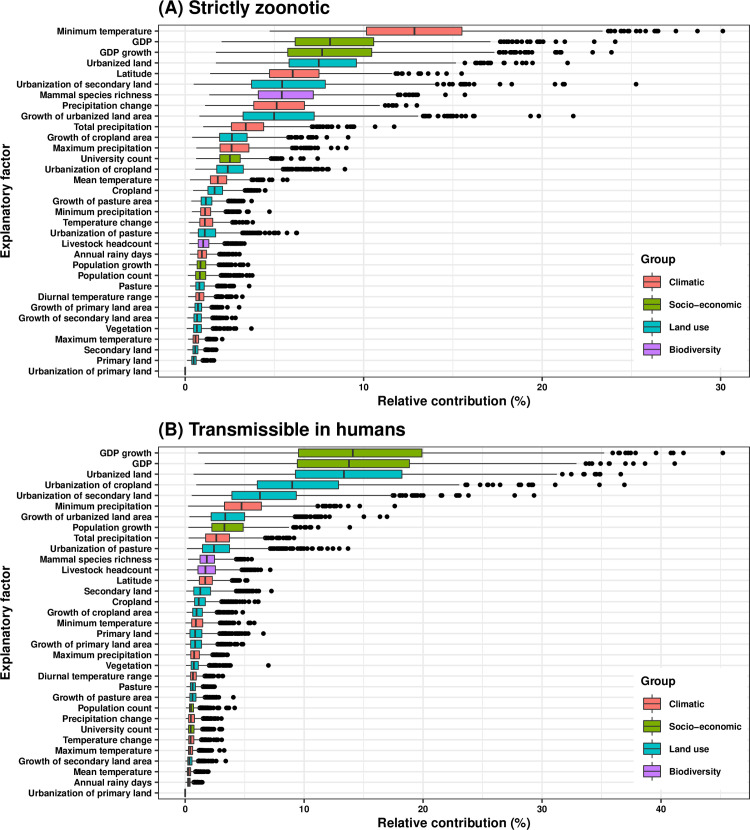
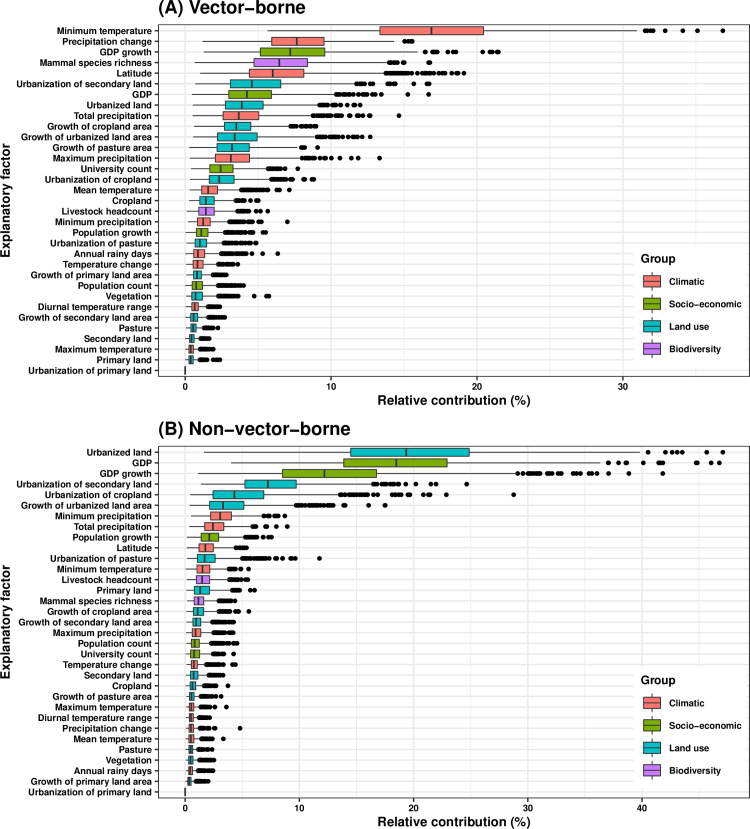
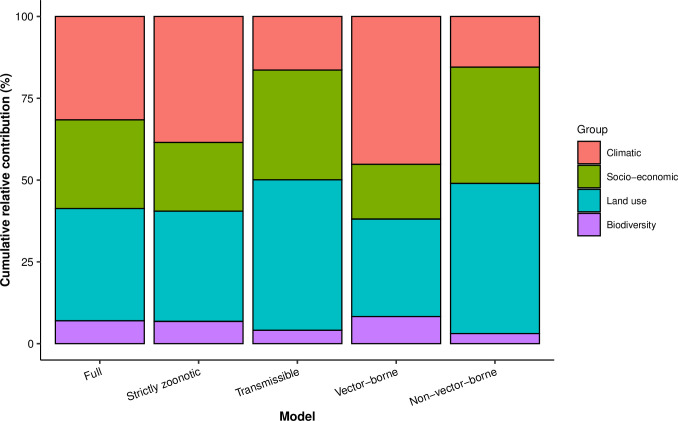
RNA viruses are a leading cause of human infectious diseases and the prediction of where new RNA viruses are likely to be discovered is a significant public health concern. Here, we geocoded the first peer-reviewed reports of 223 human RNA viruses. Using a boosted regression tree model, we matched these virus data with 33 explanatory factors related to natural virus distribution and research effort to predict the probability of virus discovery across the globe in 2010-2019. Stratified analyses by virus transmissibility and transmission mode were also performed. The historical discovery of human RNA viruses has been concentrated in eastern North America, Europe, central Africa, eastern Australia, and north-eastern South America. The virus discovery can be predicted by a combination of socio-economic, land use, climate, and biodiversity variables. Remarkably, vector-borne viruses and strictly zoonotic viruses are more associated with climate and biodiversity whereas non-vector-borne viruses and human transmissible viruses are more associated with GDP and urbanization. The areas with the highest predicted probability for 2010-2019 include three new regions including East and Southeast Asia, India, and Central America, which likely reflect both increasing surveillance and diversity of their virome. Our findings can inform priority regions for investment in surveillance systems for new human RNA viruses.
RNA 病毒是人类传染病的主要病因,预测新的 RNA 病毒可能在哪里被发现是一个重大的公共卫生关注问题。在这里,我们对 223 种人类 RNA 病毒的首次同行评审报告进行了地理编码。使用增强回归树模型,我们将这些病毒数据与 33 个与自然病毒分布和研究工作相关的解释因素相匹配,以预测 2010-2019 年全球病毒发现的概率。还按病毒的传染性和传播模式进行了分层分析。人类 RNA 病毒的历史发现主要集中在北美东部、欧洲、中非、澳大利亚东部和南美洲东北部。病毒的发现可以通过社会经济、土地利用、气候和生物多样性等变量的组合来预测。值得注意的是,媒介传播病毒和严格的人畜共患病毒与气候和生物多样性的关系更为密切,而非媒介传播病毒和人类可传播病毒与 GDP 和城市化的关系更为密切。2010-2019 年预测概率最高的地区包括三个新的地区,包括东亚和东南亚、印度和中美洲,这可能反映了它们的病毒组监测和多样性都在增加。我们的研究结果可以为新的人类 RNA 病毒监测系统的投资提供重点地区信息。