Alonso-Monge Rebeca, Guirao-Abad José P, Sánchez-Fresneda Ruth, Pla Jesús, Yagüe Genoveva, Argüelles Juan Carlos
Departamento de Microbiología y Parasitología-IRYCIS, Unidad de Microbiología, Facultad de Farmacia, Universidad Complutense de Madrid, E-28040 Madrid, Spain.
Área de Microbiología, Facultad de Biología, Universidad de Murcia, E-30071 Murcia, Spain.
Microorganisms. 2020 Nov 26;8(12):1867. doi: 10.3390/microorganisms8121867.
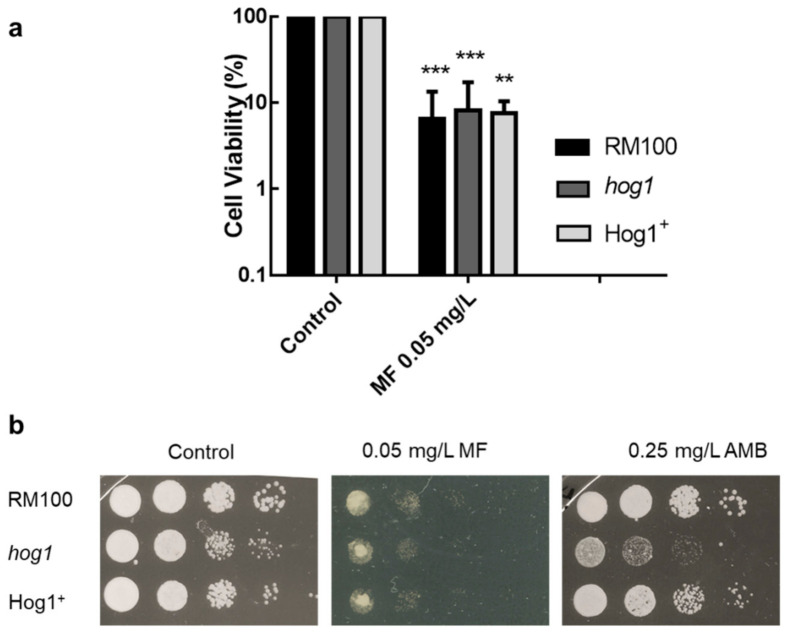
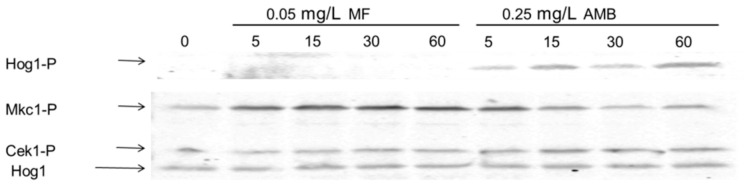
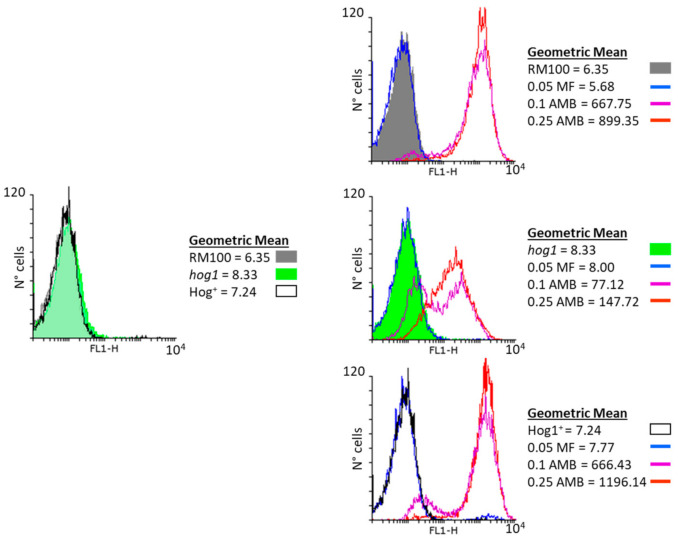
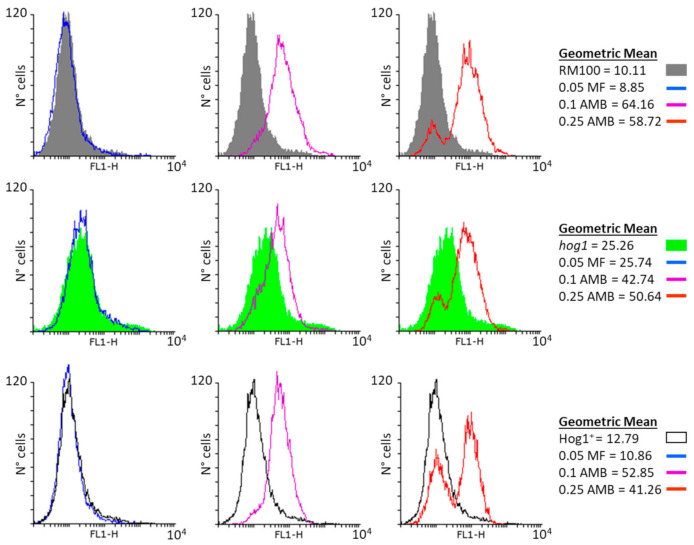
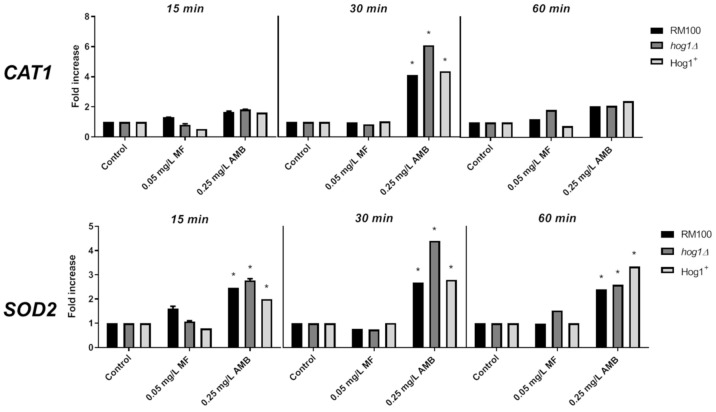
In fungi, the Mitogen-Activated Protein kinase (MAPK) pathways sense a wide variety of environmental stimuli, leading to cell adaptation and survival. The HOG pathway plays an essential role in the pathobiology of , including the colonization of the gastrointestinal tract in a mouse model, virulence, and response to stress. Here, we examined the role of Hog1 in the response to the clinically relevant antifungal Micafungin (MF), whose minimum inhibitory concentration (MIC) was identical in the parental strain (RM100) and in the isogenic homozygous mutant (0.016 mg/L). The cell viability was impaired without significant differences between the parental strain, the isogenic mutant, and the Hog1 reintegrant. This phenotype was quite similar in a collection of mutants constructed in a different background. MF-treated cells failed to induce a relevant increase of both reactive oxygen species (ROS) formation and activation of the mitochondrial membrane potential in parental and cells. MF was also unable to trigger any significant activation of the genes coding for the antioxidant activities catalase () and superoxide dismutase (), as well as on the corresponding enzymatic activities, whereas a clear induction was observed in the presence of Amphotericin B (AMB), introduced as a positive control of Hog1 signaling. Furthermore, Hog1 was not phosphorylated by the addition of MF, but, notably, this echinocandin caused Mkc1 phosphorylation. Our results strongly suggest that the toxic effect of MF on cells is not mediated by the Hog1 MAPK and is independent of the generation of an internal oxidative stress in .
在真菌中,丝裂原活化蛋白激酶(MAPK)通路可感知多种环境刺激,从而导致细胞适应和存活。高渗甘油(HOG)通路在[具体真菌名称未给出]的病理生物学中起着至关重要的作用,包括在小鼠模型中的胃肠道定植、毒力以及对压力的反应。在此,我们研究了Hog1在[具体真菌名称未给出]对临床相关抗真菌药物米卡芬净(MF)的反应中的作用,其在亲本菌株(RM100)和同基因纯合突变体中的最小抑菌浓度(MIC)相同(0.016 mg/L)。细胞活力受损,亲本菌株、同基因[具体基因名称未给出]突变体和Hog1回补菌株之间无显著差异。在不同[具体基因名称未给出]背景下构建的一系列突变体中,该表型非常相似。经MF处理的亲本细胞和[具体基因名称未给出]细胞均未能诱导活性氧(ROS)形成的相关增加以及线粒体膜电位的激活。MF也无法触发编码抗氧化活性过氧化氢酶([具体酶名称未给出])和超氧化物歧化酶([具体酶名称未给出])的基因的任何显著激活,以及相应的酶活性,而在引入两性霉素B(AMB)作为Hog1信号传导的阳性对照时观察到明显的诱导。此外,添加MF不会使Hog1磷酸化,但值得注意的是,这种棘白菌素会导致Mkc1磷酸化。我们的结果强烈表明,MF对[具体真菌名称未给出]细胞的毒性作用不是由Hog1 MAPK介导的,并且与[具体真菌名称未给出]内部氧化应激产生无关。