School of Health and Related Research, University of Sheffield, Sheffield, UK.
EuroQol Research Foundation, Rotterdam, the Netherlands.
Med Decis Making. 2021 Jan;41(1):89-99. doi: 10.1177/0272989X20969686. Epub 2020 Nov 30.
Generic preference-based measures (GPBMs) such as the EQ-5D are valid across many conditions, but in some cases, "bolting on" additional dimensions may improve validity. The selection of "bolt-ons" has been based on the psychometric impact of individual dimensions, but preferences provide another important way to select them. This study aims to test the potential of using pairwise choices to inform the selection of bolt-ons for the EQ-5D-5L.
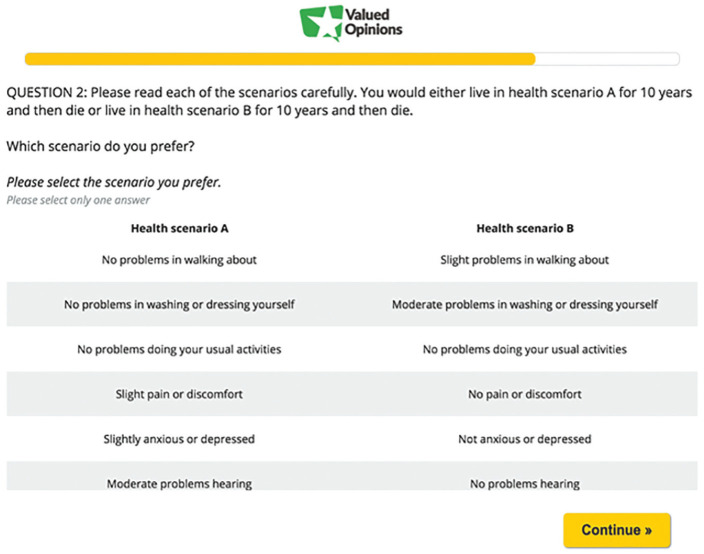
General population preferences were collected using an online survey of 1040 UK residents. Three EQ-5D-5L health state pairs were selected based on pairs that had a 50:50 split in respondent preferences from a previous pairwise survey. Participants were presented with pairwise choices of EQ-5D-5L health states without and with bolt-ons of hearing, sleep, cognition, energy, and relationships, each added individually. Logistic models were used to assess the impact of bolt-ons, as well as bolt-ons at different severity levels, on the log odds of responders choosing between health states.
Preferences varied according to the bolt-ons and their severity level (only levels 1, 3, and 5 were used). Additions of bolt-ons at level 1 generally resulted in nonstatistically significant differences while additions of bolt-ons at level 3 and level 5 produced a negative and statistically significant impact on preferences for the health state with the bolt-on. At level 5, hearing had the largest impact, followed by cognition, relationships, energy, and sleep. At level 3, cognition produced the largest impact, followed by hearing and sleep with similar impacts, energy, and relationships. This ordering offers information for bolt-on selection, with hearing and cognition appearing as the most important. The weight placed on the different health problems is not constant across severity levels between bolt-ons.
Pairwise choices provide a cost-effective approach of generating information on preferences to support bolt-on selection.
通用偏好量表(GPBMs),如 EQ-5D,在许多情况下具有有效性,但在某些情况下,“附加”其他维度可能会提高有效性。“附加”维度的选择是基于各个维度的心理计量学影响,但偏好提供了另一种选择它们的重要方法。本研究旨在测试使用配对选择来为 EQ-5D-5L 选择附加维度的潜力。
使用一项针对 1040 名英国居民的在线调查收集了一般人群的偏好。根据之前的配对调查中受访者偏好对半分裂的三个 EQ-5D-5L 健康状态对,选择了三个 EQ-5D-5L 健康状态对。参与者被呈现了没有和有附加听、睡眠、认知、能量和关系的 EQ-5D-5L 健康状态的配对选择,每个附加单独呈现。使用逻辑模型评估附加及其严重程度水平对响应者在健康状态之间选择的对数优势的影响。
偏好根据附加和它们的严重程度水平而变化(仅使用了 1、3 和 5 级)。附加 1 级附加通常不会产生统计学上显著的差异,而附加 3 级和 5 级附加会对带有附加的健康状态的偏好产生负面且统计学上显著的影响。在 5 级,听力的影响最大,其次是认知、关系、能量和睡眠。在 3 级,认知的影响最大,其次是听力和睡眠,影响相似,能量和关系。这种排序提供了有关附加选择的信息,听力和认知似乎是最重要的。在不同的严重程度水平之间,对不同健康问题的重视程度并不是固定不变的。
配对选择提供了一种具有成本效益的方法,可以生成有关偏好的信息,以支持附加选择。