Jubilee Street Practice, London.
Institute of Population Health Sciences, Queen Mary University of London, London.
Br J Gen Pract. 2020 Dec 28;71(702):e31-e38. doi: 10.3399/bjgp20X713909. Print 2021 Jan.
Missed appointments are common in primary care, contributing to reduced clinical capacity. NHS England has estimated that there are 7.2 million missed general practice appointments annually, at a cost of £216 million. Reducing these numbers is important for an efficient primary care sector.
To evaluate the impact of a system-wide quality improvement (QI) programme on the rates of missed GP appointments, and to identify effective practice interventions.
Practices within a clinical commissioning group (CCG) in East London, with an ethnically diverse and socially deprived population.
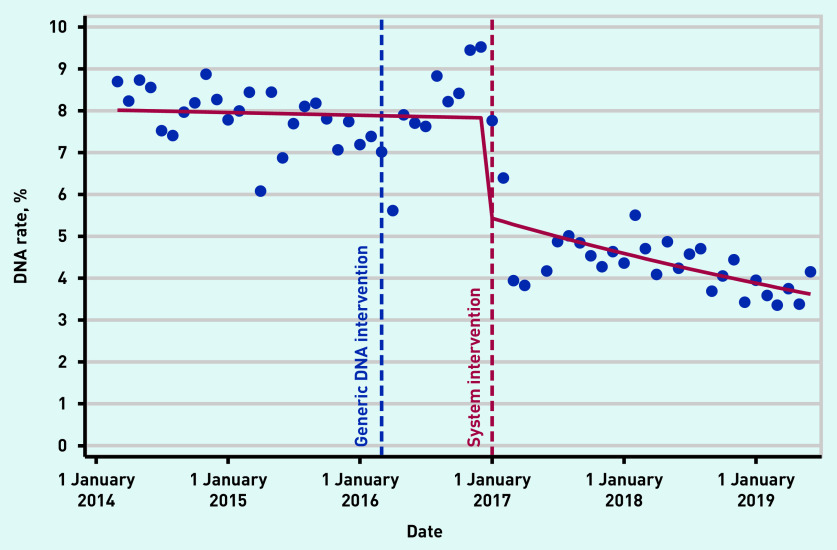
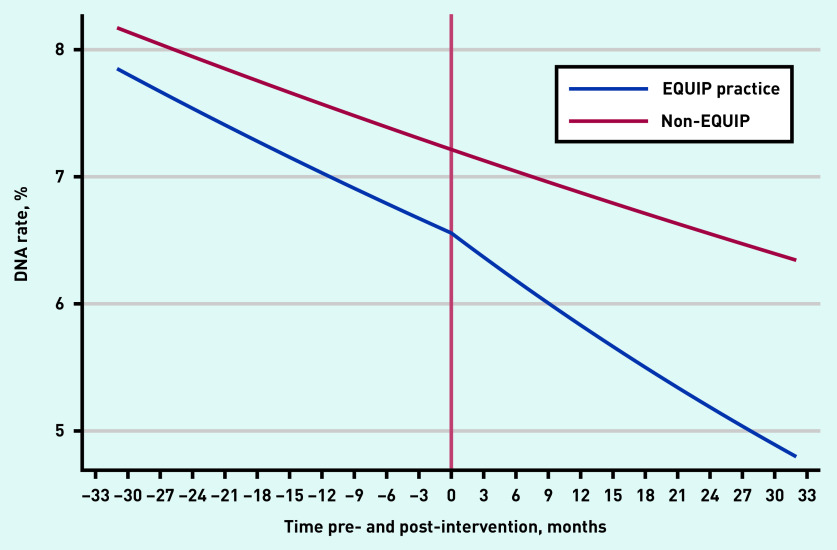
Study practices engaged in a generic QI programme, which included sharing data on appointment systems and Did Not Attend (DNA) rates. Fourteen out of 25 practices implemented DNA reduction projects, supported by practice-based coaching. Appointment data were collected from practice electronic health records. Evaluation included comparisons of DNA rates pre- and post-intervention using interrupted times series analysis.
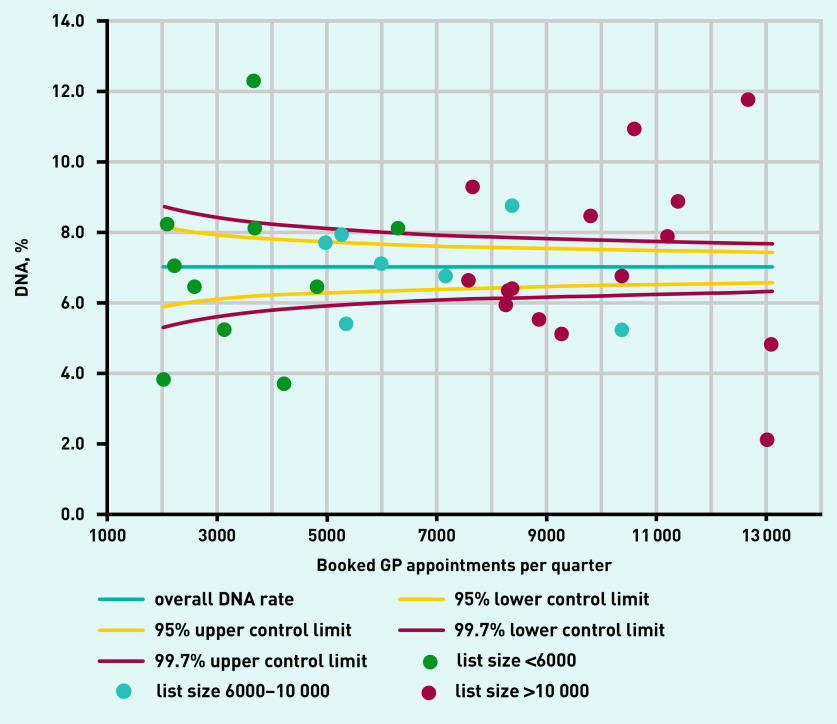
In total, 25 out of 32 practices engaged with the programme. The mean DNA rate at baseline was 7% (range 2-12%); 2 years later the generic intervention DNA rates were 5.2%. This equates to a reduction of 4030 missed appointments. The most effective practice intervention was to reduce the forward booking time to 1 day. The practice that made this change reduced its mean DNA rate from 7.8% to 3.9%.
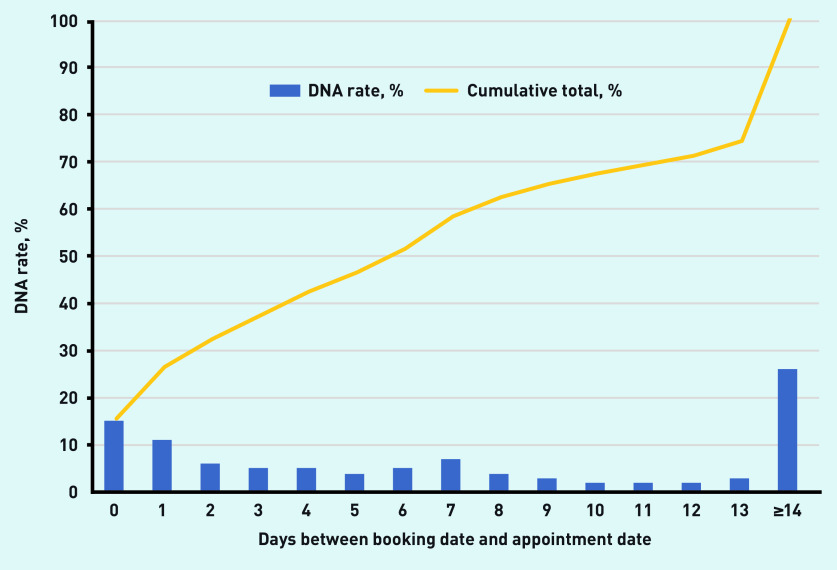
Forward booking time in days is the best predictor of practice DNA rates. Sharing appointment data produced a significant reduction in missed appointments, and behaviour change interventions with patients had a modest additional impact; in contrast, introducing structural change to the appointment system effectively reduced DNA rates. To reduce non-attendance, it appears that the appointment system needs to change, not the patient.
错过预约在初级保健中很常见,这导致临床能力下降。英格兰国民保健制度估计,每年有 720 万例全科医生预约被错过,损失达 2.16 亿英镑。减少这些数字对于提高初级保健部门的效率非常重要。
评估全系统质量改进(QI)计划对错过全科医生预约率的影响,并确定有效的实践干预措施。
位于伦敦东部一个临床委托组(CCG)内的实践,其人群具有种族多样性和社会贫困。
参与研究的实践采用了通用 QI 计划,包括分享预约系统和未就诊(DNA)率数据。25 个实践中有 14 个实施了 DNA 减少项目,由基于实践的辅导提供支持。预约数据来自实践电子健康记录。评估包括使用中断时间序列分析比较干预前后的 DNA 率。
共有 25 个/32 个实践参与了该计划。基线时的平均 DNA 率为 7%(范围为 2-12%);2 年后,通用干预措施的 DNA 率为 5.2%。这相当于减少了 4030 次错过预约。最有效的实践干预措施是将提前预约时间缩短至 1 天。实施此更改的实践将其平均 DNA 率从 7.8%降低至 3.9%。
提前预约天数是预测实践 DNA 率的最佳指标。分享预约数据可显著减少错过预约的情况,而对患者进行行为改变干预的效果则稍差;相比之下,对预约系统进行结构性改变可有效降低 DNA 率。要减少非就诊情况,似乎需要改变预约系统,而不是改变患者。