School of Pharmacy, University of Waterloo, Kitchener, ON, Canada.
Centre for Family Medicine Family Health Team, Kitchener, ON, Canada.
J Med Internet Res. 2020 Dec 1;22(12):e18074. doi: 10.2196/18074.
Medication management among older adults continues to be a challenge, and innovative electronic medication adherence products have been developed to address this need.
The aim of this study is to examine user experience with electronic medication adherence products, with particular emphasis on features, usefulness, and preferences.
Older adults, caregivers, and health care providers tested the usability of 22 electronic medication adherence products. After testing 5 products, participants were invited to participate in a one-on-one interview to investigate their perceptions and experiences with the features, usefulness, and preference for electronic medication adherence products tested. The interviews were audio recorded, transcribed, and analyzed using exploratory inductive coding to generate themes. The first 13 interviews were independently coded by 2 researchers. The percentage agreement and Cohen kappa after analyzing those interviews were 79% and 0.79, respectively. A single researcher analyzed the remaining interviews.
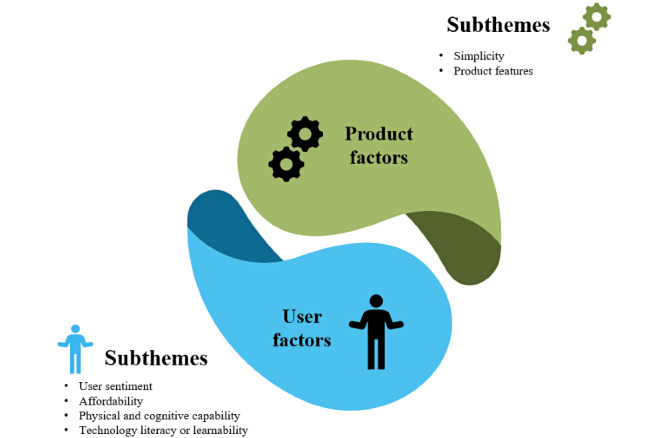
Of the 37 participants, 21 (57%) were older adults, 5 (14%) were caregivers, and 11 (30%) were health care providers. The themes and subthemes generated from the qualitative analysis included product factors (subthemes: simplicity and product features, including availability and usability of alarms, portability, restricted access to medications, and storage capacity) and user factors (subthemes: sentiment, affordability, physical and cognitive capability, and technology literacy and learnability).
Electronic medication adherence products have the potential to enable independent medication management in older adults. The choice of a particular product should be made after considering individual preferences for product features, affordability, and the sentiment of the users. Older adults, caregivers, and health care providers prefer electronic medication adherence products that are simple to set up and use, are portable, have easy-to-access medication compartments, are secure, and have adequate storage capacity.
老年人的药物管理仍然是一个挑战,因此开发了创新的电子药物依从性产品来满足这一需求。
本研究旨在研究电子药物依从性产品的用户体验,特别强调产品的功能、有用性和偏好。
老年人、护理人员和医疗保健提供者测试了 22 种电子药物依从性产品的可用性。在测试了 5 种产品后,邀请参与者参加一对一的访谈,以调查他们对所测试的电子药物依从性产品的功能、有用性和偏好的看法和体验。访谈进行了录音、转录,并使用探索性归纳编码进行分析,以生成主题。前 13 次访谈由 2 位研究人员进行独立编码。分析这些访谈后的百分比一致性和 Cohen kappa 分别为 79%和 0.79。一位研究人员对其余的访谈进行了分析。
在 37 名参与者中,21 名(57%)是老年人,5 名(14%)是护理人员,11 名(30%)是医疗保健提供者。从定性分析中生成的主题和子主题包括产品因素(子主题:简单性和产品功能,包括可用性和报警功能、便携性、药物限制访问、存储容量)和用户因素(子主题:情感、负担能力、身体和认知能力、技术素养和易学性)。
电子药物依从性产品有可能使老年人能够独立管理药物。在考虑个人对产品功能、负担能力和用户情绪的偏好后,应选择特定的产品。老年人、护理人员和医疗保健提供者更喜欢易于设置和使用、便携、易于存取药物、安全且具有足够存储容量的电子药物依从性产品。