Black Dog Institute, Randwick, Australia.
University of Melbourne, Melbourne, Australia.
J Med Internet Res. 2020 Dec 1;22(12):e16729. doi: 10.2196/16729.
People with type 2 diabetes mellitus (T2DM) often experience mental health symptoms that exacerbate illness and increase mortality risk. Access to psychological support is low in people with T2DM. Detection of depression is variable in primary care and can be further hampered by mental health stigma. Electronic mental health (eMH) programs may provide an accessible, private, nonstigmatizing mental health solution for this group.
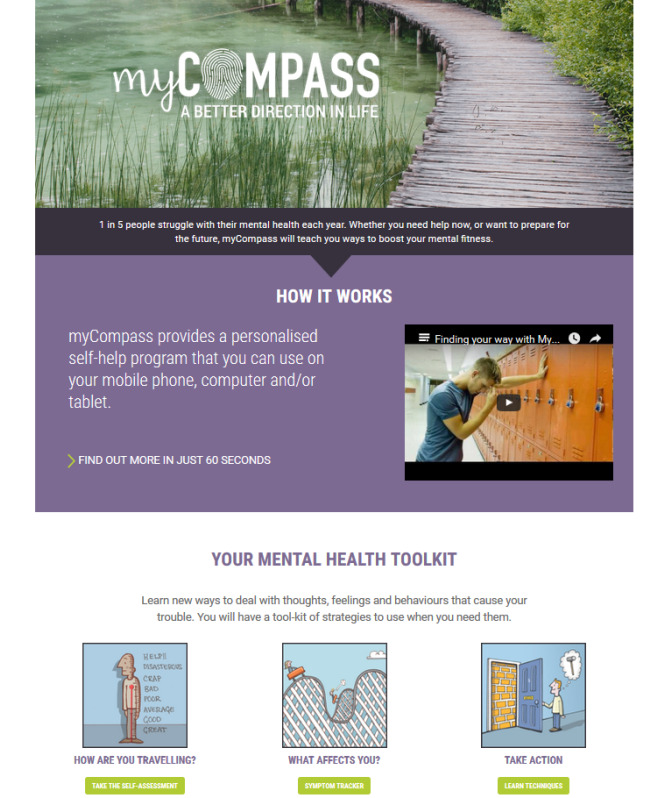
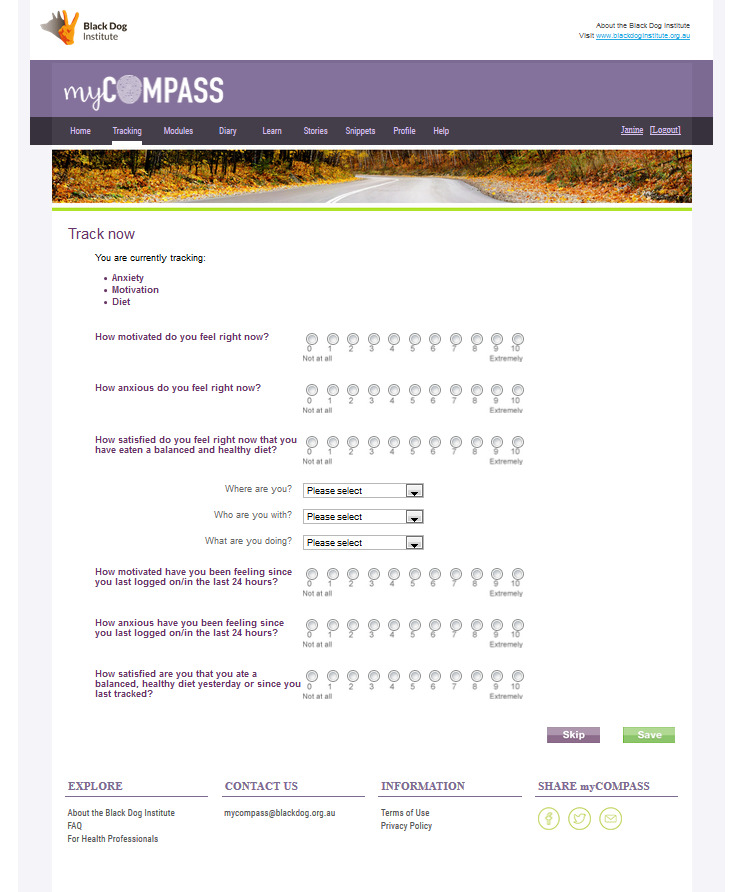
This study aims to evaluate the efficacy over 12 months of follow-up of an eMH program (myCompass) for improving social and occupational functioning in a community sample of people with T2DM and self-reported mild-to-moderate depressive symptoms. myCompass is a fully automated and self-guided web-based public health program for people with depression or anxiety. The effects of myCompass on depressive symptoms, diabetes-related distress, anxiety symptoms, and self-care behavior were also examined.
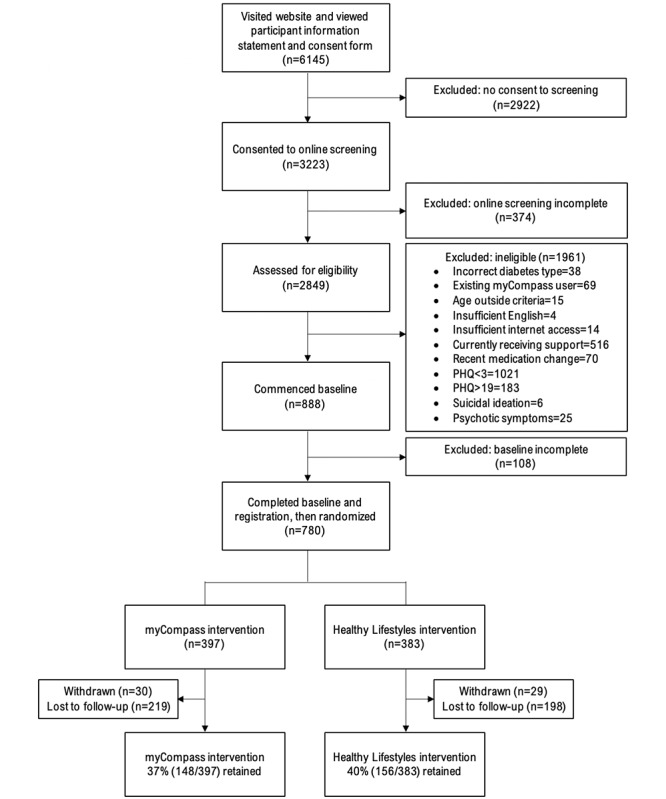
Adults with T2DM and mild-to-moderate depressive symptoms (N=780) were recruited via online advertisements, community organizations, and general practices. Screening, consent, and self-report questionnaires were administered online. Eligible participants were randomized to receive either myCompass (n=391) or an attention control generic health literacy program (Healthy Lifestyles; n=379) for 8 weeks. At baseline and at 3, 6, and 12 months postintervention, participants completed the Work and Social Adjustment Scale, the Patient Health Questionnaire-9 item, the Diabetes Distress Scale, the Generalized Anxiety Disorder Questionnaire-7 item, and items from the Self-Management Profile for Type 2 Diabetes. Glycosylated hemoglobin measurements were obtained at baseline and 6 and 12 months postintervention.
A total of 38.9% (304/780) of the trial participants completed all postintervention assessments. myCompass users logged in on an average of 6 times and completed an average of 0.29 modules. Healthy Lifestyles users logged in on an average of 4 times and completed an average of 1.37 modules. At baseline, the mean scores on several outcome measures, including the primary outcome of work and social functioning, were close to the normal range, despite a varied and extensive recruitment process. Intention-to-treat analyses revealed slightly greater improvement at 12 months in work and social functioning for the Healthy Lifestyles group relative to the myCompass group. All participants reported equivalent improvements in depression anxiety, diabetes distress, diabetes self-management, and glycemic control across the trial.
The Healthy Lifestyles group reported higher ratings of social and occupational functioning than the myCompass group, but no differences were observed for any secondary outcome. Although these findings should be interpreted in light of the near-floor symptom scores at baseline, the trial yields important insights into how people with T2DM might be engaged in eMH programs and the challenges of focusing specifically on mental health. Several avenues emerge for continued investigation into how best to deal with the growing mental health burden in adults with T2DM.
Australian New Zealand Clinical Trials Registry Number (ACTRN) 12615000931572; https://www.anzctr.org.au/Trial/Registration/TrialReview.aspx?id=368109&isReview=true.
2 型糖尿病患者(T2DM)常经历加重病情和增加死亡率风险的心理健康症状。T2DM 患者获得心理支持的机会较少。初级保健中抑郁的检出率存在差异,且心理健康污名化可能会进一步阻碍检出。电子心理健康(eMH)项目可能为这一人群提供一种可及、私密、无污名化的心理健康解决方案。
本研究旨在评估 myCompass(一种针对抑郁或焦虑人群的完全自动化和自我引导的基于网络的公共卫生程序)在社区样本中随访 12 个月对 T2DM 患者社会和职业功能的疗效,这些患者自我报告有轻度至中度抑郁症状。myCompass 对抑郁症状、糖尿病相关困扰、焦虑症状和自我护理行为的影响也进行了评估。
通过在线广告、社区组织和普通诊所招募 T2DM 和轻度至中度抑郁症状(N=780)的成年人。在线进行筛查、同意和自我报告问卷调查。符合条件的参与者被随机分配接受 myCompass(n=391)或通用健康素养计划(Healthy Lifestyles;n=379)治疗 8 周。在干预前、干预后 3、6 和 12 个月,参与者完成了工作和社会适应量表、患者健康问卷-9 项、糖尿病困扰量表、广泛性焦虑症问卷-7 项和 2 型糖尿病自我管理简表的项目。在干预前和干预后 6 和 12 个月测量糖化血红蛋白。
共有 38.9%(304/780)的试验参与者完成了所有的干预后评估。myCompass 用户平均登录 6 次,完成了 0.29 个模块。Healthy Lifestyles 用户平均登录 4 次,完成了 1.37 个模块。在基线时,包括主要结局指标(工作和社会功能)在内的几个结局指标的平均得分接近正常值,尽管采用了多样化和广泛的招募流程。意向治疗分析显示,与 myCompass 组相比,Healthy Lifestyles 组在 12 个月时工作和社会功能的改善略大。所有参与者在整个试验中报告了抑郁、焦虑、糖尿病困扰、糖尿病自我管理和血糖控制的同等改善。
Healthy Lifestyles 组报告的社会和职业功能评分高于 myCompass 组,但在任何次要结局指标上均未观察到差异。尽管应根据基线时接近地板症状评分来解释这些发现,但该试验提供了有关如何使 T2DM 患者参与 eMH 计划以及如何特别关注心理健康的重要见解。有几个途径可以继续探索如何最好地应对成年人中日益增长的心理健康负担。
澳大利亚和新西兰临床试验注册中心编号(ACTRN)12615000931572;https://www.anzctr.org.au/Trial/Registration/TrialReview.aspx?id=368109&isReview=true。