Granholm Eric, Holden Jason, Dwyer Kristen, Mikhael Tanya, Link Peter, Depp Colin
VA San Diego Healthcare System, San Diego, CA, United States.
Department of Psychiatry, University of California, San Diego, San Diego, CA, United States.
JMIR Ment Health. 2020 Dec 1;7(12):e24406. doi: 10.2196/24406.
Negative symptoms are an important unmet treatment need for schizophrenia. This study is a preliminary, open, single-arm trial of a novel hybrid intervention called mobile-assisted cognitive behavioral therapy for negative symptoms (mCBTn).
The primary aim was to test whether mCBTn was feasible and could reduce severity of the target mechanism, defeatist performance attitudes, which are associated with experiential negative symptoms and poor functioning in schizophrenia.
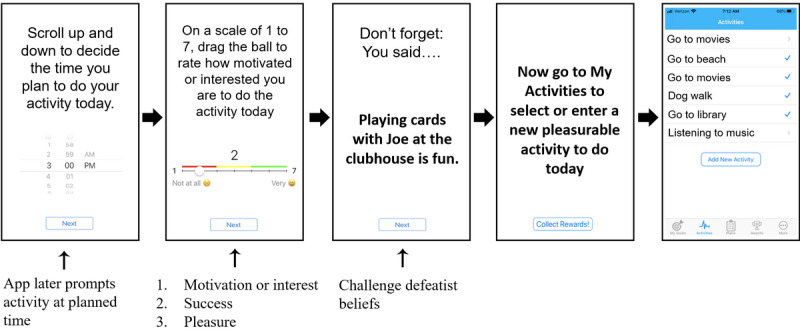
Participants with schizophrenia or schizoaffective disorder (N=31) who met prospective criteria for persistent negative symptoms were enrolled. The blended intervention combines weekly in-person group therapy with a smartphone app called CBT2go. The app extended therapy group skills, including recovery goal setting, thought challenging, scheduling of pleasurable activities and social interactions, and pleasure-savoring interventions to modify defeatist attitudes and improve experiential negative symptoms.
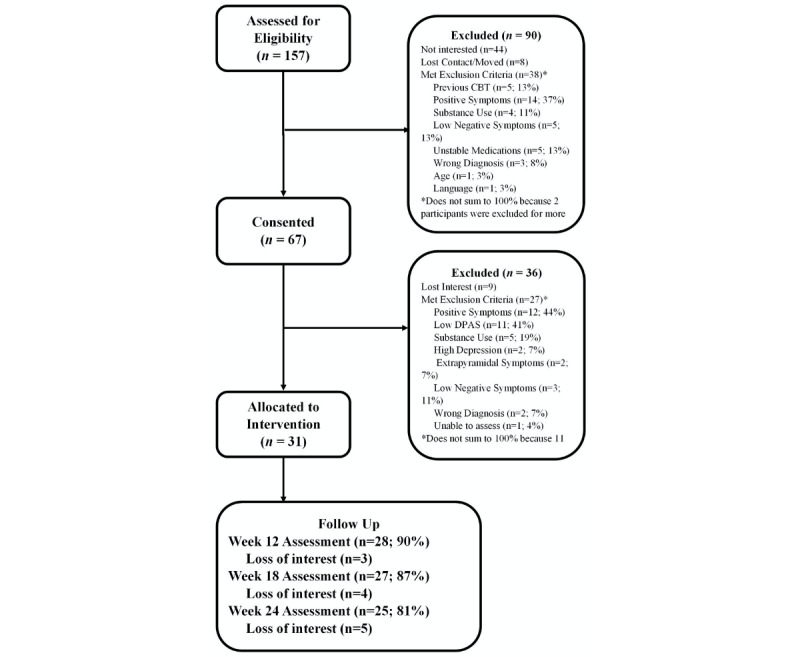
Retention was excellent (87% at 18 weeks), and severity of defeatist attitudes and experiential negative symptoms declined significantly in the mCBTn intervention with large effect sizes.
The findings suggest that mCBTn is a feasible and potentially effective treatment for experiential negative symptoms, if confirmed in a larger randomized controlled trial. The findings also provide support for the defeatist attitude model of experiential negative symptoms and suggest that blended technology-supported interventions such as mCBTn can strengthen and shorten intensive psychosocial interventions for schizophrenia.
ClinicalTrials.gov NCT03179696; https://clinicaltrials.gov/ct2/show/NCT03179696.
阴性症状是精神分裂症尚未满足的重要治疗需求。本研究是一项针对一种名为阴性症状移动辅助认知行为疗法(mCBTn)的新型混合干预措施的初步、开放性单臂试验。
主要目的是测试mCBTn是否可行,以及是否能降低与经验性阴性症状及精神分裂症功能不良相关的目标机制——失败主义表现态度的严重程度。
招募符合持续性阴性症状前瞻性标准的精神分裂症或分裂情感性障碍患者(N = 31)。这种混合干预将每周的面对面团体治疗与一款名为CBT2go的智能手机应用程序相结合。该应用程序扩展了治疗团体技能,包括设定康复目标、挑战思维、安排愉悦活动和社交互动,以及采用品味愉悦干预措施来改变失败主义态度并改善经验性阴性症状。
保留率极佳(18周时为87%),在mCBTn干预中,失败主义态度和经验性阴性症状的严重程度显著下降,效应量较大。
研究结果表明,如果在更大规模的随机对照试验中得到证实,mCBTn对于经验性阴性症状是一种可行且可能有效的治疗方法。这些结果还为经验性阴性症状的失败主义态度模型提供了支持,并表明诸如mCBTn这种技术支持的混合干预措施可以加强并缩短针对精神分裂症的强化心理社会干预。
ClinicalTrials.gov NCT03179696;https://clinicaltrials.gov/ct2/show/NCT03179696 。