School of Public Health, University of Saskatchewan, Saskatoon, SK, Canada.
Department of Psychiatry, College of Medicine, University of Saskatchewan, Saskatoon, SK, Canada.
J Child Psychol Psychiatry. 2021 Sep;62(9):1050-1066. doi: 10.1111/jcpp.13358. Epub 2020 Dec 1.
Many observational studies have found a direct association between adverse in utero, perinatal and postnatal exposures and offspring's depression. These findings are consistent with the 'developmental origins of disease hypothesis'. But no review has comprehensively summarized the roles of these exposures. This review aims to systematically scrutinize the strength of associations between individual prenatal, perinatal, and postnatal exposures and subsequent depression in offspring.
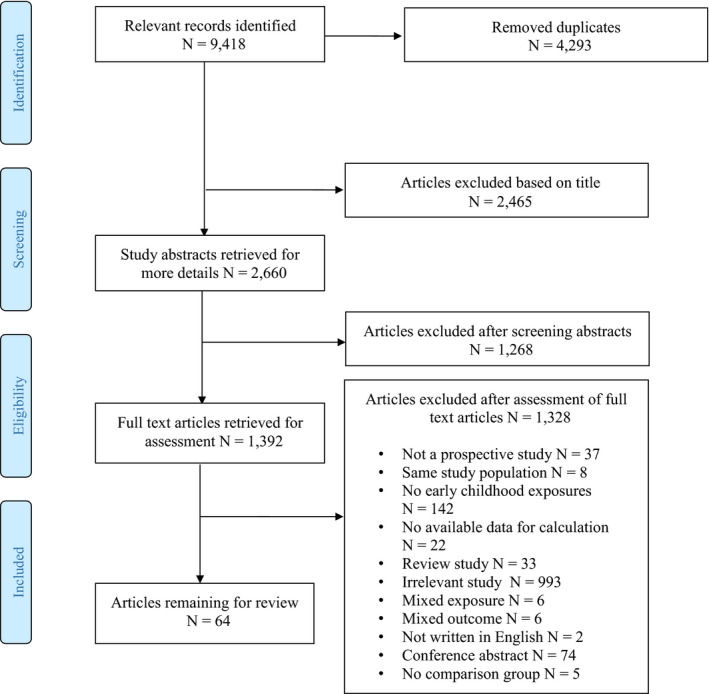
We conducted a systematic review and meta-analysis to synthesize the literature from the EMBASE, HealthStar, PsychoInfo, and Medline databases since their inception to September 1, 2019. English language articles on population-based prospective cohort studies examining the associations between in utero, perinatal, and postnatal exposures and offspring's depression were searched. Random-effects models were used to calculate pooled estimates, and heterogeneity and sensitivity tests were conducted to explore potential confounders in the relationships of depression and early-life factors. Qualitative analysis was also conducted.
Sixty-four prospective cohort studies with 28 exposures studied in the relationships to offspring's depression met inclusion criteria. The meta-analysis found 12 prenatal, perinatal, and postnatal characteristics were associated with an increased risk of depression in offspring: low birth weight, premature birth, small gestational age, maternal education, socioeconomic status, having younger parents (<20 years), having older parents (≥35 years), maternal smoking, paternal smoking, maternal stress, maternal anxiety, and prenatal depression. Heterogeneity and sensitivity tests supported the findings. By and large, study characteristics had no effects on conclusions. Qualitative analyses generally supported the findings of meta-analysis and reported on additional risk factors.
This review provides a robust and comprehensive overview of the lasting psychopathological effects of in utero, perinatal, and postnatal exposures. The findings highlight the need for clinical and public health interventions focusing on the identified risk factors. Large prospective cohort studies are warranted to investigate the combined effects of multiple co-existing early-life exposures.
许多观察性研究发现,不良的宫内、围产期和产后暴露与后代的抑郁之间存在直接关联。这些发现与“疾病的发育起源假说”一致。但是,还没有综述全面总结这些暴露因素的作用。本综述旨在系统审查个体产前、围产期和产后暴露与后代随后发生抑郁之间的关联强度。
我们进行了系统综述和荟萃分析,综合了自 EMBASE、HealthStar、PsychoInfo 和 Medline 数据库建立以来至 2019 年 9 月 1 日的文献。搜索了关于在子宫内、围产期和产后暴露与后代抑郁之间关联的基于人群的前瞻性队列研究的英文文章。使用随机效应模型计算合并估计值,并进行异质性和敏感性检验,以探讨抑郁和生命早期因素关系中的潜在混杂因素。还进行了定性分析。
符合纳入标准的 64 项前瞻性队列研究共研究了 28 种与后代抑郁相关的暴露因素。荟萃分析发现 12 种产前、围产期和产后特征与后代患抑郁症的风险增加有关:低出生体重、早产、小胎龄、母亲教育程度、社会经济地位、父母年龄较小(<20 岁)、父母年龄较大(≥35 岁)、母亲吸烟、父亲吸烟、母亲压力、母亲焦虑和产前抑郁。异质性和敏感性检验支持这些发现。总的来说,研究特征对结论没有影响。定性分析大体上支持荟萃分析的结果,并报告了其他风险因素。
本综述提供了关于宫内、围产期和产后暴露对持久精神病理影响的全面概述。这些发现强调了需要针对已确定的风险因素进行临床和公共卫生干预。需要进行大型前瞻性队列研究,以调查多种共存的生命早期暴露的综合影响。