WHO Collaborating Centre for Research and Training in Mental Health and Service Evaluation, Department of Neuroscience, Biomedicine and Movement Sciences, Section of Psychiatry, University of Verona, Verona, Italy.
Department of Neurosciences and Mental Health, Policlinico Umberto I, Sapienza University of Rome, Rome, Italy.
BMC Psychiatry. 2020 Dec 1;20(1):576. doi: 10.1186/s12888-020-02988-0.
In recent years there has been a progressive rise in the number of asylum seekers and refugees displaced from their country of origin, with significant social, economic, public health and mental health implications. The aim of this study is to (1) describe the level of psychological distress and frequency of psychiatric disorders in a sample of male asylum seekers and refugees across different ethnic groups resettled in Italy; (2) establish whether the number of traumatic events experienced before, during and after the migration process is associated with level of psychological distress and depressive symptoms.
In two large Italian catchment areas, over a period of 1 year a consecutive series of male asylum seekers and refugees, aged 18 or above and included in the Italian protection system, were screened for psychological distress and psychiatric disorders using validated questionnaires.
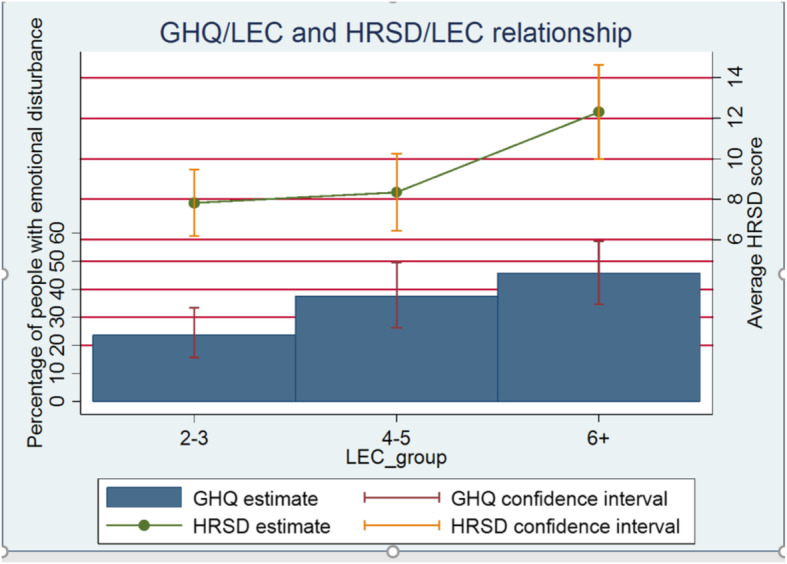
During the study period, 252 male asylum seekers or refugees were recruited. More than one-third of the participants (34.5%) showed clinically relevant psychological distress, and one-fourth (22.2%), met the criteria for a psychiatric diagnosis, mainly Post Traumatic Stress Disorder and depressive disorders. The number of traumatic events turned out to be a risk factor for both clinically relevant psychological distress and depressive disorders. Receiving good social support emerged as a protective factor, while migrants with unclear status were at higher risk of psychological distress than those holding or awaiting a permission.
In an unselected sample of male asylum seekers and refugees, after around 1 year of resettlement in Italy, the frequency of psychological distress and psychiatric disorders was substantial and clinically relevant. The association between traumatic events, especially post-migration problems, and mental health conditions suggests the need of developing services to assist refugees and asylum seekers to address the multi-faceted problems they experience, such as social support in host country, legal problems concerning permit status and asylum procedure, and family reunification, as well as addressing trauma and mental health issues.
近年来,寻求庇护者和难民的数量逐渐增加,他们被迫离开原籍国,这给社会、经济、公共卫生和精神健康带来了重大影响。本研究旨在:(1)描述在意大利重新安置的不同族裔的男性寻求庇护者和难民群体中的心理困扰程度和精神障碍发病率;(2)确定在迁移过程之前、期间和之后经历的创伤事件数量与心理困扰和抑郁症状水平之间的关系。
在两个意大利大型收容区,在一年的时间内,通过验证性问卷对连续一系列年龄在 18 岁及以上且纳入意大利保护系统的男性寻求庇护者和难民进行心理困扰和精神障碍筛查。
在研究期间,共招募了 252 名男性寻求庇护者或难民。超过三分之一的参与者(34.5%)表现出明显的心理困扰,四分之一(22.2%)符合精神诊断标准,主要为创伤后应激障碍和抑郁障碍。创伤事件的数量是心理困扰和抑郁障碍的一个风险因素。获得良好的社会支持被证明是一个保护因素,而身份不明的移民比持有或等待许可的移民心理困扰风险更高。
在意大利重新安置约 1 年后,在未选择的男性寻求庇护者和难民样本中,心理困扰和精神障碍的频率很高,且具有临床意义。创伤事件,特别是迁移后的问题与心理健康状况之间的关联表明,需要开发服务来帮助难民和寻求庇护者解决他们所经历的多方面问题,例如在东道国的社会支持、与许可身份和庇护程序相关的法律问题以及家庭团聚问题,以及解决创伤和精神健康问题。