Department of Population and Family Health, Mailman School of Public Health, Columbia University, USA.
School of Public Health, University of California, Berkeley, USA.
Soc Sci Med. 2020 Nov;265:113544. doi: 10.1016/j.socscimed.2020.113544. Epub 2020 Nov 22.
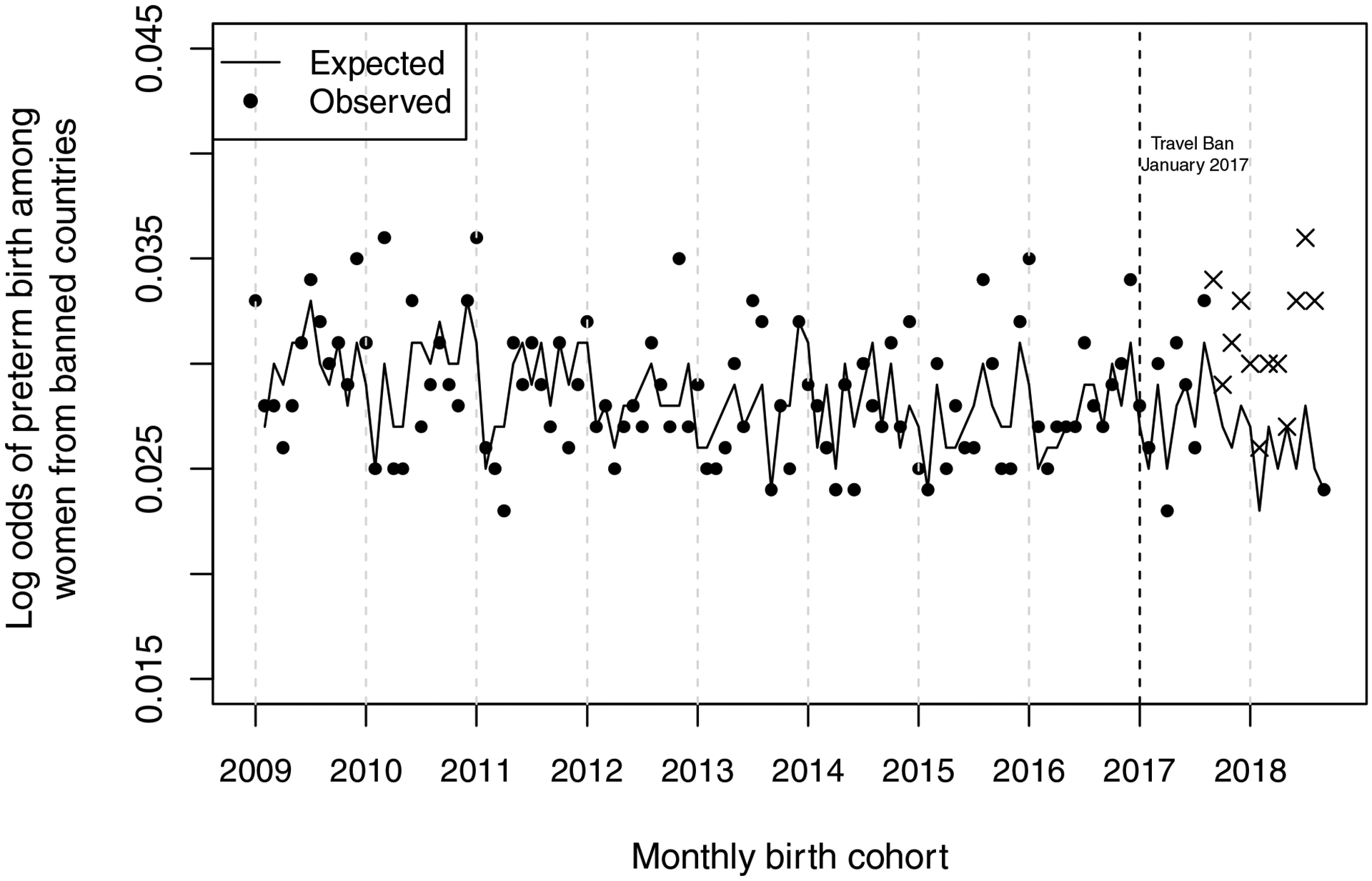
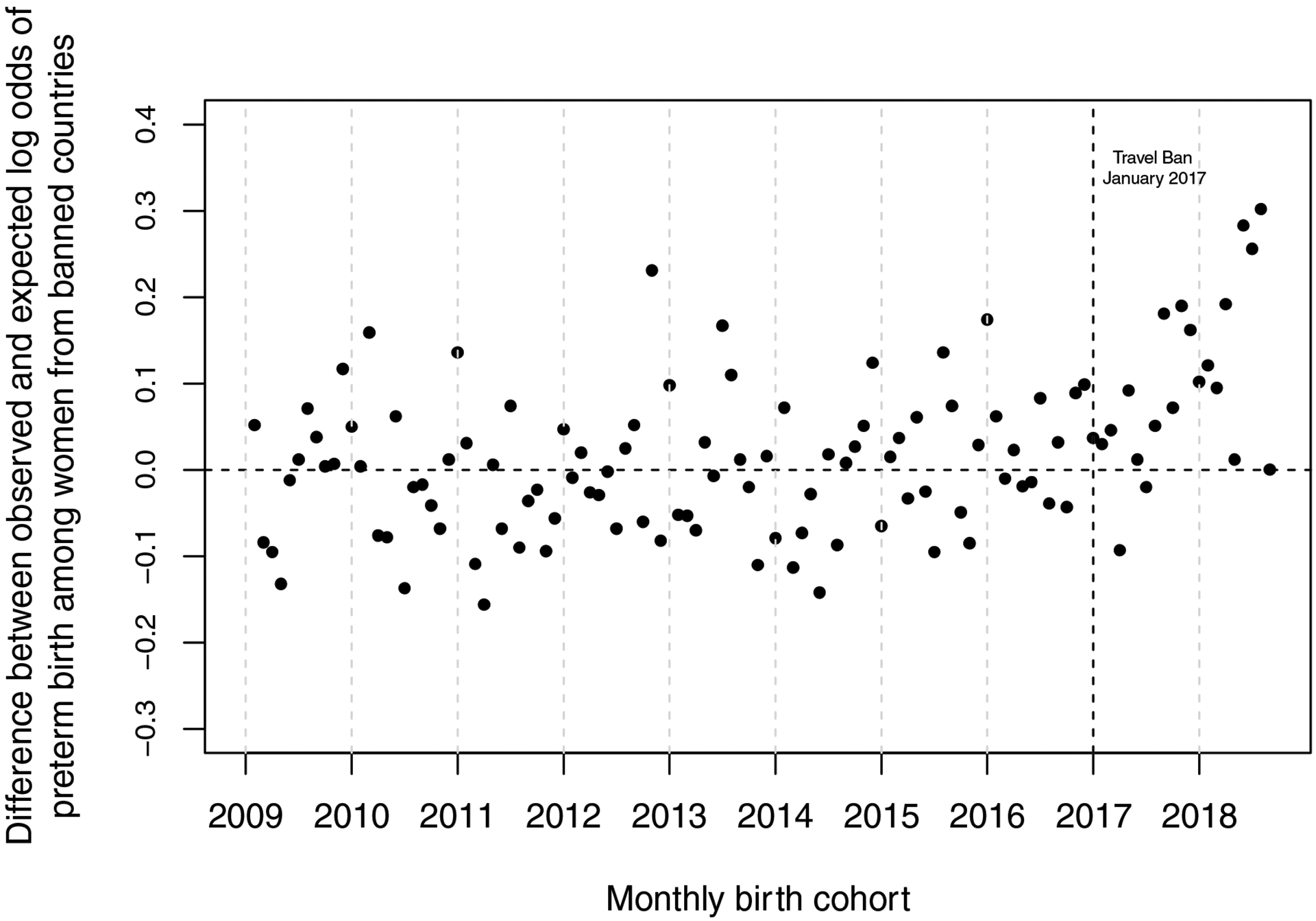
Anti-immigrant stigma or xenophobia is increasingly pervasive globally. Racism is a determinant of adverse health outcomes, but the epidemiological implications of the recent wave of xenophobic policies have not been well studied. The 2017 travel ban on individuals from Muslim majority countries is an example of such policy efforts in the United States. Using the 2009-2018 National Center for Health Statistics period linked infant birth-death data, we used time series methods to compare the monthly odds of preterm births to women from travel ban countries (Iran, Iraq, Libya, Somalia, Sudan, Syria, and Yemen) after the January 2017 travel ban to the number expected had the ban not been implemented. We estimated our counterfactual from the history of preterm birth among women born in countries included in the ban as well as trends in preterm birth among native-born non-Hispanic (NH) White women. Among the 18,945,795 singleton live births included in our study period (including 191,121 born to women from banned countries), the average monthly rate of births that were preterm birth was 8.5% (range: 6.8%, 10.6%) among women born in the countries affected by the ban and 8.6% (range: 7.7%, 9.8%) among native-born NH White women. Our results show an increase in the odds of preterm birth among infants born to women from travel ban countries in September 2017 and persisting through the cohort born in August 2018. The coefficient for exposed infants born in these months suggests that the odds of preterm birth increased by 6.8% among women from banned countries (p < 0.001). Our results suggest that the first U.S. Executive Order (#13769) of the travel ban targeting individuals from Muslim majority countries may be associated with preterm births. We therefore conclude that structurally xenophobic and racist policies in the U.S. may have a harmful effect on birth outcomes and early life indicators of life-long health outcomes.
反移民污名或仇外心理在全球范围内日益普遍。种族主义是不良健康结果的决定因素,但最近一波仇外政策的流行病学影响尚未得到充分研究。2017 年对来自穆斯林占多数国家的个人实施的旅行禁令就是美国此类政策努力的一个例子。我们使用 2009-2018 年国家卫生统计中心链接的婴儿出生-死亡数据,使用时间序列方法比较了自 2017 年 1 月旅行禁令以来,来自旅行禁令国家(伊朗、伊拉克、利比亚、索马里、苏丹、叙利亚和也门)的妇女早产的每月几率与如果没有实施禁令,预期的几率。我们从禁令所包括的国家出生的妇女的早产历史以及非西班牙裔(NH)白人生育期早产的趋势中估计了我们的反事实。在我们研究期间的 18945795 名单胎活产中(包括 191121 名来自被禁国家的妇女),在受禁令影响的国家出生的妇女中,早产的平均每月比率为 8.5%(范围:6.8%,10.6%),而在本土出生的 NH 白种妇女中为 8.6%(范围:7.7%,9.8%)。我们的结果表明,2017 年 9 月,来自旅行禁令国家的妇女所生婴儿的早产几率增加,并持续到 2018 年 8 月出生的队列。这些月份暴露的婴儿的系数表明,来自被禁国家的妇女早产的几率增加了 6.8%(p<0.001)。我们的结果表明,美国针对穆斯林占多数国家的个人的第一份行政命令(#13769)可能与早产有关。因此,我们的结论是,美国具有排外和种族主义结构的政策可能对生育结果和终身健康结果的早期生活指标产生有害影响。