Centro de Estudios de Estado y Sociedad, Buenos Aires, Argentina.
Cancer Health Equity, Cancer Institute of New Jersey, Rutgers-The State University of New Jersey, New Brunswick, NJ, USA.
Womens Health (Lond). 2020 Jan-Dec;16:1745506520976011. doi: 10.1177/1745506520976011.
Among cancer prevention studies, little is known about knowledge, attitudes, and beliefs toward triage adherence in the context of the human papillomavirus self-collection test. This formative research aims to identify knowledge, attitudes, and beliefs related to human papillomavirus and cervical cancer prevention specifically about adherence to Pap triage among women residing in a low-income province in Argentina.
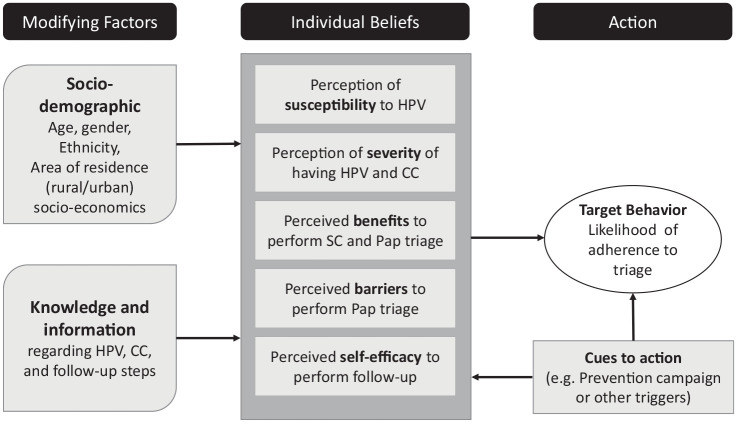
We conducted six focus groups, stratified by residence and age. All participants were aged 30 or older and had performed human papillomavirus self-collection. Data collection and thematic analysis were carried out using constructs from the Health Belief Model.
Misinformation regarding human papillomavirus and cervical cancer was common and was a source of distress. Women could not distinguish Pap screening from triage; human papillomavirus risk perception was limited but cervical cancer was perceived as a threatening disease. Women were willing to follow-up after receiving an abnormal screening result. Negative views about clinician-collected screening/triage were common, defined as painful and shameful, and comes with an economic cost (transport/time). Lack of help from family/friends was an obstacle to adhering to triage. Health issues in the family's records and a physician's recommendation were a cue to adhere to triage.
Lack of knowledge or misinformation of the causes of cervical cancer, human papillomavirus, and the multi-step screening and triage process are barriers to follow-up adherence. Interventions to improve communication between women and health providers about screening results and follow-up are needed. Also, health services should be organized to respond to women's needs and reduce access barriers to follow-up.
在癌症预防研究中,人们对人乳头瘤病毒自我采集检测背景下分诊依从性的知识、态度和信念知之甚少。这项基础研究旨在确定与人类乳头瘤病毒和宫颈癌预防相关的知识、态度和信念,特别是居住在阿根廷一个低收入省份的女性对 Pap 分诊的依从性。
我们进行了 6 组焦点小组,按居住和年龄分层。所有参与者年龄均在 30 岁或以上,并且进行了人乳头瘤病毒自我采集。使用健康信念模型中的构建来进行数据收集和主题分析。
有关人乳头瘤病毒和宫颈癌的错误信息很常见,是造成困扰的原因。女性无法区分 Pap 筛查和分诊;对人乳头瘤病毒风险的认知有限,但宫颈癌被认为是一种威胁性疾病。女性愿意在收到异常筛查结果后进行随访。对临床医生采集的筛查/分诊的负面看法很普遍,认为其既痛苦又羞耻,且费用较高(交通/时间)。缺乏家人/朋友的帮助是坚持分诊的障碍。家庭记录中的健康问题和医生的建议是坚持分诊的提示。
对宫颈癌、人乳头瘤病毒的病因以及多步骤筛查和分诊过程缺乏了解或信息错误,是后续依从性的障碍。需要采取干预措施,改善妇女与卫生提供者之间关于筛查结果和后续措施的沟通。此外,应组织卫生服务以满足妇女的需求并减少后续障碍。