Cojocariu Iulia, Carlotto Silvia, Sturmeit Henning Maximilian, Zamborlini Giovanni, Cinchetti Mirko, Cossaro Albano, Verdini Alberto, Floreano Luca, Jugovac Matteo, Puschnig Peter, Piamonteze Cinthia, Casarin Maurizio, Feyer Vitaliy, Schneider Claus Michael
Peter Grünberg Institute (PGI-6), Forschungszentrum Jülich GmbH, Leo-Brandt-Straße, 52428, Jülich, Germany.
Dipartimento di Scienze Chimiche, Università degli Studi di Padova, via F. Marzolo 1, 35131, Padova, Italy.
Chemistry. 2021 Feb 15;27(10):3526-3535. doi: 10.1002/chem.202004932. Epub 2021 Jan 25.
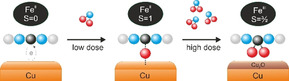
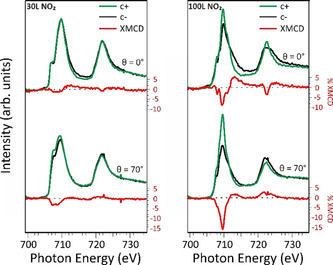
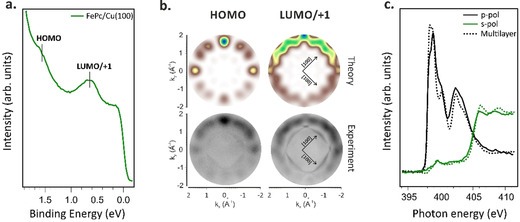
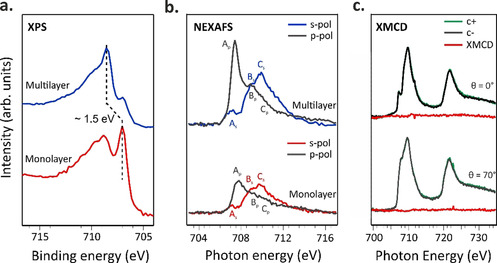
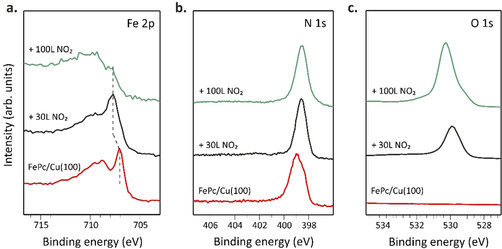
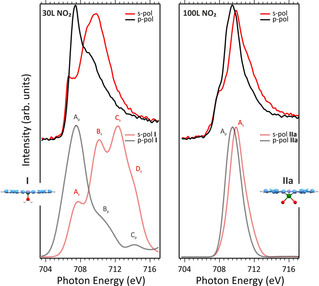
Due to its unique magnetic properties offered by the open-shell electronic structure of the central metal ion, and for being an effective catalyst in a wide variety of reactions, iron phthalocyanine has drawn significant interest from the scientific community. Nevertheless, upon surface deposition, the magnetic properties of the molecular layer can be significantly affected by the coupling occurring at the interface, and the more reactive the surface, the stronger is the impact on the spin state. Here, we show that on Cu(100), indeed, the strong hybridization between the Fe d-states of FePc and the sp-band of the copper substrate modifies the charge distribution in the molecule, significantly influencing the magnetic properties of the iron ion. The Fe ion is stabilized in the low singlet spin state (S=0), leading to the complete quenching of the molecule magnetic moment. By exploiting the FePc/Cu(100) interface, we demonstrate that NO dissociation can be used to gradually change the magnetic properties of the iron ion, by trimming the gas dosage. For lower doses, the FePc film is decoupled from the copper substrate, restoring the gas phase triplet spin state (S=1). A higher dose induces the transition from ferrous to ferric phthalocyanine, in its intermediate spin state, with enhanced magnetic moment due to the interaction with the atomic ligands. Remarkably, in this way, three different spin configurations have been observed within the same metalorganic/metal interface by exposing it to different doses of NO at room temperature.
由于中心金属离子的开壳层电子结构赋予其独特的磁性,且作为多种反应的有效催化剂,酞菁铁引起了科学界的极大兴趣。然而,在表面沉积时,分子层的磁性会受到界面处耦合的显著影响,表面反应性越强,对自旋态的影响就越大。在此,我们表明,在Cu(100)上,实际上,酞菁铁的铁d态与铜衬底的sp带之间的强杂化改变了分子中的电荷分布,显著影响了铁离子的磁性。铁离子稳定在低单重态自旋状态(S = 0),导致分子磁矩完全淬灭。通过利用酞菁铁/ Cu(100)界面,我们证明可以通过调整气体剂量,利用NO解离来逐渐改变铁离子的磁性。对于较低剂量,酞菁铁薄膜与铜衬底解耦,恢复气相三重态自旋状态(S = 1)。较高剂量会诱导酞菁铁从亚铁态转变为中间自旋态的铁酞菁,由于与原子配体的相互作用,磁矩增强。值得注意的是,通过这种方式,在室温下将同一金属有机/金属界面暴露于不同剂量的NO中,观察到了三种不同的自旋构型。