Zhang Chi, Cong Fengyu, Kujala Tuomo, Liu Wenya, Liu Jia, Parviainen Tiina, Ristaniemi Tapani
School of Biomedical Engineering, Faculty of Electronic Information and Electrical Engineering, Dalian University of Technology, Dalian 116024, China.
Faculty of Information Technology, University of Jyvaskyla, Jyvaskyla FIN-40014, Finland.
Entropy (Basel). 2018 Apr 25;20(5):311. doi: 10.3390/e20050311.
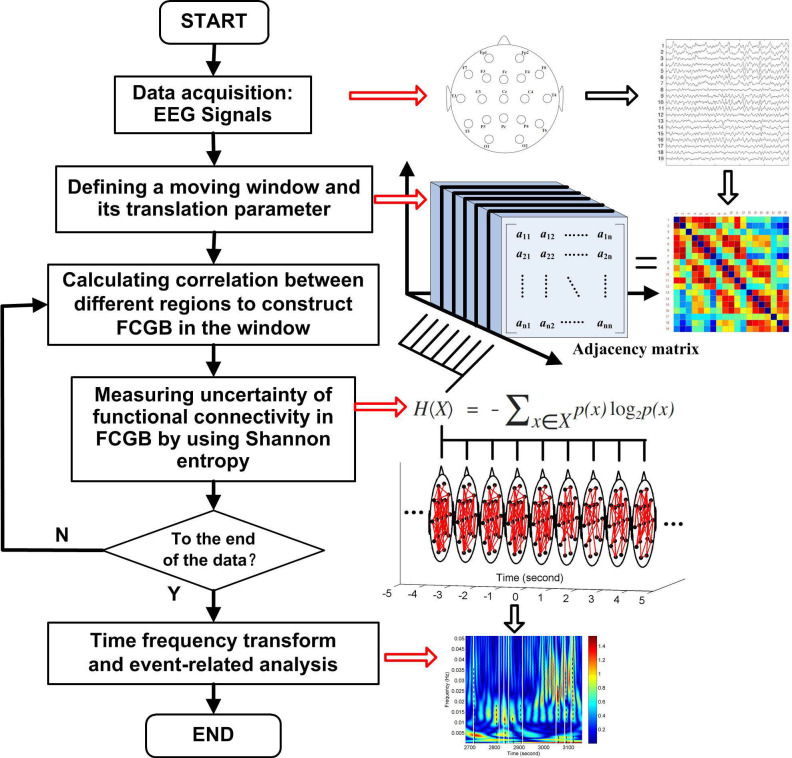
Dynamic representation of functional brain networks involved in the sequence analysis of functional connectivity graphs of the brain (FCGB) gains advances in uncovering evolved interaction mechanisms. However, most of the networks, even the event-related ones, are highly heterogeneous due to spurious interactions, which bring challenges to revealing the change patterns of interactive information in the complex dynamic process. In this paper, we propose a network entropy (NE) method to measure connectivity uncertainty of FCGB sequences to alleviate the spurious interaction problem in dynamic network analysis to realize associations with different events during a complex cognitive task. The proposed dynamic analysis approach calculated the adjacency matrices from ongoing electroencephalpgram (EEG) in a sliding time-window to form the FCGB sequences. The probability distribution of Shannon entropy was replaced by the connection sequence distribution to measure the uncertainty of FCGB constituting NE. Without averaging, we used time frequency transform of the NE of FCGB sequences to analyze the event-related changes in oscillatory activity in the single-trial traces during the complex cognitive process of driving. Finally, the results of a verification experiment showed that the NE of the FCGB sequences has a certain time-locked performance for different events related to driver fatigue in a prolonged driving task. The time errors between the extracted time of high-power NE and the recorded time of event occurrence were distributed within the range [-30 s, 30 s] and 90.1% of the time errors were distributed within the range [-10 s, 10 s]. The high correlation ( = 0.99997, < 0.001) between the timing characteristics of the two types of signals indicates that the NE can reflect the actual dynamic interaction states of brain. Thus, the method may have potential implications for cognitive studies and for the detection of physiological states.
参与大脑功能连接图(FCGB)序列分析的功能性脑网络的动态表征在揭示进化的交互机制方面取得了进展。然而,由于虚假交互的存在,大多数网络,甚至是与事件相关的网络,都具有高度的异质性,这给揭示复杂动态过程中交互信息的变化模式带来了挑战。在本文中,我们提出了一种网络熵(NE)方法来测量FCGB序列的连接不确定性,以缓解动态网络分析中的虚假交互问题,从而在复杂认知任务中实现与不同事件的关联。所提出的动态分析方法在滑动时间窗口中从正在进行的脑电图(EEG)计算邻接矩阵,以形成FCGB序列。用连接序列分布代替香农熵的概率分布来测量构成NE的FCGB的不确定性。在不进行平均的情况下,我们使用FCGB序列的NE的时频变换来分析驾驶复杂认知过程中单试次痕迹中振荡活动的事件相关变化。最后,验证实验结果表明,FCGB序列的NE在长时间驾驶任务中对于与驾驶员疲劳相关的不同事件具有一定的时间锁定性能。高功率NE提取时间与事件发生记录时间之间的时间误差分布在[-30 s, 30 s]范围内,90.1%的时间误差分布在[-10 s, 1 s]范围内。两种信号的时间特征之间的高相关性( = 0.99997, < 0.001)表明NE可以反映大脑的实际动态交互状态。因此,该方法可能对认知研究和生理状态检测具有潜在意义。