Research Center for Industrialization of Natural Nutraceuticals, Dankook University, Cheonan 31116, Korea.
Department of Food Science and Nutrition, Dankook University, Cheonan 31116, Korea.
Nutrients. 2020 Nov 30;12(12):3713. doi: 10.3390/nu12123713.
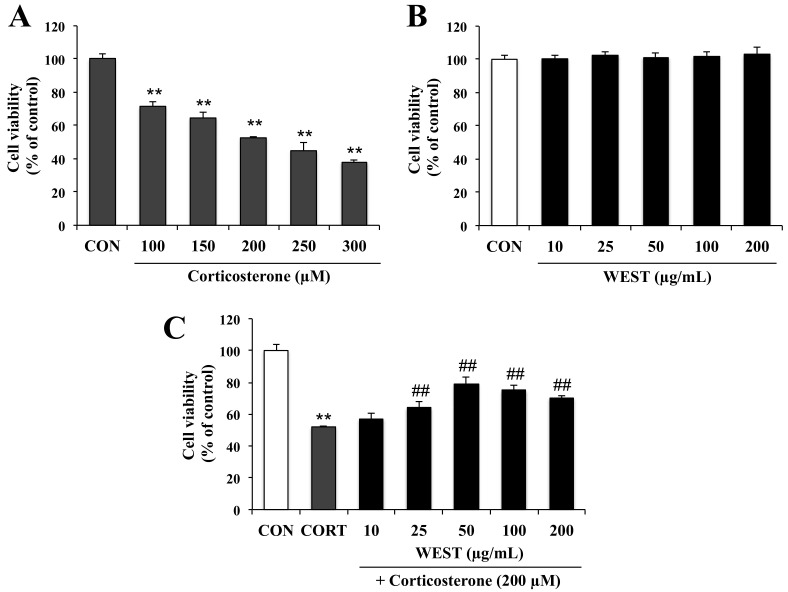
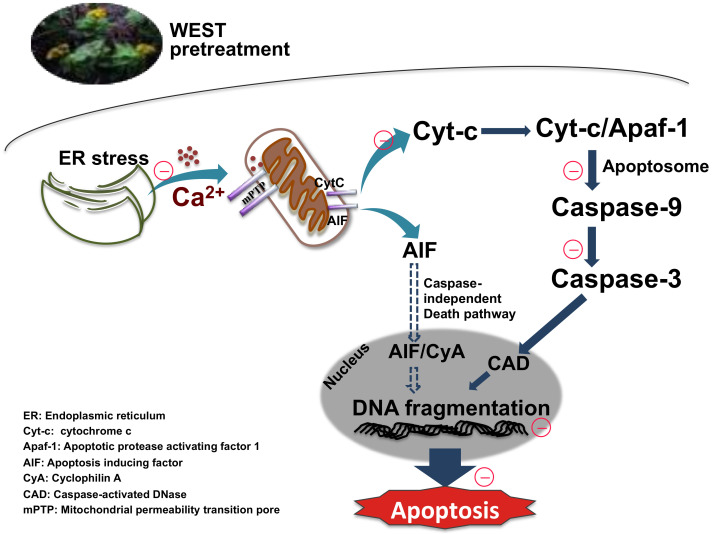
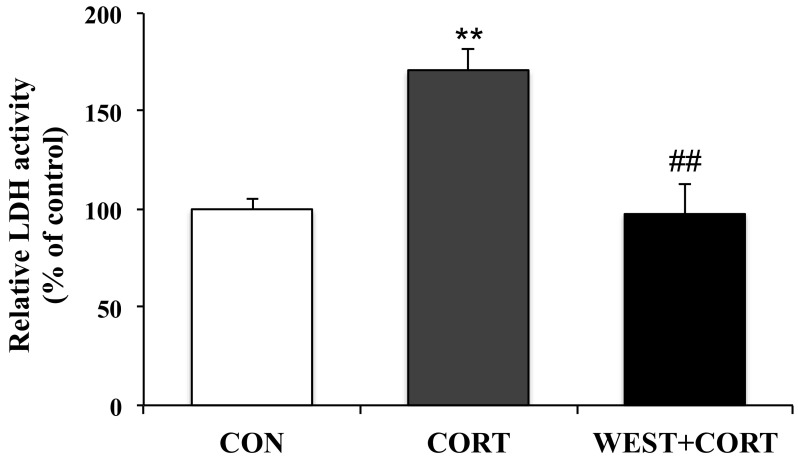
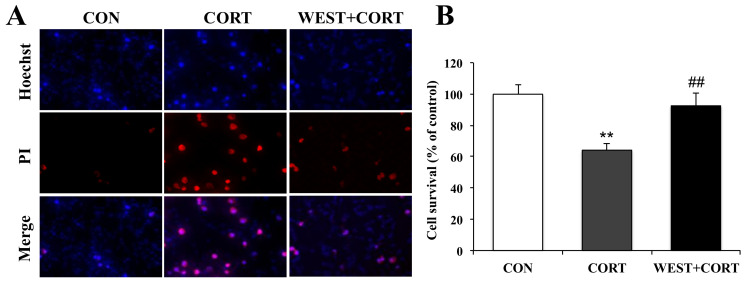
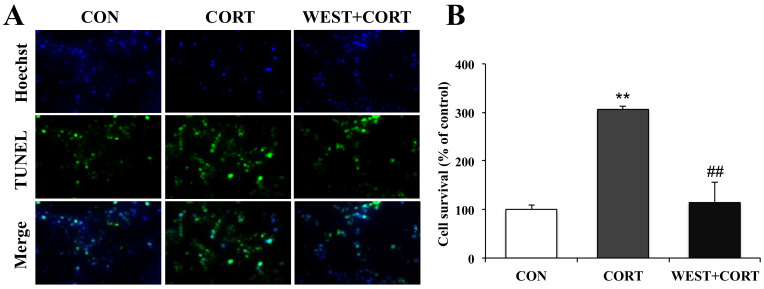
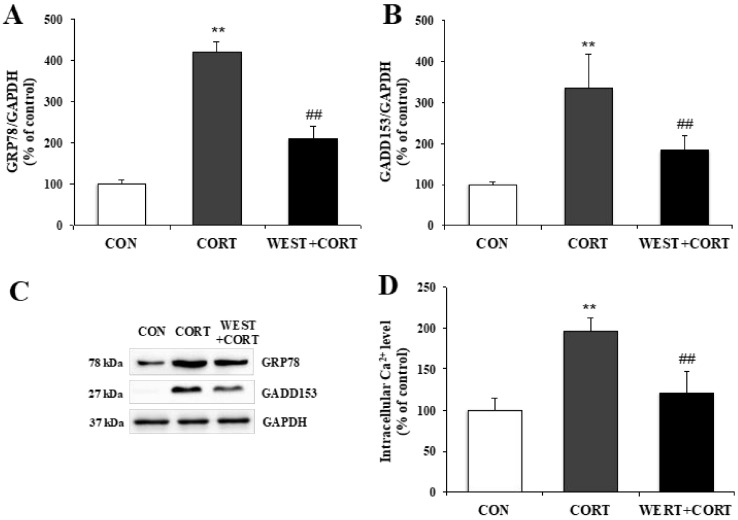
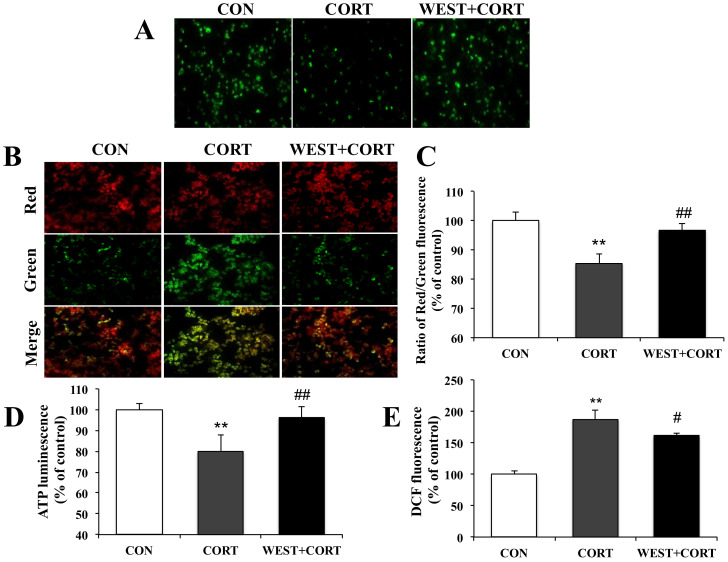
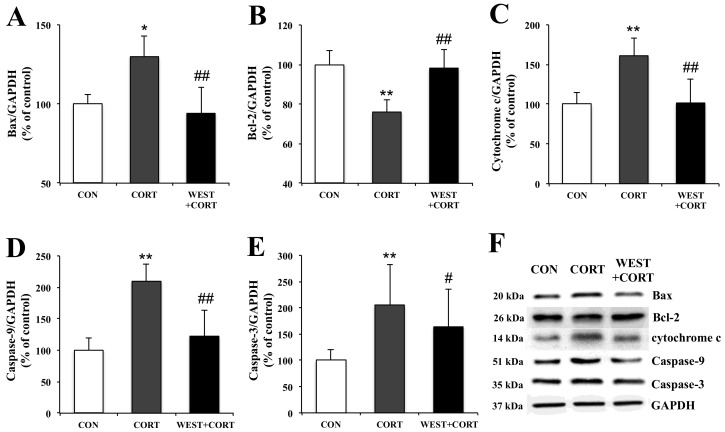
Neuronal cell death induced by chronic stress in the central nervous system is a cause of neurological dysfunction. We investigated the neuroprotective potential of a water extract of (WEST) against corticosterone-induced apoptosis in PC12 cells and the possible underlying mechanisms. Cells were pretreated with 50 µg/mL of WEST to evaluate its neuroprotective effect based on endoplasmic reticulum (ER) stress inhibition and mitochondrial function improvement. Pretreatment with WEST prevented corticosterone-induced injury in PC12 cells, resulting in increased cell survival, decreased lactate dehydrogenase (LDH) release, and potent apoptosis inhibition by a reduction in apoptotic nuclei demonstrated by Hoechst 33,342 and propidium iodide (PI) double staining, and TUNEL staining. WEST strongly attenuated calcium (Ca) elevation, inducing the closure of mitochondrial permeability transition pores (mPTPs), which were opened by corticosterone. It also stabilized mitochondrial membrane potential (MMP) loss and inhibited the corticosterone-induced decrease in adenosine triphosphate (ATP) levels. Furthermore, the increased reactive oxygen species (ROS) production induced by corticosterone was prevented in PC12 cells treated with WEST. WEST also downregulated the expression of glucose-regulated protein 78 (GRP78), growth arrest- and DNA damage-inducible gene 153 (GADD153), the pro-apoptotic protein Bcl-2-associated X (Bax), cytochrome c, cysteine-aspartic protease (caspase)-9, and caspase-3, and upregulated the expression of the anti-apoptotic protein B-cell lymphoma 2 (Bcl-2). Thus, WEST exerts a neuroprotective effect by inhibiting the apoptosis pathway in ER stress and the mitochondrial dysfunction induced by corticosterone. These results demonstrate that WEST reduces neuronal damage from the neurotoxicity caused by chronic stress.
中枢神经系统慢性应激诱导的神经元细胞死亡是神经功能障碍的一个原因。我们研究了 (WEST) 的水提取物对皮质酮诱导的 PC12 细胞凋亡的神经保护潜力及其可能的机制。细胞用 50μg/mL 的 WEST 预处理,根据内质网(ER)应激抑制和线粒体功能改善来评估其神经保护作用。WEST 预处理可防止皮质酮诱导的 PC12 细胞损伤,导致细胞存活率增加、乳酸脱氢酶(LDH)释放减少,以及通过 Hoechst 33,342 和碘化丙啶(PI)双重染色和 TUNEL 染色显示凋亡核减少来有效抑制凋亡。WEST 强烈抑制钙(Ca)升高,诱导线粒体通透性转换孔(mPTP)关闭,而皮质酮可打开 mPTP。它还稳定线粒体膜电位(MMP)的丧失,并抑制皮质酮诱导的三磷酸腺苷(ATP)水平降低。此外,WEST 还可防止皮质酮诱导的 PC12 细胞中活性氧(ROS)的产生增加。WEST 还下调葡萄糖调节蛋白 78(GRP78)、生长停滞和 DNA 损伤诱导基因 153(GADD153)、促凋亡蛋白 Bcl-2 相关 X(Bax)、细胞色素 c、半胱天冬氨酸蛋白酶(caspase)-9 和 caspase-3 的表达,并上调抗凋亡蛋白 B 细胞淋巴瘤 2(Bcl-2)的表达。因此,WEST 通过抑制内质网应激和皮质酮诱导的线粒体功能障碍中的凋亡途径发挥神经保护作用。这些结果表明,WEST 减轻了慢性应激引起的神经毒性导致的神经元损伤。