Laboratory of Clinical Chemistry, Faculty of Medicine, University of Ioannina, 45110 Ioannina, Greece.
Institute of Clinical Physiology, National Research Council, 56124 Pisa, Italy.
Int J Mol Sci. 2020 Nov 22;21(22):8835. doi: 10.3390/ijms21228835.
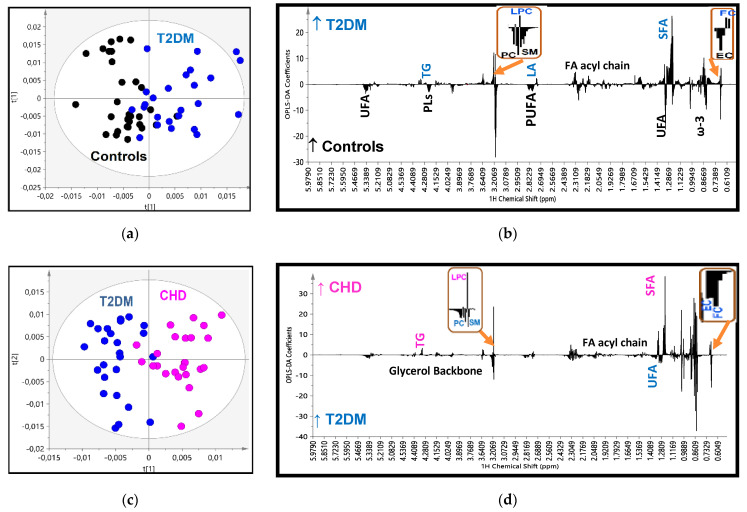
Cardiovascular disease (CVD) is the major cause of death in patients with type-2 diabetes mellitus (T2DM), although the factors that accelerate atherosclerosis in these patients are poorly understood. The identification of the altered quantity and quality of lipoproteins, closely related to atherogenesis, is limited in routine to a pattern of high triglycerides and low HDL-cholesterol (HDL-C) and in research as dysfunctional HDLs. We used the emerging NMR-based lipidomic technology to investigate compositional features of the HDLs of healthy individuals with normal coronary arteries, drug-naïve; recently diagnosed T2DM patients with normal coronary arteries; and patients with recent acute coronary syndrome. Patients with T2DM and normal serum lipid profiles even at diagnosis presented significant lipid alterations in HDL, characterized by higher triglycerides, lysophosphatidylcholine and saturated fatty acids; and lower cholesterol, phosphatidylcholine, phosphatidylethanolamine, sphingomyelin, plasmalogens and polyunsaturated fatty acids, an atherogenic pattern that may be involved in the pathogenesis of atherosclerosis. These changes are qualitatively similar to those found, more profoundly, in normolipidemic patients with established Coronary Heart Disease (CHD). We also conclude that NMR-based lipidomics offer a novel holistic exploratory approach for identifying and quantifying lipid species in biological matrixes in physiological processes and disease states or in disease biomarker discovery.
心血管疾病(CVD)是 2 型糖尿病(T2DM)患者死亡的主要原因,尽管这些患者动脉粥样硬化加速的因素尚未完全了解。尽管常规研究将脂蛋白数量和质量的改变与动脉粥样硬化密切相关,但仅局限于高甘油三酯和低高密度脂蛋白胆固醇(HDL-C)的模式,在研究中则表现为功能失调的高密度脂蛋白(HDL)。我们使用新兴的基于 NMR 的脂质组学技术,研究了正常冠状动脉、无药物治疗的健康个体的 HDL 的组成特征;新诊断的正常冠状动脉 T2DM 患者;以及最近发生急性冠状动脉综合征的患者。即使在诊断时血脂谱正常的 T2DM 患者,其 HDL 中的脂质也发生了显著改变,表现为甘油三酯、溶血磷脂酰胆碱和饱和脂肪酸升高;胆固醇、磷脂酰胆碱、磷脂酰乙醇胺、鞘磷脂、血浆酯和多不饱和脂肪酸降低,这是一种动脉粥样硬化的致病模式。这些变化与在确诊冠心病(CHD)的血脂正常患者中发现的变化在性质上相似。我们还得出结论,基于 NMR 的脂质组学为在生理过程和疾病状态或疾病生物标志物发现中识别和定量生物基质中的脂质种类提供了一种新颖的整体探索方法。