El-Yaagoubi Mohammed, Goya-Esteban Rebeca, Jabrane Younes, Muñoz-Romero Sergio, García-Alberola Arcadi, Rojo-Álvarez José Luis
Department of Signal Theory and Communications, Telematics and Computing Systems, Rey Juan Carlos University, 28933 Fuenlabrada, Spain.
GECOS Lab, ENSA, Cadi Ayyad University, 40000 Marrakech, Morocco.
Entropy (Basel). 2019 Jun 15;21(6):594. doi: 10.3390/e21060594.
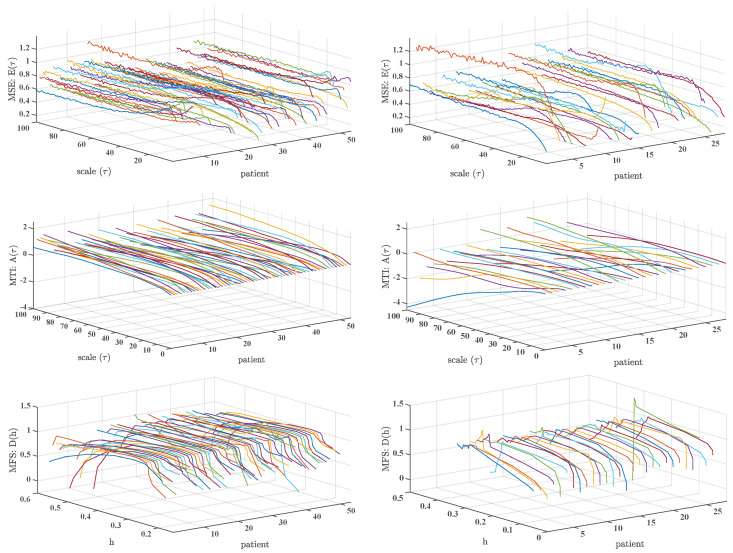
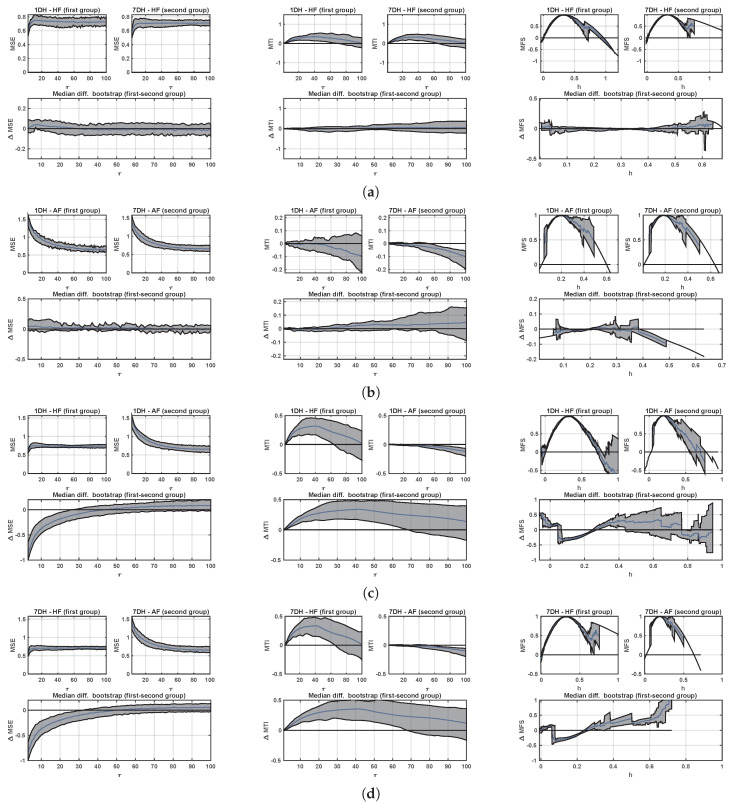
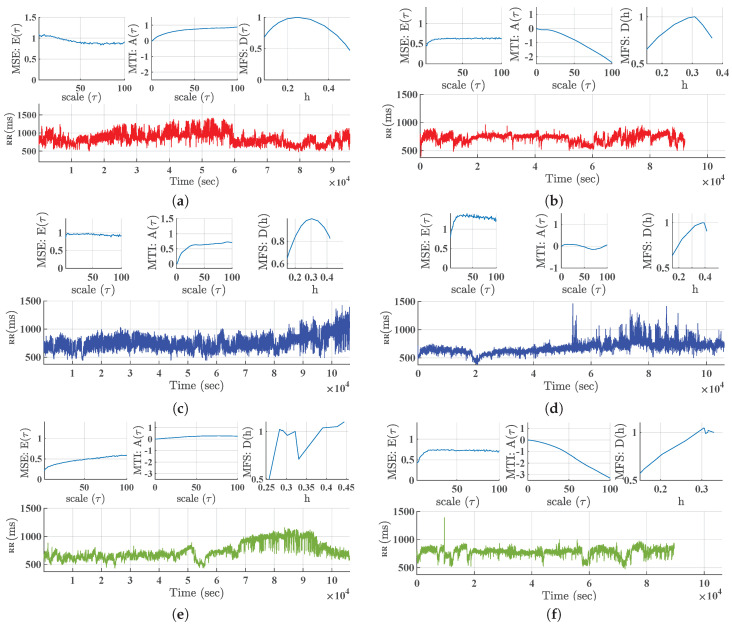
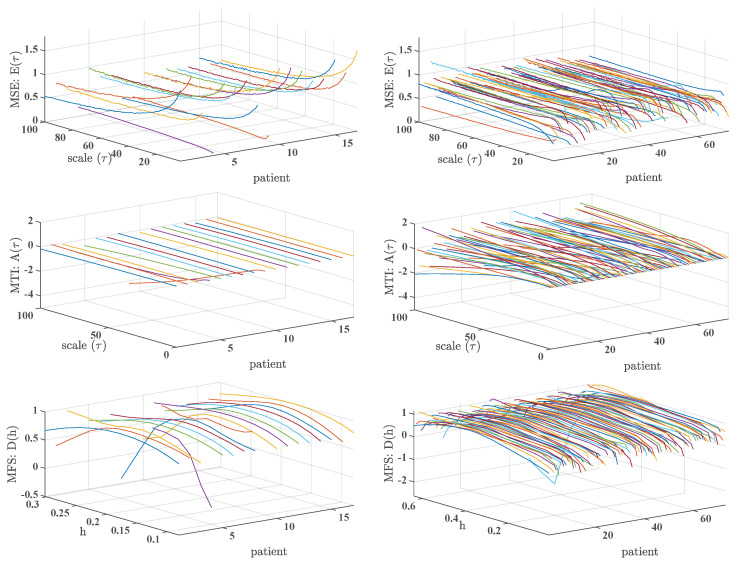
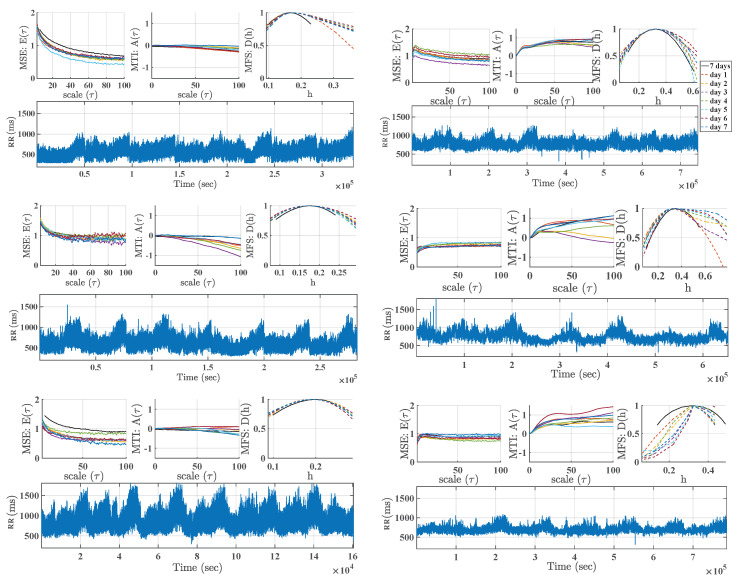
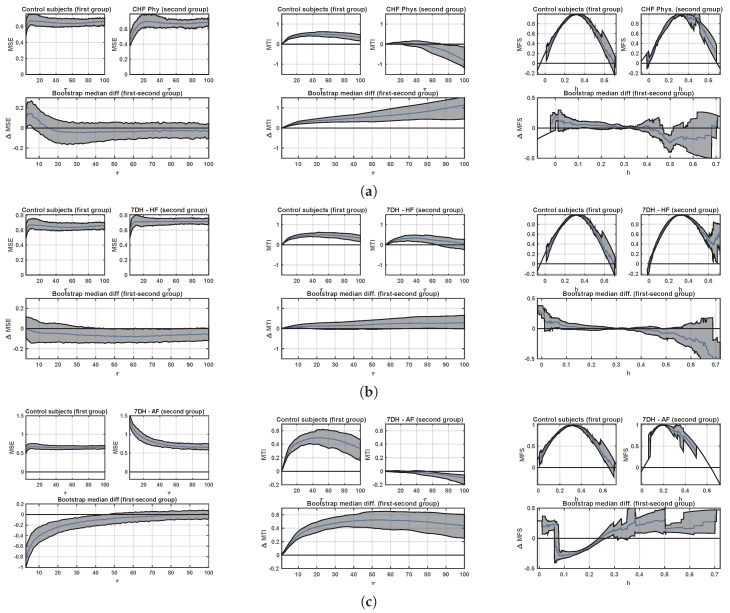
The identification of patients with increased risk of Sudden Cardiac Death (SCD) has been widely studied during recent decades, and several quantitative measurements have been proposed from the analysis of the electrocardiogram (ECG) stored in 1-day Holter recordings. Indices based on nonlinear dynamics of Heart Rate Variability (HRV) have shown to convey predictive information in terms of factors related with the cardiac regulation by the autonomous nervous system, and among them, multiscale methods aim to provide more complete descriptions than single-scale based measures. However, there is limited knowledge on the suitability of nonlinear measurements to characterize the cardiac dynamics in current long-term monitoring scenarios of several days. Here, we scrutinized the long-term robustness properties of three nonlinear methods for HRV characterization, namely, the Multiscale Entropy (MSE), the Multiscale Time Irreversibility (MTI), and the Multifractal Spectrum (MFS). These indices were selected because all of them have been theoretically designed to take into account the multiple time scales inherent in healthy and pathological cardiac dynamics, and they have been analyzed so far when monitoring up to 24 h of ECG signals, corresponding to about 20 time scales. We analyzed them in 7-day Holter recordings from two data sets, namely, patients with Atrial Fibrillation and with Congestive Heart Failure, by reaching up to 100 time scales. In addition, a new comparison procedure is proposed to statistically compare the poblational multiscale representations in different patient or processing conditions, in terms of the non-parametric estimation of confidence intervals for the averaged median differences. Our results show that variance reduction is actually obtained in the multiscale estimators. The MSE (MTI) exhibited the lowest (largest) bias and variance at large scales, whereas all the methods exhibited a consistent description of the large-scale processes in terms of multiscale index robustness. In all the methods, the used algorithms could turn to give some inconsistency in the multiscale profile, which was checked not to be due to the presence of artifacts, but rather with unclear origin. The reduction in standard error for several-day recordings compared to one-day recordings was more evident in MSE, whereas bias was more patently present in MFS. Our results pave the way of these techniques towards their use, with improved algorithmic implementations and nonparametric statistical tests, in long-term cardiac Holter monitoring scenarios.
近几十年来,对心脏性猝死(SCD)风险增加患者的识别进行了广泛研究,并且通过分析存储在1天动态心电图(ECG)记录中的心电图,提出了几种定量测量方法。基于心率变异性(HRV)非线性动力学的指标已显示出在与自主神经系统心脏调节相关因素方面传递预测信息,其中,多尺度方法旨在提供比单尺度测量更完整的描述。然而,在当前数天的长期监测场景中,关于非线性测量用于表征心脏动力学的适用性的知识有限。在此,我们仔细研究了三种用于HRV表征的非线性方法的长期稳健性特性,即多尺度熵(MSE)、多尺度时间不可逆性(MTI)和多重分形谱(MFS)。选择这些指标是因为它们在理论上都被设计为考虑健康和病理性心脏动力学中固有的多个时间尺度,并且到目前为止,在监测长达24小时的ECG信号(对应约20个时间尺度)时对它们进行了分析。我们通过达到多达100个时间尺度,在来自两个数据集(即房颤患者和充血性心力衰竭患者)的7天动态心电图记录中对它们进行了分析。此外,还提出了一种新的比较程序,以便根据平均中位数差异的置信区间的非参数估计,在不同患者或处理条件下对总体多尺度表示进行统计比较。我们的结果表明,在多尺度估计器中实际上实现了方差降低。MSE(MTI)在大尺度上表现出最低(最大)的偏差和方差,而所有方法在多尺度指标稳健性方面对大尺度过程都表现出一致的描述。在所有方法中,所使用的算法在多尺度分布中可能会出现一些不一致性,经检查这不是由于伪迹的存在,而是来源不明。与1天记录相比,数天记录的标准误差降低在MSE中更为明显,而偏差在MFS中更为明显。我们的结果为这些技术在长期心脏动态心电图监测场景中的应用铺平了道路,通过改进算法实现和非参数统计测试。