Department of Nutrition, Harvard TH Chan School of Public Health, 655 Huntington Avenue, Boston, MA 02115, USA.
Channing Division of Network Medicine, Department of Medicine, Brigham and Women's Hospital, Harvard Medical School, Boston, MA, USA.
BMJ. 2020 Dec 2;371:m4141. doi: 10.1136/bmj.m4141.
To study total, processed, and unprocessed red meat in relation to risk of coronary heart disease (CHD) and to estimate the effects of substituting other protein sources for red meat with CHD risk.
Prospective cohort study with repeated measures of diet and lifestyle factors.
Health Professionals Follow-Up Study cohort, United States, 1986-2016.
43 272 men without cardiovascular disease or cancer at baseline.
The primary outcome was total CHD, comprised of acute non-fatal myocardial infarction or fatal CHD. Cox models were used to estimate hazard ratios and 95% confidence intervals across categories of red meat consumption. Substitution analyses were conducted by comparing coefficients for red meat and the alternative food in models, including red meat and alternative foods as continuous variables.
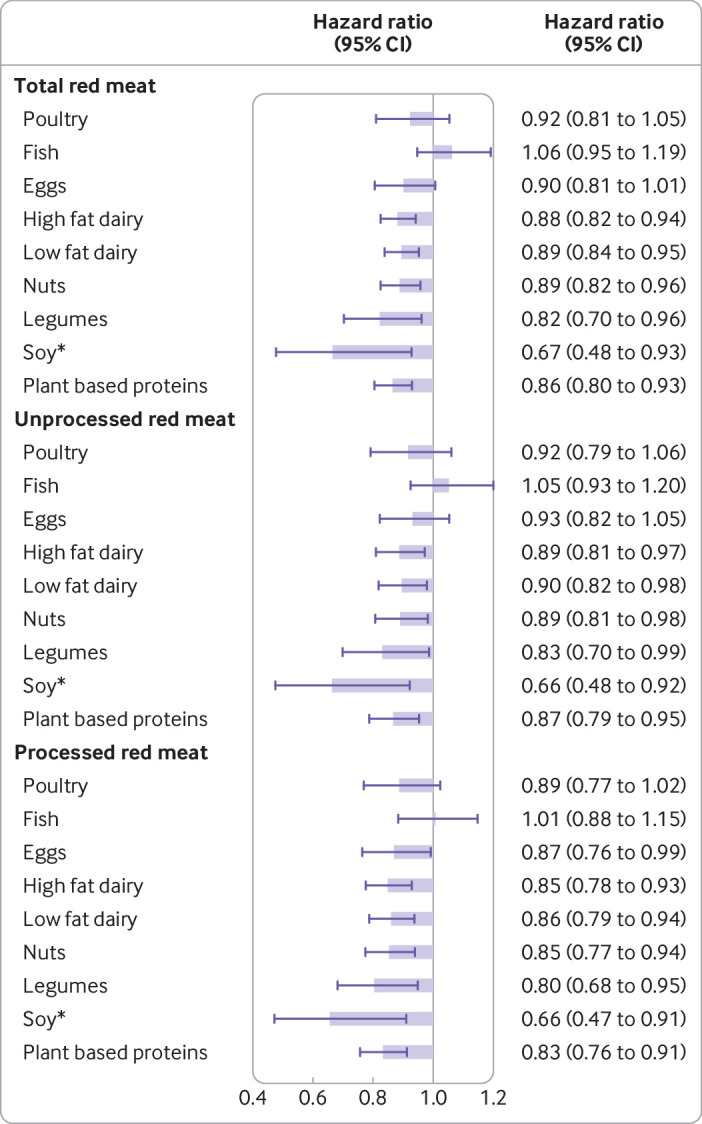
During 1 023 872 person years of follow-up, 4456 incident CHD events were documented of which 1860 were fatal. After multivariate adjustment for dietary and non-dietary risk factors, total, unprocessed, and processed red meat intake were each associated with a modestly higher risk of CHD (hazard ratio for one serving per day increment: 1.12 (95% confidence interval 1.06 to 1.18) for total red meat, 1.11 (1.02 to 1.21) for unprocessed red meat, and 1.15 (1.06 to 1.25) for processed red meat). Compared with red meat, the intake of one serving per day of combined plant protein sources (nuts, legumes, and soy) was associated with a lower risk of CHD (0.86 (0.80 to 0.93) compared with total red meat, 0.87 (0.79 to 0.95) compared with unprocessed red meat, and 0.83 (0.76 to 0.91) compared with processed red meat). Substitutions of whole grains and dairy products for total red meat and eggs for processed red meat were also associated with lower CHD risk.
Substituting high quality plant foods such as legumes, nuts, or soy for red meat might reduce the risk of CHD. Substituting whole grains and dairy products for total red meat, and eggs for processed red meat, might also reduce this risk.
研究总红肉类、加工红肉类和未加工红肉类与冠心病(CHD)风险的关系,并估计用红肉类的其他蛋白质来源替代红肉类对 CHD 风险的影响。
前瞻性队列研究,重复测量饮食和生活方式因素。
美国健康专业人员随访研究队列,1986-2016 年。
43272 名基线时无心血管疾病或癌症的男性。
主要结局为总 CHD,包括急性非致死性心肌梗死或致死性 CHD。Cox 模型用于估计不同红肉类摄入量组别的危险比和 95%置信区间。通过在模型中比较红肉类和替代食品的系数来进行替代分析,包括红肉类和替代食品作为连续变量。
在 1023872 人年的随访期间,记录了 4456 例新发 CHD 事件,其中 1860 例为致死性事件。在对饮食和非饮食危险因素进行多变量调整后,总红肉类、未加工红肉类和加工红肉类的摄入量均与 CHD 风险略有增加相关(每天增加一份的危险比:总红肉类 1.12(95%置信区间 1.06 至 1.18),未加工红肉类 1.11(1.02 至 1.21),加工红肉类 1.15(1.06 至 1.25))。与红肉类相比,每天摄入一份的混合植物蛋白来源(坚果、豆类和大豆)与 CHD 风险降低相关(与总红肉类相比,0.86(0.80 至 0.93),与未加工红肉类相比,0.87(0.79 至 0.95),与加工红肉类相比,0.83(0.76 至 0.91))。用全谷物和乳制品代替总红肉类,用鸡蛋代替加工红肉类,也与 CHD 风险降低相关。
用豆类、坚果或大豆等高质量植物性食物代替红肉类可能会降低 CHD 风险。用全谷物和乳制品代替总红肉类,用鸡蛋代替加工红肉类,也可能降低这种风险。