Cermenek Bernd, Genorio Boštjan, Winter Thomas, Wolf Sigrid, Connell Justin G, Roschger Michaela, Letofsky-Papst Ilse, Kienzl Norbert, Bitschnau Brigitte, Hacker Viktor
Institute of Chemical Engineering and Environmental Technology, Fuel Cell Systems Group, Graz University of Technology, NAWI Graz, Inffeldgasse 25/C, 8010 Graz, Austria.
Faculty of Chemistry and Chemical Technology, University of Ljubljana, Večna pot 113, 1000 Ljubljana, Slovenia.
Electrocatalysis (N Y). 2020;11(2):203-214. doi: 10.1007/s12678-019-00577-8. Epub 2020 Jan 3.
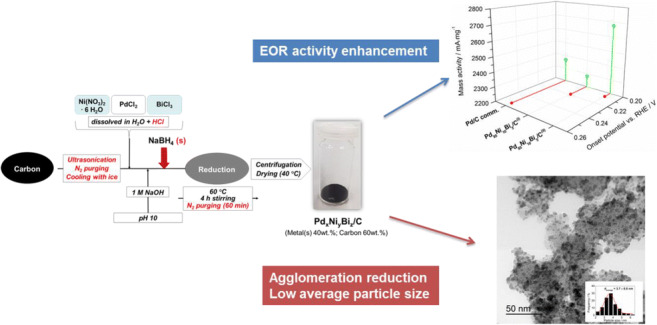
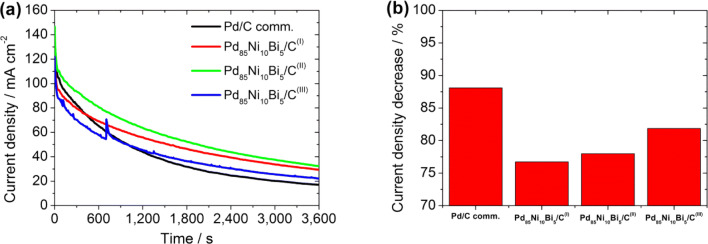
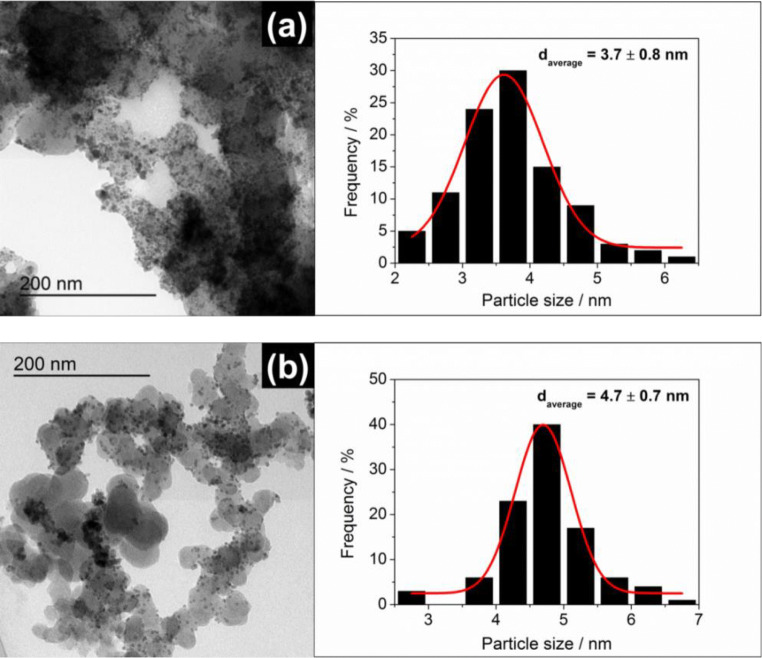
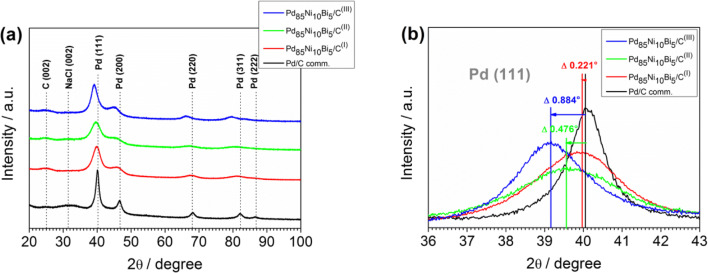
Direct ethanol fuel cells (DEFC) still lack active and efficient electrocatalysts for the alkaline ethanol oxidation reaction (EOR). In this work, a new instant reduction synthesis method was developed to prepare carbon supported ternary PdNiBi nanocatalysts with improved EOR activity. Synthesized catalysts were characterized with a variety of structural and compositional analysis techniques in order to correlate their morphology and surface chemistry with electrochemical performance. The modified instant reduction synthesis results in well-dispersed, spherical PdNiBi nanoparticles on Vulcan XC72R support (PdNiBi/C), with sizes ranging from 3.7 ± 0.8 to 4.7 ± 0.7 nm. On the other hand, the common instant reduction synthesis method leads to significantly agglomerated nanoparticles (PdNiBi/C). EOR activity and stability of these three different carbon supported PdNiBi anode catalysts with a nominal atomic ratio of 85:10:5 were probed via cyclic voltammetry and chronoamperometry using the rotating disk electrode method. PdNiBi/C showed the highest electrocatalytic activity (150 mA⋅cm; 2678 mA⋅mg) with low onset potential (0.207 V) for EOR in alkaline medium, as compared to a commercial Pd/C and to the other synthesized ternary nanocatalysts PdNiBi/C and PdNiBi/C. This new synthesis approach provides a new avenue to developing efficient, carbon supported ternary nanocatalysts for future energy conversion devices. Graphical AbstractThe modified instant reduction method for synthesis of ternary PdNiBi/C nanocatalyst using Vulcan XC72R as carbon support initiates an agglomeration reduction, provides low average particle size, and enables enhanced activity for the alkaline ethanol oxidation reaction (EOR) compared to the common instant reduction method and to a commercial Pd/C catalyst.
直接乙醇燃料电池(DEFC)仍然缺乏用于碱性乙醇氧化反应(EOR)的活性和高效电催化剂。在这项工作中,开发了一种新的即时还原合成方法来制备具有改进的EOR活性的碳载三元PdNiBi纳米催化剂。为了将其形态和表面化学与电化学性能相关联,使用各种结构和组成分析技术对合成的催化剂进行了表征。改进后的即时还原合成法在Vulcan XC72R载体(PdNiBi/C)上得到了分散良好的球形PdNiBi纳米颗粒,尺寸范围为3.7±0.8至4.7±0.7 nm。另一方面,普通的即时还原合成方法导致纳米颗粒明显团聚(PdNiBi/C)。使用旋转圆盘电极法通过循环伏安法和计时电流法探究了这三种不同的标称原子比为85:10:5的碳载PdNiBi阳极催化剂的EOR活性和稳定性。与市售Pd/C以及其他合成的三元纳米催化剂PdNiBi/C和PdNiBi/C相比,PdNiBi/C在碱性介质中对EOR表现出最高的电催化活性(150 mA·cm;2678 mA·mg),起始电位低(0.207 V)。这种新的合成方法为开发用于未来能量转换装置的高效碳载三元纳米催化剂提供了一条新途径。图形摘要使用Vulcan XC72R作为碳载体合成三元PdNiBi/C纳米催化剂的改进即时还原方法可减少团聚,提供低平均粒径,并与普通即时还原方法和市售Pd/C催化剂相比,增强碱性乙醇氧化反应(EOR)的活性。