Kaaijk Patricia, Nicolaie M Alina, van Rooijen Debbie, van Houten Marianne A, van der Klis Fiona R, Buisman Anne-Marie, van Binnendijk Rob S
Centre for Infectious Disease Control, National Institute for Public Health and the Environment (RIVM), Bilthoven, the Netherlands.
Spaarne Gasthuis Academy, Hoofddorp, the Netherlands.
Open Forum Infect Dis. 2020 Oct 20;7(11):ofaa505. doi: 10.1093/ofid/ofaa505. eCollection 2020 Nov.
Breakthrough infections of measles and mumps have raised concerns about the duration of vaccine-induced immunity, which might be improved by a third dose of measles-mumps-rubella vaccine (MMR3).
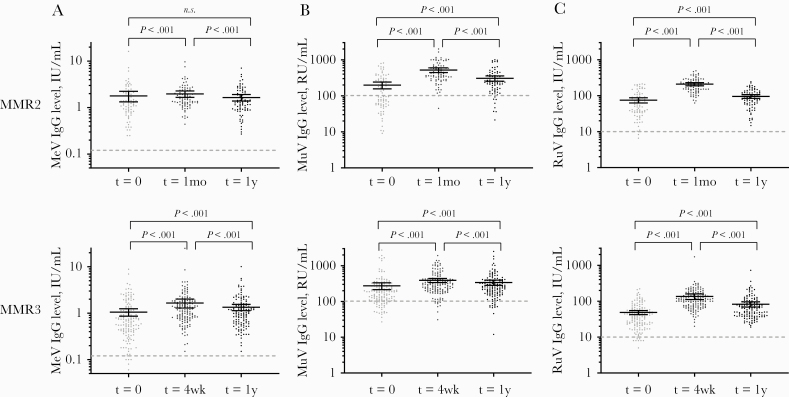
Here we compared (IgG) antibody levels against measles, mumps, and rubella in blood samples of 9-year-old children and young adults (18-25 years) following MMR2 and MMR3, respectively.
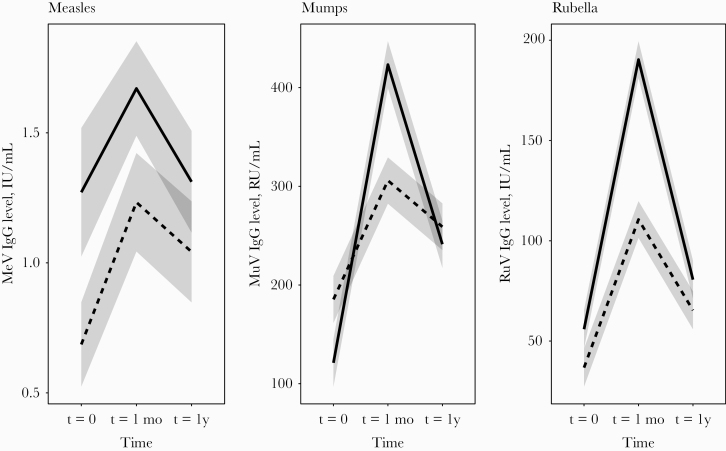
We found that, in addition to antibody boosting for all 3 vaccine components, MMR3 resulted in lower antibody decay rates than MMR2; the declines were most prominent for mumps and rubella.
This study suggests that MMR3 provides long-lasting seroprotection against measles, mumps, and rubella.
麻疹和腮腺炎突破性感染引发了对疫苗诱导免疫持续时间的担忧,而麻疹-腮腺炎-风疹三联疫苗第三剂(MMR3)可能会改善这一情况。
在此,我们分别比较了9岁儿童和年轻成年人(18 - 25岁)在接种MMR2和MMR3后血液样本中针对麻疹、腮腺炎和风疹的(IgG)抗体水平。
我们发现,除了对所有三种疫苗成分的抗体增强作用外,MMR3导致的抗体衰减率低于MMR2;腮腺炎和风疹的下降最为显著。
本研究表明,MMR3可提供针对麻疹、腮腺炎和风疹的长期血清保护。