Ferreira Sofia, Raimundo Ana F, Menezes Regina, Martins Ivo C
iBET - Instituto de Biologia Experimental e Tecnológica, Oeiras; CEDOC - Chronic Diseases Research Center, Faculdade de Ciências Médicas, Universidade Nova de Lisboa, Lisboa, Portugal.
iBET - Instituto de Biologia Experimental e Tecnológica, Oeiras; CEDOC - Chronic Diseases Research Center, Faculdade de Ciências Médicas, Universidade Nova de Lisboa, Lisboa; ITQB-NOVA, Instituto de Tecnologia Química e Biológica António Xavier, Universidade Nova de Lisboa, Oeiras, Portugal.
Neural Regen Res. 2021 Jun;16(6):1127-1130. doi: 10.4103/1673-5374.300323.
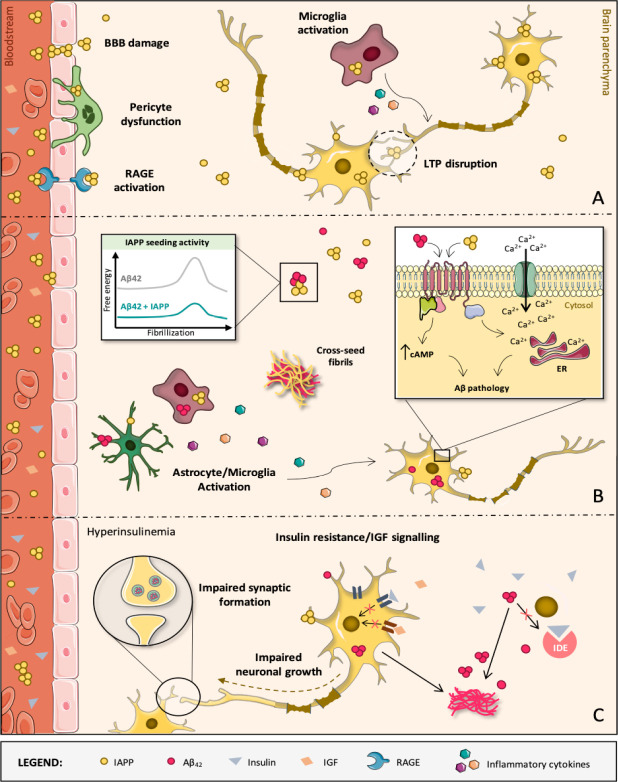
Alzheimer's disease (AD) is a neurodegenerative disorder that affects millions worldwide. Due to population ageing, the incidence of AD is increasing. AD patients develop cognitive decline and dementia, features for which is known, requiring permanent care. This poses a major socio-economic burden on healthcare systems as AD patients' relatives and healthcare workers are forced to cope with rising numbers of affected people. Despite recent advances, AD pathological mechanisms are not fully understood. Nevertheless, it is clear that the amyloid beta (Aβ) peptide, which forms amyloid plaques in AD patients' brains, plays a key role. Type 2 diabetes, the most common form of diabetes, affects hundreds of million people globally. Islet amyloid polypeptide (IAPP) is a hormone co-produced and secreted with insulin in pancreatic β-cells, with a key role in diabetes, as it helps regulate glucose levels and control adiposity and satiation. Similarly to Aβ, IAPP is very amyloidogenic, generating intracellular amyloid deposits that cause β-cell dysfunction and death. It is now clear that IAPP can also have a pathological role in AD, decreasing cognitive function. IAPP harms the blood-brain barrier, directly interacts and co-deposits with Aβ, promoting diabetes-associated dementia. IAPP can cause a metabolic dysfunction in the brain, leading to other diabetes-related forms of AD. Thus, here we discuss IAPP association with diabetes, Aβ and dementia, in the context of what we designate a "diabetes brain phenotype" AD hypothesis. Such approach helps to set a conceptual framework for future IAPP-based drugs against AD.
阿尔茨海默病(AD)是一种影响全球数百万人的神经退行性疾病。由于人口老龄化,AD的发病率正在上升。AD患者会出现认知能力下降和痴呆症状,已知这些症状需要长期护理。这给医疗系统带来了巨大的社会经济负担,因为AD患者的亲属和医护人员不得不应对受影响人数的不断增加。尽管最近取得了进展,但AD的病理机制尚未完全了解。然而,很明显,在AD患者大脑中形成淀粉样斑块的β-淀粉样蛋白(Aβ)肽起着关键作用。2型糖尿病是最常见的糖尿病形式,全球有数亿人受其影响。胰岛淀粉样多肽(IAPP)是一种与胰岛素在胰腺β细胞中共同产生和分泌的激素,在糖尿病中起关键作用,因为它有助于调节血糖水平并控制肥胖和饱腹感。与Aβ类似,IAPP具有很强的淀粉样变性,会产生细胞内淀粉样沉积物,导致β细胞功能障碍和死亡。现在很清楚,IAPP在AD中也可能具有病理作用,会降低认知功能。IAPP会损害血脑屏障,直接与Aβ相互作用并共同沉积,促进糖尿病相关痴呆。IAPP会导致大脑代谢功能障碍,引发其他与糖尿病相关的AD形式。因此,在此我们在我们所称的“糖尿病脑表型”AD假说的背景下,讨论IAPP与糖尿病、Aβ和痴呆的关联。这种方法有助于为未来基于IAPP的抗AD药物建立一个概念框架。