Tang Bo, Tang Li, Huang Cheng, Tian Chuan, Chen Ling, He Zhijun, Yang Guodong, Zuo Luo, Zhao Guoce, Liu En, Wang Sumin, Lin Hui, He Jialin, Yang Shiming
Department of Gastroenterology, Xinqiao Hospital, Third Military Medical University, Chongqing, China.
Department of Gastroenterology, Chongqing Iron and Steel General Hospital, Chongqing, China.
Infect Dis Ther. 2021 Mar;10(1):317-333. doi: 10.1007/s40121-020-00372-9. Epub 2020 Dec 3.
Helicobacter pylori eradication therapy may lead to the perturbation of gut microbiota. We aim to investigate the impact of probiotics on eradication rate and gut microbiota during eradication therapy.
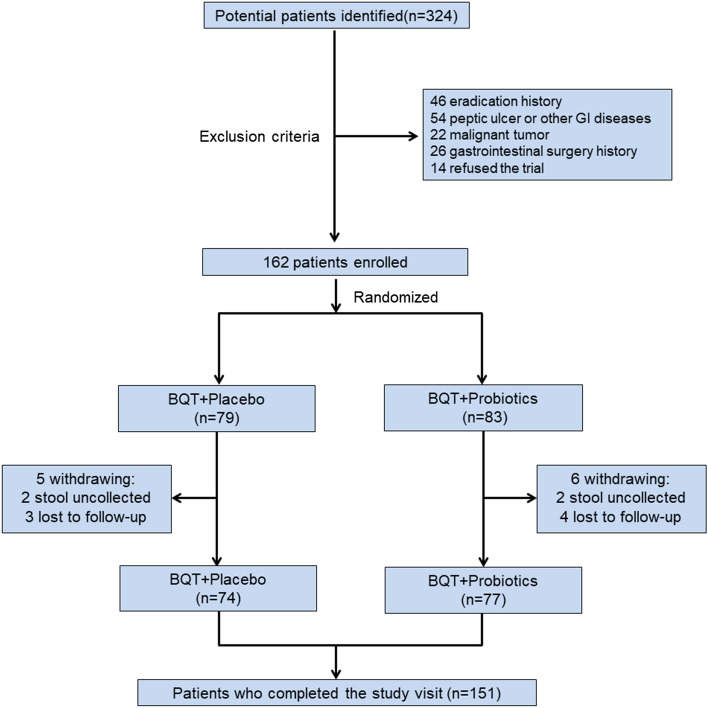
A total of 162 patients receiving bismuth quadruple therapy were enrolled and randomly assigned to groups given probiotics (n = 83) or placebo (n = 79) for 4 weeks. Fecal samples were collected before treatment and 2, 4, 6, and 8 weeks after eradication therapy. Gut microbiota was analyzed by 16S rRNA high-throughput sequencing.
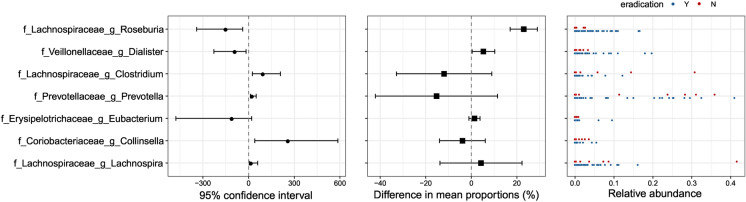
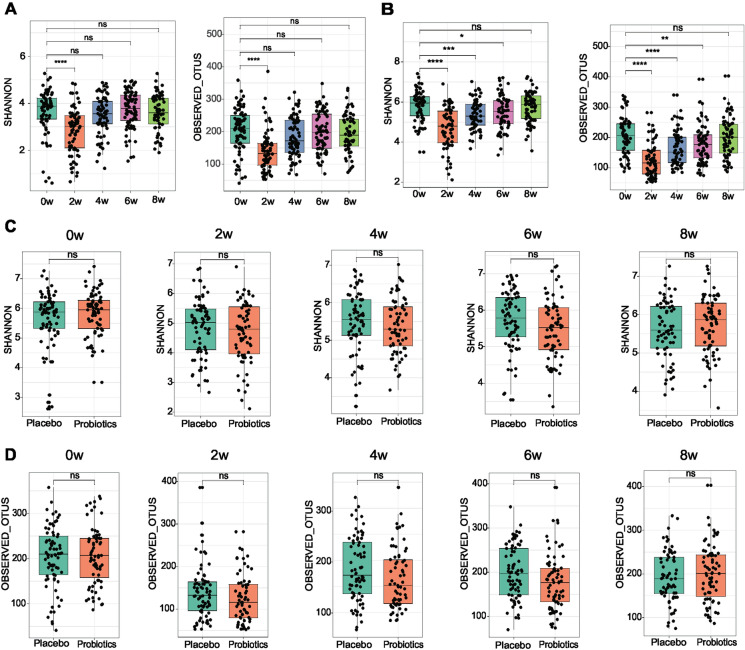
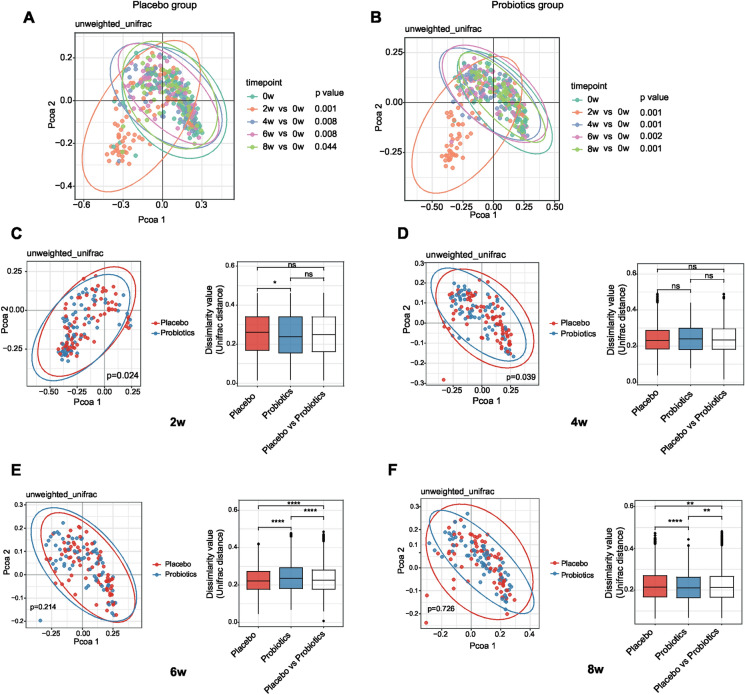
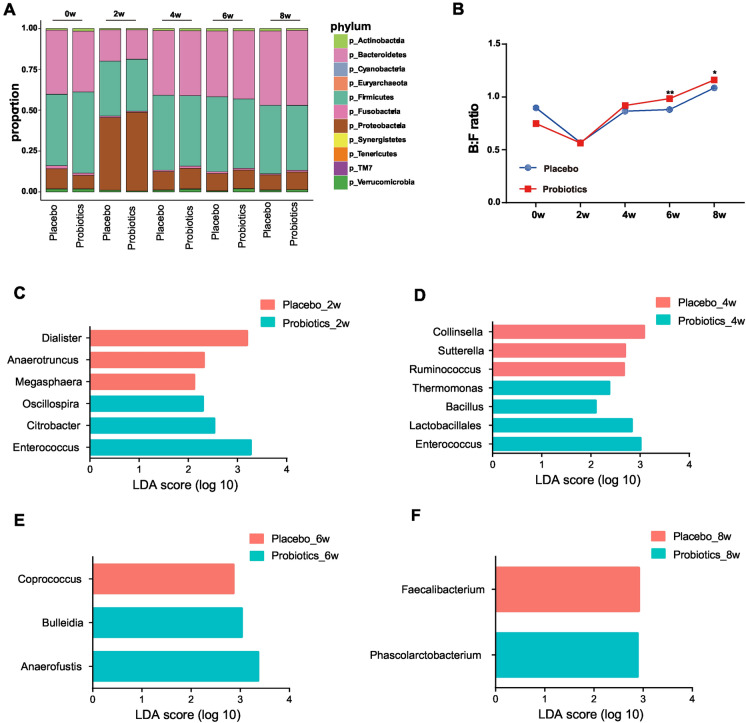
The eradication rates in the placebo and probiotics group were 82.43% and 87.01%, respectively (P > 0.05). Compared with baseline, alpha and beta diversity was significantly altered 2 weeks after eradication in both groups, which was restored at week 8. There were no significant differences in diversity between the two groups. H. pylori eradication therapy resulted in enrichment of some detrimental bacteria taxa such as Shigella, Klebsiella, and Streptococcus, while probiotics supplementation could rapidly restore these taxa levels after eradication and increase the taxa of Bacillus and Lactobacillales. Functional analysis revealed that lipopolysaccharide biosynthesis and polymyxin resistance pathways were significantly enriched after eradication, while probiotics supplementation mainly enriched the cofactors and vitamins metabolism pathways. Increased relative abundances of Roseburia and Dialister were associated with the positive eradication outcome.
Probiotics supplementation might help to construct a beneficial profile of gut microbiota after eradication therapy. Specific bacteria taxa are associated with H. pylori eradication outcome. These findings may be of value in rational use of probiotics during H. pylori eradication.
Chinese Clinical Trial Registry, ChiCTR1900022116.
幽门螺杆菌根除治疗可能会导致肠道微生物群紊乱。我们旨在研究益生菌在根除治疗期间对根除率和肠道微生物群的影响。
共有162例接受铋剂四联疗法的患者入组,并随机分为接受益生菌治疗组(n = 83)和安慰剂组(n = 79),治疗4周。在治疗前以及根除治疗后2、4、6和8周收集粪便样本。通过16S rRNA高通量测序分析肠道微生物群。
安慰剂组和益生菌组的根除率分别为82.43%和87.01%(P>0.05)。与基线相比,两组在根除治疗后2周时α和β多样性均发生显著改变,并在第8周恢复。两组之间的多样性无显著差异。幽门螺杆菌根除治疗导致一些有害细菌类群如志贺氏菌、克雷伯氏菌和链球菌富集,而补充益生菌可在根除后迅速恢复这些类群的水平,并增加芽孢杆菌和乳杆菌目的类群。功能分析显示,根除后脂多糖生物合成和多粘菌素抗性途径显著富集,而补充益生菌主要富集辅因子和维生素代谢途径。罗氏菌属和戴阿利斯特菌属相对丰度的增加与根除治疗的阳性结果相关。
补充益生菌可能有助于在根除治疗后构建有益的肠道微生物群谱。特定的细菌类群与幽门螺杆菌根除结果相关。这些发现可能对幽门螺杆菌根除期间合理使用益生菌具有价值。
中国临床试验注册中心,ChiCTR1900022116。