Infectious Disease Research Collaboration, Kampala, Uganda.
London School of Hygiene and Tropical Medicine, London, United Kingdom.
PLoS One. 2020 Dec 3;15(12):e0243303. doi: 10.1371/journal.pone.0243303. eCollection 2020.
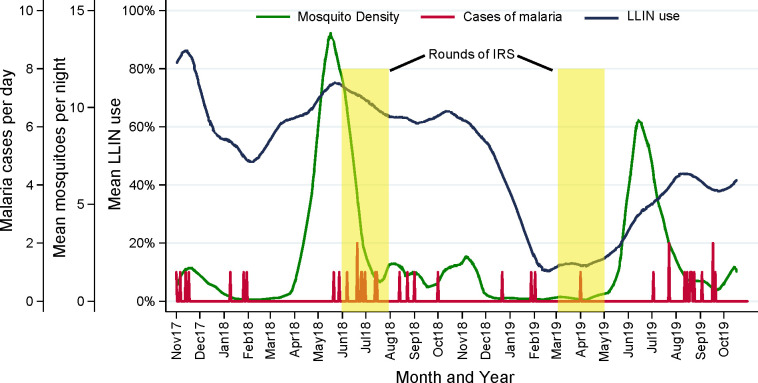
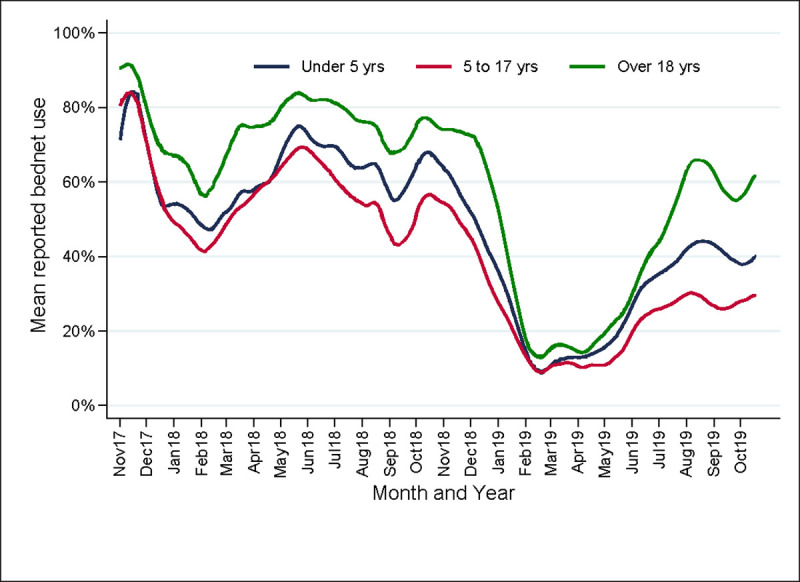
Indoor residual spraying (IRS) and long-lasting insecticide-treated bednets (LLINs) are common tools for reducing malaria transmission. We studied a cohort in Uganda with universal access to LLINs after 5 years of sustained IRS to explore LLIN adherence when malaria transmission has been greatly reduced. Eighty households and 526 individuals in Nagongera, Uganda were followed from October 2017 -October 2019. Every two weeks, mosquitoes were collected from sleeping rooms and LLIN adherence the prior night assessed. Episodes of malaria were diagnosed using passive surveillance. Risk factors for LLIN non-adherence were evaluated using multi-level mixed logistic regression. An age-matched case-control design was used to measure the association between LLIN non-adherence and malaria. Across all time periods, and particularly in the last 6 months, non-adherence was higher among both children <5 years (OR 3.31, 95% CI: 2.30-4.75; p<0.001) and school-aged children 5-17 years (OR 6.88, 95% CI: 5.01-9.45; p<0.001) compared to adults. In the first 18 months, collection of fewer mosquitoes was associated with non-adherence (OR 3.25, 95% CI: 2.92-3.63; p<0.001), and, in the last 6 months, residents of poorer households were less adherent (OR 5.1, 95% CI: 1.17-22.2; p = 0.03). Any reported non-adherence over the prior two months was associated with a 15-fold increase in the odds of having malaria (OR 15.0, 95% CI: 1.95 to 114.9; p = 0.009). Knowledge about LLIN use was high, and the most frequently reported barriers to use included heat and low perceived risk of malaria. Children, particularly school-aged, participants exposed to fewer mosquitoes, and those from poorer households, were less likely to use LLINs. Non-adherence to LLINs was associated with an increased risk of malaria. Strategies, such as behavior change communications, should be prioritized to ensure consistent LLIN use even when malaria transmission has been greatly reduced.
室内滞留喷洒(IRS)和长效驱虫蚊帐(LLIN)是减少疟疾传播的常用工具。我们在乌干达进行了一项研究,该研究中所有家庭都可以普遍获得 LLIN,且在持续 IRS 五年后疟疾传播大大减少,以探索此时 LLIN 的使用情况。2017 年 10 月至 2019 年 10 月,我们对乌干达 Nagongera 的 80 户家庭和 526 人进行了随访。每两周收集一次卧室中的蚊子,并评估前一晚的 LLIN 使用情况。使用被动监测来诊断疟疾发作。使用多水平混合逻辑回归评估 LLIN 不使用的风险因素。采用年龄匹配的病例对照设计来衡量 LLIN 不使用与疟疾之间的关联。在所有时间段,尤其是在最后 6 个月,年龄在 5 岁以下的儿童(OR 3.31,95%CI:2.30-4.75;p<0.001)和 5-17 岁的学龄儿童(OR 6.88,95%CI:5.01-9.45;p<0.001)的 LLIN 不使用率高于成年人。在最初的 18 个月中,蚊子数量较少与不使用 LLIN 有关(OR 3.25,95%CI:2.92-3.63;p<0.001),而在最后 6 个月中,来自较贫困家庭的居民使用 LLIN 的频率较低(OR 5.1,95%CI:1.17-22.2;p = 0.03)。过去两个月中任何报告的不使用都与疟疾发生几率增加 15 倍有关(OR 15.0,95%CI:1.95 至 114.9;p = 0.009)。对 LLIN 使用的认识较高,而最常报告的使用障碍包括热和疟疾的低感知风险。接触到较少蚊子、来自较贫困家庭的儿童,特别是学龄儿童,不太可能使用 LLIN。LLIN 不使用与疟疾风险增加有关。应优先采取行为改变沟通等策略,以确保即使在疟疾传播大大减少的情况下,也能持续使用 LLIN。