Paediatric Intensive Care Unit, Southampton Children's Hospital, Southampton, UK
School of Health Sciences, University of Southampton, Southampton, UK.
BMJ Open. 2020 Dec 3;10(12):e041234. doi: 10.1136/bmjopen-2020-041234.
An admission to paediatric intensive care unit (PICU) is associated with multiple physical and environmental stressors, often involving many negative and painful oral experiences. Evidence from children with complex medical conditions suggests that feeding difficulties post-PICU stay are common, causing significant parental anxiety. Adult intensive care unit (ICU) survivor studies suggest feeding issues lasting up to 3 months post-discharge from ICU. There is, however, a paucity of evidence regarding feeding outcomes for previously healthy children following a PICU admission and whether painful oral experiences during an admission contribute to feeding difficulties post-discharge, negatively impacting on parental/caregiver anxiety.
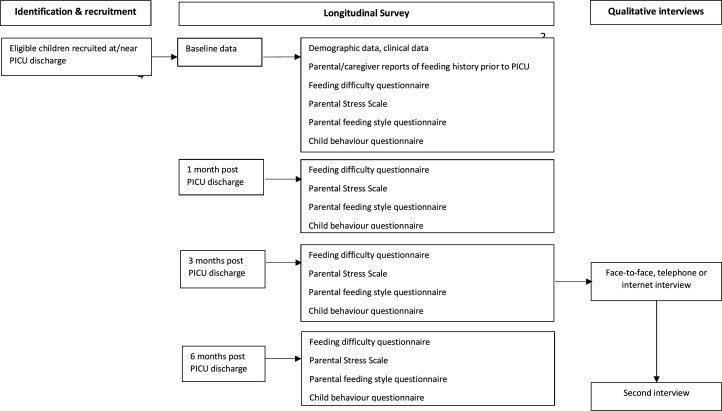
This longitudinal mixed-methods study will explore the impact of feeding difficulties, identifying any clinical risk factors during the first 6 months of PICU discharge in previously healthy young children (≤4 years). Parents/caregivers of children will be asked to complete questionnaires relating to: feeding difficulties, parental/caregiver stress, and child and parental/caregivers' feeding behaviours at the point of PICU discharge, 1, 3 and 6 months post-discharge. Parents/caregivers will be invited to participate in qualitative semistructured interviews at 3 and 6 months post-PICU discharge exploring parental/caregiver experiences of feeding their child after PICU. Statistical analysis of the survey data will consist of descriptive and inferential statistics, plus qualitative analysis of any free text comments using thematic analysis.
This study will provide an insight and increase our understanding of the prevalence of feeding difficulties in previously healthy children admitted to PICU and parental/caregiver experiences. Multiple methods will be used to ensure that the findings are effectively disseminated to service users, clinicians, policy and academic audiences. The study has full ethical approval from the National Health Service Research Ethics Committee (Ref: 20/YH/0160) and full governance clearance.
儿科重症监护病房(PICU)入院与多种身体和环境压力源相关,常涉及许多负面和痛苦的口腔体验。来自患有复杂医疗条件的儿童的证据表明,PICU 住院后存在常见的喂养困难,导致父母明显焦虑。成人重症监护病房(ICU)幸存者研究表明,ICU 出院后 3 个月内仍存在喂养问题。然而,关于 PICU 入院后健康儿童的喂养结果以及入院期间的痛苦口腔体验是否会导致出院后喂养困难,从而对父母/照顾者的焦虑产生负面影响,相关证据非常有限。
这项纵向混合方法研究将探讨喂养困难的影响,确定健康幼儿(≤4 岁)在 PICU 出院后的前 6 个月内的任何临床危险因素。将要求 PICU 出院时的儿童的父母/照顾者完成与喂养困难、父母/照顾者压力以及儿童和父母/照顾者喂养行为相关的问卷,分别在 PICU 出院时、出院后 1、3 和 6 个月时进行。将邀请父母/照顾者在 PICU 出院后 3 和 6 个月时参加半结构式定性访谈,探讨 PICU 出院后父母/照顾者喂养孩子的经历。调查数据的统计分析将包括描述性和推断性统计,以及对任何自由文本评论使用主题分析进行定性分析。
这项研究将提供一个深入了解和增加我们对 PICU 入院的健康儿童的喂养困难的普遍性以及父母/照顾者的经历的理解。将使用多种方法确保研究结果有效地传播给服务用户、临床医生、政策制定者和学术界。该研究已获得国家卫生服务伦理委员会(编号:20/YH/0160)的完全伦理批准和全面治理批准。