German Center for Neurodegenerative Diseases (DZNE), Von-Siebold-Str. 3a, 37075, Göttingen, Germany.
Max Planck Institute for Biophysical Chemistry, Am Faßberg 11, 37077, Göttingen, Germany.
Sci Rep. 2020 Dec 3;10(1):21210. doi: 10.1038/s41598-020-78161-0.
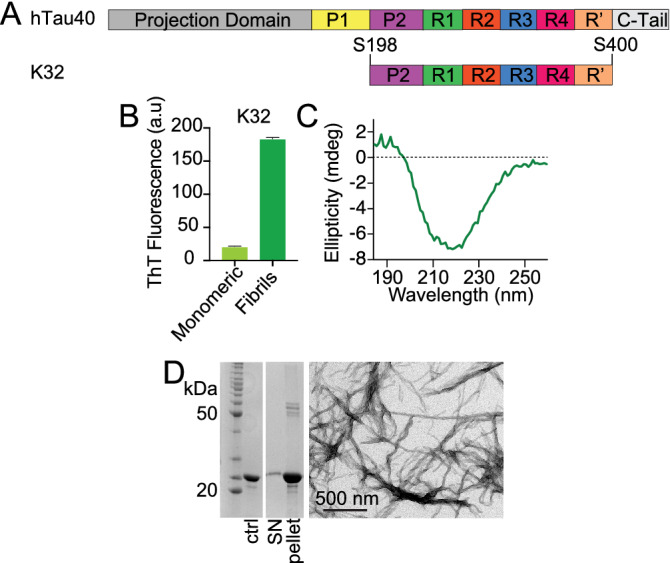
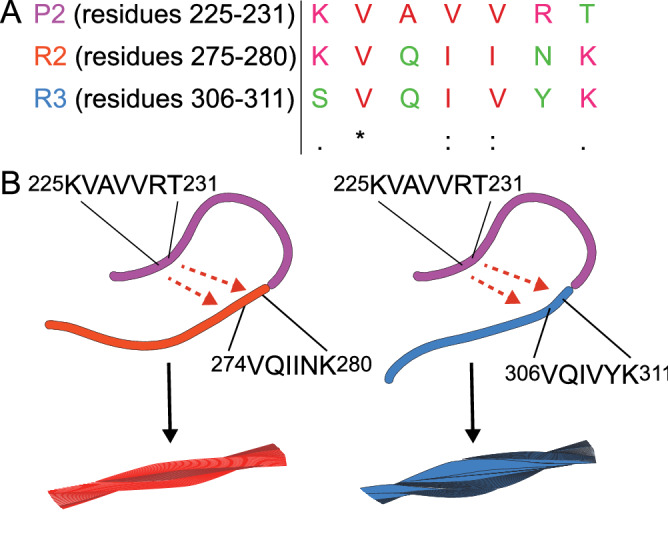
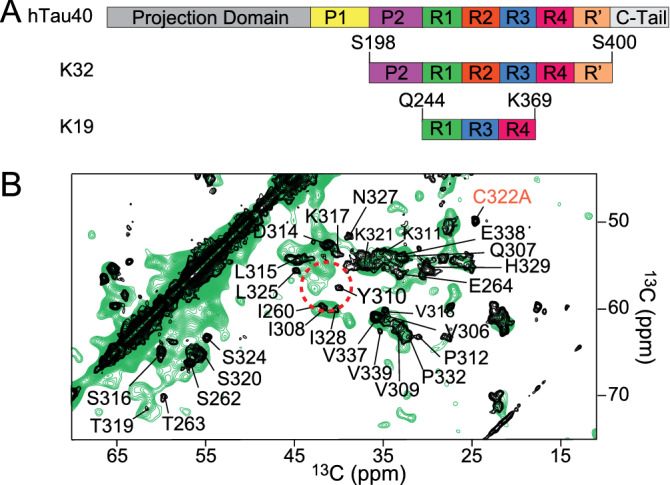
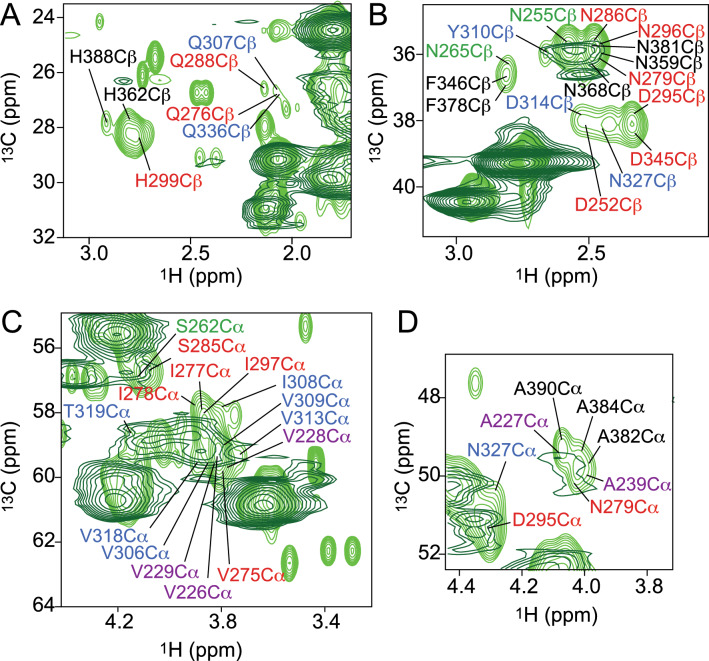
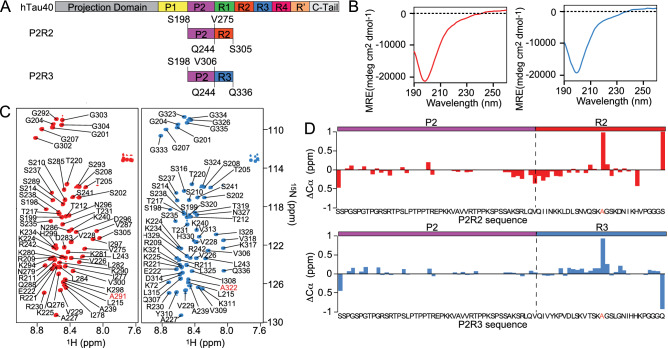
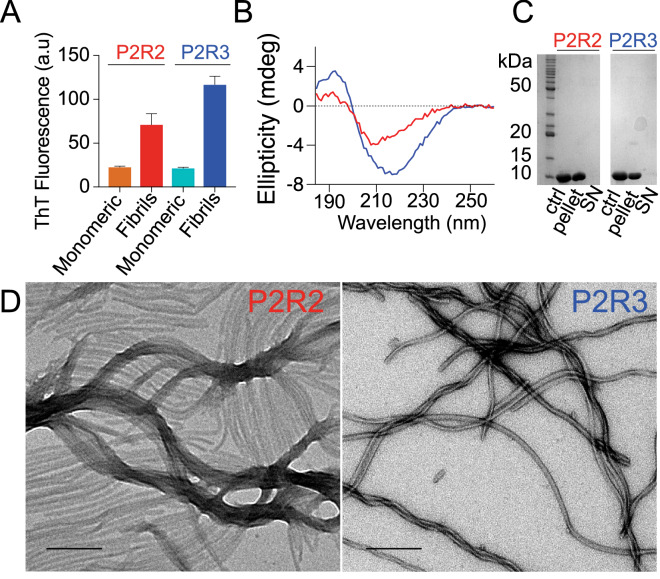
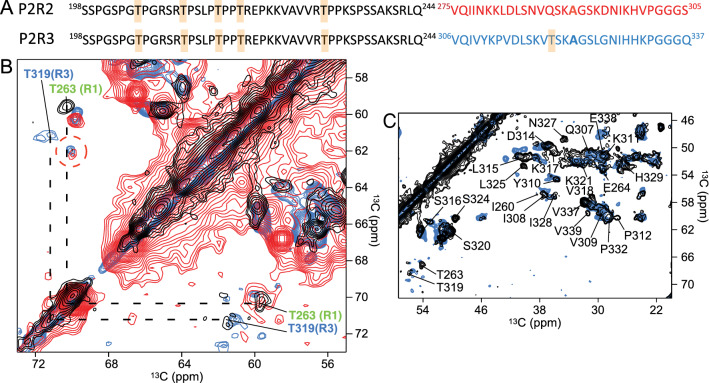
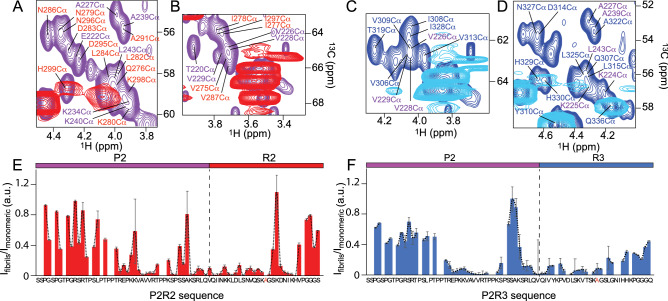
The aggregation of hyperphosphorylated tau into amyloid fibrils is closely linked to the progression of Alzheimer's disease. To gain insight into the link between amyloid structure and disease, the three-dimensional structure of tau fibrils has been studied using solid-state NMR (ssNMR) and cryogenic electron microscopy (cryo-EM). The proline-rich region of tau remains poorly defined in the context of tau amyloid structures, despite the clustering of several phosphorylation sites, which have been associated with Alzheimer's disease. In order to gain insight into the contribution of the proline-rich region P2 of tau to amyloid fibrils, we studied in vitro aggregated amyloid fibrils of tau constructs, which contain both the proline-rich region P2 and the pseudo-repeats. Using ssNMR we show that the sequence [Formula: see text], the most hydrophobic patch within the P2 region, loses its flexibility upon formation of amyloid fibrils. The data suggest a contribution of the P2 region to tau amyloid fibril formation, which might account for some of the unassigned electron density in cryo-EM studies of tau fibrils and could be modulated by tau phosphorylation at the disease-associated AT180 epitope T231/S235.
过度磷酸化的 tau 聚集形成淀粉样纤维与阿尔茨海默病的进展密切相关。为了深入了解淀粉样结构与疾病之间的联系,已经使用固态 NMR(ssNMR)和低温电子显微镜(cryo-EM)研究了 tau 纤维的三维结构。尽管几个与阿尔茨海默病相关的磷酸化位点聚集在一起,但在 tau 淀粉样结构的情况下,tau 的脯氨酸丰富区域仍然定义不明确。为了深入了解 tau 的脯氨酸丰富区 P2 对淀粉样纤维的贡献,我们研究了含有脯氨酸丰富区 P2 和假重复的 tau 构建体体外聚集的淀粉样纤维。使用 ssNMR,我们表明序列 [Formula: see text],即 P2 区域内最疏水的斑块,在形成淀粉样纤维时失去了其柔韧性。数据表明 P2 区域对 tau 淀粉样纤维形成有贡献,这可能解释了 tau 纤维的 cryo-EM 研究中一些未分配的电子密度,并且可能被疾病相关 AT180 表位 T231/S235 处的 tau 磷酸化调节。