Mah Dylan, Zhao Jing, Liu Xinyue, Zhang Fuming, Liu Jian, Wang Lianchun, Linhardt Robert, Wang Chunyu
Department of Biological Sciences, Department of Chemistry and Chemical Biology, Center for Biotechnology and Interdisciplinary Studies, Rensselaer Polytechnic Institute, Troy, NY, United States.
College of Food Science and Nutritional Engineering, China Agricultural University, Beijing, China.
Front Mol Biosci. 2021 May 20;8:671458. doi: 10.3389/fmolb.2021.671458. eCollection 2021.
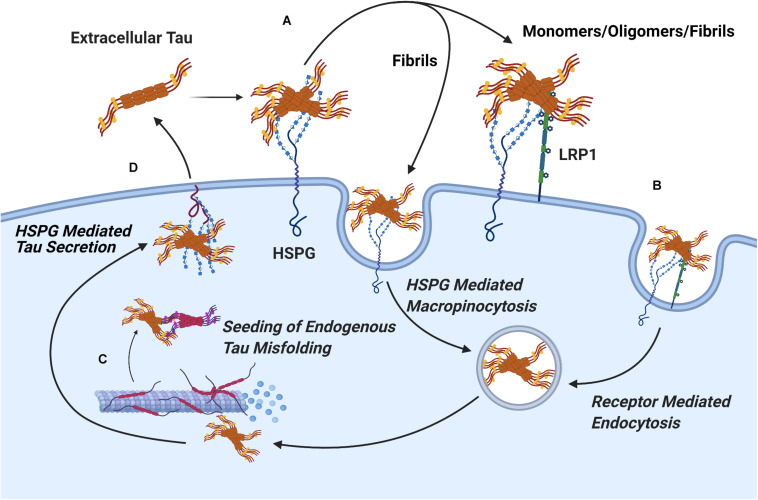
Tauopathies are a heterogenous family of progressive neurodegenerative diseases defined by the appearance of proteinaceous lesions within the brain composed of abnormally folded species of Microtubule Associated Protein Tau (tau). Alzheimer's Disease (AD), the most common tauopathy, is the leading cause of cognitive decline among the elderly and is responsible for more than half of all cases of senile dementia worldwide. The characteristic pathology of many tauopathies-AD included-presents as Neurofibrillary Tangles (NFTs), insoluble inclusions found within the neurons of the central nervous system composed primarily of tau protein arranged into Paired Helical Fibrils (PHFs). The spatial extent of this pathology evolves in a remarkably consistent pattern over the course of disease progression. Among the leading hypotheses which seek to explain the stereotypical progression of tauopathies is the , which proposes that the spread of tau pathology is mediated by the transmission of self-propagating tau conformers between cells in a fashion analogous to the mechanism of communicable prion diseases. Protein-glycan interactions between tau and Heparan Sulfate Proteoglycans (HSPGs) have been implicated as a key facilitator in each stage of the prion-like propagation of tau pathology, from the initial secretion of intracellular tau protein into the extracellular matrix, to the uptake of pathogenic tau seeds by cells, and the self-assembly of tau into higher order aggregates. In this review we outline the biochemical basis of the tau-HS interaction and discuss our current understanding of the mechanisms by which these interactions contribute to the propagation of tau pathology in tauopathies, with a particular focus on AD.
tau蛋白病是一类异质性的进行性神经退行性疾病,其定义为大脑中出现由异常折叠的微管相关蛋白Tau(tau)组成的蛋白质性病变。阿尔茨海默病(AD)是最常见的tau蛋白病,是老年人认知能力下降的主要原因,在全球所有老年痴呆病例中占一半以上。许多tau蛋白病(包括AD)的特征性病理表现为神经原纤维缠结(NFTs),这是在中枢神经系统神经元内发现的不溶性包涵体,主要由排列成双螺旋细丝(PHF)的tau蛋白组成。这种病理的空间范围在疾病进展过程中以一种非常一致的模式演变。在试图解释tau蛋白病刻板进展的主要假说中,有一种假说认为,tau病理的传播是由自我传播的tau构象异构体在细胞间传递介导的,其方式类似于传染性朊病毒疾病的机制。tau蛋白与硫酸乙酰肝素蛋白聚糖(HSPG)之间的蛋白质-聚糖相互作用被认为是tau病理的朊病毒样传播各个阶段的关键促进因素,从细胞内tau蛋白最初分泌到细胞外基质,到细胞摄取致病性tau种子,以及tau蛋白自组装成高阶聚集体。在这篇综述中,我们概述了tau与HS相互作用的生化基础,并讨论了我们目前对这些相互作用促进tau蛋白病中tau病理传播机制的理解,特别关注AD。