Research Center for Environmental Medicine, Kaohsiung Medical University, Kaohsiung, Taiwan.
Ph.D. Program in Environmental and Occupational Medicine, College of Medicine, Kaohsiung Medical University and National Health Research Institutes, Taiwan.
Mediators Inflamm. 2020 Nov 14;2020:8890300. doi: 10.1155/2020/8890300. eCollection 2020.
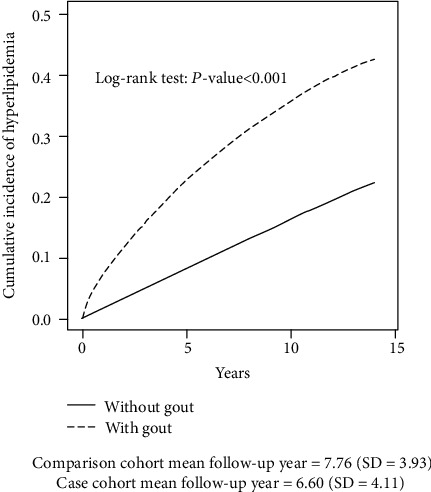
Patients with gout are at a higher risk of cardiovascular disease, which is associated with hyperlipidemia. Management of gout in Taiwan is poor, and the association between urate-lowering therapy (ULT) among gout patients and hyperlipidemia is unclear. We conducted a retrospective cohort study using data from the Longitudinal Health Insurance Database (LHID) of Taiwan on new-onset gout patients and a comparison cohort without gout. A Cox proportional hazards model was used to analyze differences in the risk of hyperlipidemia between patients with and without gout after considering related comorbidities. We also examined the ULT medications on the hepatic expression of lipogenesis-related genes. After adjusting for potential confounders, the case group (44,413 patients) was found to have a higher risk of hyperlipidemia than the control cohort (177,652 patients) [adjusted hazards ratio (aHR) = 2.55]. Gout patients without antigout treatment had significantly higher risk of hyperlipidemia than the control cohort (aHR = 3.10). Among gout patients receiving ULT, except those receiving probenecid (aHR = 0.80), all had significantly lower risk of hyperlipidemia than gout patients without ULT (all aHR < 0.90). Using real-time polymerase chain reaction, we found that most of the antigout drugs decreased the expression of hepatic genes related to lipogenesis in differentiated HepaRG cells. These data indicate that these antigout drugs reduce hyperlipidemia in gout patients, partly via the reduction in expression of lipogenesis-related genes, leading to improved blood lipid profiles. We provide evidence of the strong association between gout and hyperlipidemia and highlight the need for appropriate treatment guidelines.
痛风患者患心血管疾病的风险较高,而心血管疾病与血脂异常有关。台湾地区痛风管理不善,尿酸降低治疗(ULT)与痛风患者血脂异常之间的关联尚不清楚。我们使用来自台湾纵向健康保险数据库(LHID)的新发病例痛风患者和无痛风对照队列的数据进行了回顾性队列研究。考虑到相关合并症后,使用Cox 比例风险模型分析了痛风患者和无痛风患者之间血脂异常风险的差异。我们还检查了 ULT 药物对肝内脂质生成相关基因表达的影响。在调整潜在混杂因素后,发现病例组(44413 例患者)发生血脂异常的风险高于对照组(177652 例患者)[调整后的风险比(aHR)=2.55]。未接受抗痛风治疗的痛风患者发生血脂异常的风险明显高于对照组(aHR=3.10)。在接受 ULT 的痛风患者中,除了丙磺舒(aHR=0.80)外,所有患者发生血脂异常的风险均明显低于未接受 ULT 的痛风患者(所有 aHR<0.90)。使用实时聚合酶链反应,我们发现大多数抗痛风药物降低分化 HepaRG 细胞中与脂质生成相关的肝基因表达。这些数据表明,这些抗痛风药物通过降低与脂质生成相关基因的表达来降低痛风患者的血脂异常,从而改善血脂谱。我们提供了痛风与血脂异常之间存在强关联的证据,并强调需要制定适当的治疗指南。