Department of Medicine, Jawaharlal Institute of Postgraduate Medical Education and Research (JIPMER), Dhanvantri Nagar, Puducherry, 605006, India.
Department of Urology, Jawaharlal Institute of Postgraduate Medical Education and Research (JIPMER), Dhanvantri Nagar, Puducherry, 605006, India.
F1000Res. 2020 Jun 16;9:617. doi: 10.12688/f1000research.24094.3. eCollection 2020.
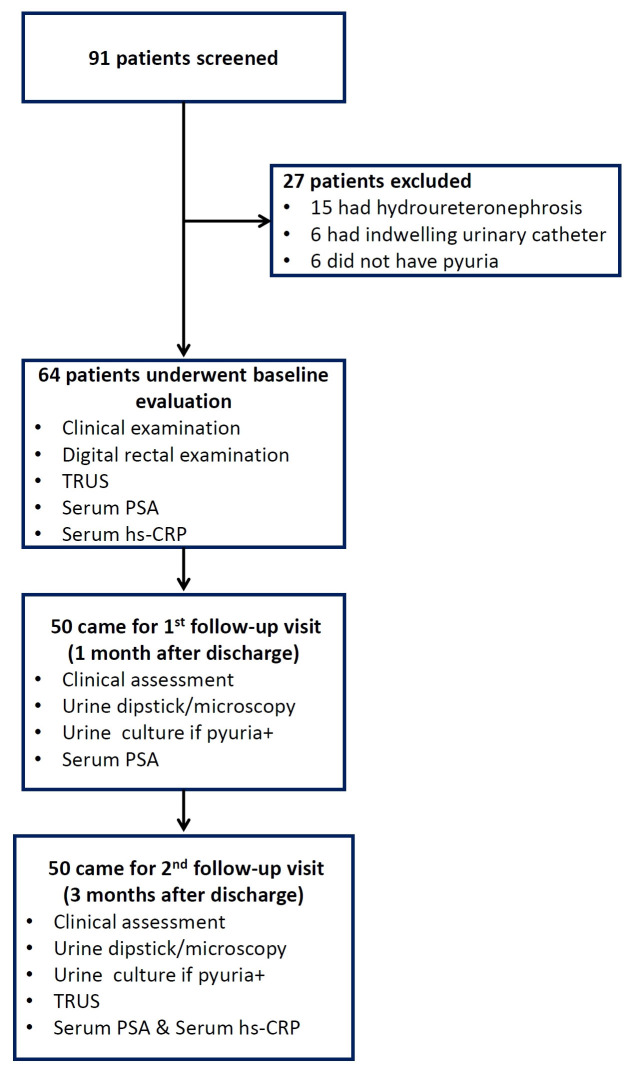
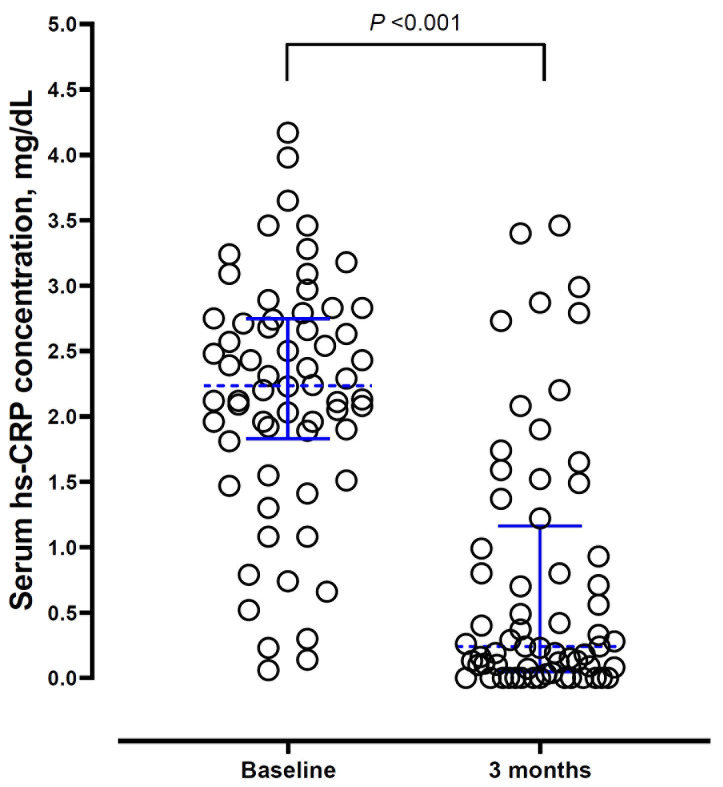
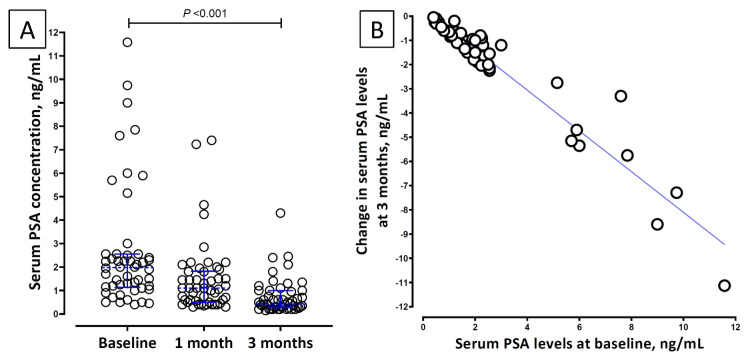
: Frequent asymptomatic involvement of the prostate has been demonstrated in men with febrile urinary tract infection (fUTI). In view of this, men with fUTI are often given a longer duration of antibiotic treatment; however, evidence to support this is limited. : We prospectively studied adult men with fUTI admitted under the Department of Medicine in a tertiary care hospital in southern India. fUTI was defined as fever of ≥38°C with at least one symptom/sign of UTI and pyuria, requiring hospitalization. We estimated serum total prostate-specific antigen (PSA) levels at enrollment, one month and three months after treatment completion. We assessed prostatic volume by transrectal ultrasonography (TRUS) and estimated the serum high sensitivity C-reactive protein (hs-CRP) levels at baseline and after three months. : We enrolled 64 men (median [IQR] age 53 [45-60] years); 50 patients completed follow-up. At baseline, 24 (38%) of 64 patients had elevated serum PSA values compared to age-specific upper limit. The median (IQR) serum PSA level was 2.15 (1.18-3.02) ng/mL and median (IQR) serum hs-CRP level was 2.23 (1.85-2.74) mg/dL (N=64). At three months, serum PSA levels decreased by ≥25% in 47 (94%) of 50 patients. The median (IQR) of prostatic volume was 25.4 (18.9-34) mL at baseline (N=64), and ≥10% decrease in prostatic volume was observed in 24 (48%) of 50 patients at three months. The change in the serum PSA levels did not correlate with clinical findings like prostatic tenderness or with prostatic volume changes. Further, serum PSA levels did not correlate with hs-CRP levels. On follow-up, seven patients had lower urinary tract symptoms; only one of them had recurrent fUTI. : Asymptomatic prostatic involvement, although common in men with fUTI, does not seem to influence the treatment outcomes.
:发热性尿路感染(fUTI)患者的前列腺常出现无症状受累。鉴于此,fUTI 患者常接受更长时间的抗生素治疗;然而,支持这一治疗的证据有限。:我们前瞻性研究了在印度南部一家三级护理医院内科住院的 fUTI 成年男性。fUTI 定义为发热≥38°C,至少有一个 UTI 症状/体征和脓尿,需要住院治疗。我们在入组时、治疗完成后 1 个月和 3 个月时估计血清总前列腺特异性抗原(PSA)水平。我们通过经直肠超声(TRUS)评估前列腺体积,并在基线和 3 个月后估计血清高敏 C 反应蛋白(hs-CRP)水平。:我们纳入了 64 名男性(中位数[IQR]年龄 53[45-60]岁);50 名患者完成了随访。基线时,64 名患者中有 24 名(38%)血清 PSA 值高于年龄特异性上限。血清 PSA 水平中位数(IQR)为 2.15(1.18-3.02)ng/mL,血清 hs-CRP 水平中位数(IQR)为 2.23(1.85-2.74)mg/dL(N=64)。3 个月时,50 名患者中有 47 名(94%)血清 PSA 水平下降≥25%。基线时前列腺体积中位数(IQR)为 25.4(18.9-34)mL(N=64),50 名患者中有 24 名(48%)在 3 个月时前列腺体积减少≥10%。血清 PSA 水平的变化与前列腺触诊等临床发现或前列腺体积变化无关。此外,血清 PSA 水平与 hs-CRP 水平无关。随访时,7 名患者出现下尿路症状;其中仅 1 名患者出现复发性 fUTI。:虽然 fUTI 患者中前列腺常无症状受累,但似乎不会影响治疗结果。