Lamrous Amin, Repetto Ernestina, Depp Tim, Jimenez Carolina, Chua Arlene C, Kanapathipillai Rupa, Jensen Tomas O
Médecins Sans Frontières, Operational Center Barcelona, Barcelona, Spain.
Médecins Sans Frontières, Operational Center Geneva, Geneva, Switzerland.
JAC Antimicrob Resist. 2023 May 17;5(3):dlad057. doi: 10.1093/jacamr/dlad057. eCollection 2023 Jun.
C-reactive protein (CRP) and procalcitonin (PCT) are widely used biomarkers in high-income countries. However, evidence for their use in low- and middle-income countries (LMICs) is scant. Because many factors, including rates of endemic disease, comorbidities and genetics, may influence biomarkers' behaviour, we aimed to review available evidence generated in LMICs.
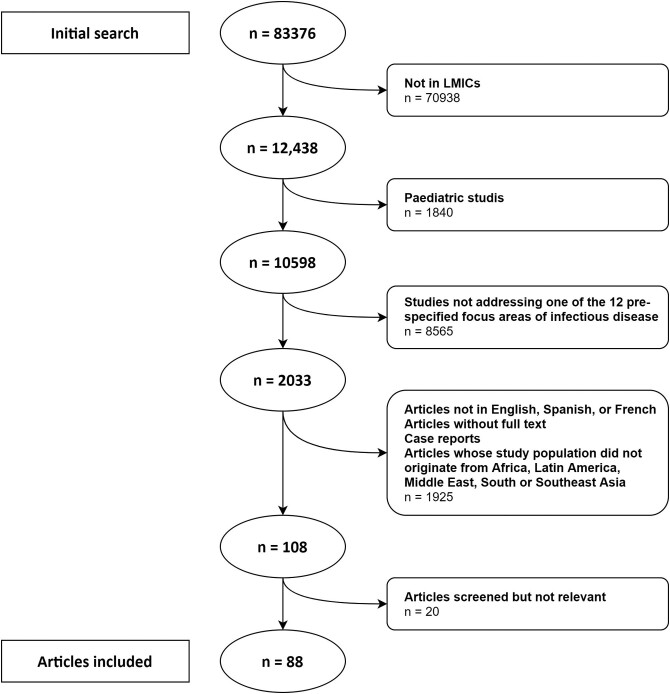
We searched the PubMed database for relevant studies within the last 20 years that originated in regions of interest (Africa, Latin America, Middle East, South Asia or South East Asia), and full-text articles involving diagnosis, prognostication and evaluation of therapeutic response with CRP and/or PCT in adults ( = 88) were reviewed and categorized in 12 predefined focus areas.
Overall, results were highly heterogeneous, at times conflicting, and often lacking clinically useful cut-off values. However, most studies demonstrated higher levels of CRP/PCT in patients with bacterial versus other infections. HIV and TB patients had consistently higher levels of CRP/PCT versus controls. In addition, higher CRP/PCT levels at baseline and follow-up in HIV, TB, sepsis and respiratory tract infections were associated with poorer prognosis.
Evidence generated from LMIC cohorts suggests that CRP and PCT may have potential to become effective clinical guiding tools particularly in respiratory tract infections, sepsis and HIV/TB. However, more studies are needed to define potential scenarios for use and cost-effectiveness. Consensus across stakeholders regarding target conditions, laboratory standards and cut-off values would support the quality and applicability of future evidence.
C反应蛋白(CRP)和降钙素原(PCT)在高收入国家是广泛使用的生物标志物。然而,它们在低收入和中等收入国家(LMICs)使用的证据却很少。由于包括地方病发病率、合并症和遗传学等许多因素可能影响生物标志物的表现,我们旨在综述LMICs中产生的现有证据。
我们在PubMed数据库中搜索过去20年内源自感兴趣区域(非洲、拉丁美洲、中东、南亚或东南亚)的相关研究,并对涉及成人CRP和/或PCT诊断、预后及治疗反应评估的全文文章(n = 88)进行综述,并归类到12个预定义的重点领域。
总体而言,结果高度异质,有时相互矛盾,且常常缺乏临床有用的临界值。然而,大多数研究表明,细菌感染患者的CRP/PCT水平高于其他感染患者。与对照组相比,HIV和结核病患者的CRP/PCT水平一直较高。此外,HIV、结核病、脓毒症和呼吸道感染患者基线和随访时较高的CRP/PCT水平与较差的预后相关。
来自LMIC队列的证据表明,CRP和PCT可能有潜力成为有效的临床指导工具,特别是在呼吸道感染、脓毒症和HIV/结核病方面。然而,需要更多研究来确定潜在的使用场景和成本效益。利益相关者就目标疾病、实验室标准和临界值达成共识,将有助于提高未来证据的质量和适用性。