Goyal Nishant, Swain Srikant Kumar, Gupta Kanav, Chaturvedi Jitender, Arora Rajnish Kumar, Sharma Suresh K
Department of Neurosurgery, All India Institute of Medical Sciences, Rishikesh, Uttarakhand, India.
College of Nursing, All India Institute of Medical Sciences, Rishikesh, Uttarakhand, India.
Surg Neurol Int. 2020 Nov 18;11:395. doi: 10.25259/SNI_675_2020. eCollection 2020.
As citizens have been forced to stay home during coronavirus disease of 2019 (COVID-19) pandemic, the crisis created unique trends in the neurotrauma patterns with changes in mode, severity, and outcome of head injured patients.
Details of neurotrauma admissions under the neurosurgery department at our institute since the onset of COVID-19 pandemic in the country were collected retrospectively and compared to the same period last year in terms of demographic profile, mode of injury, GCS at admission, severity of head injury, radiological diagnosis, management (surgical/conservative), and outcome. The patients were studied according to which phase of pandemic they were admitted in - "lockdown" period (March 25 to May 31, 2020) or "unlock" period (June 1 to September 15, 2020).
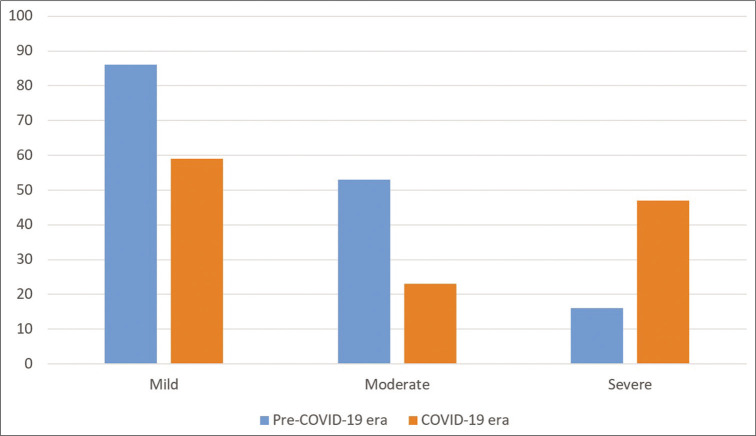
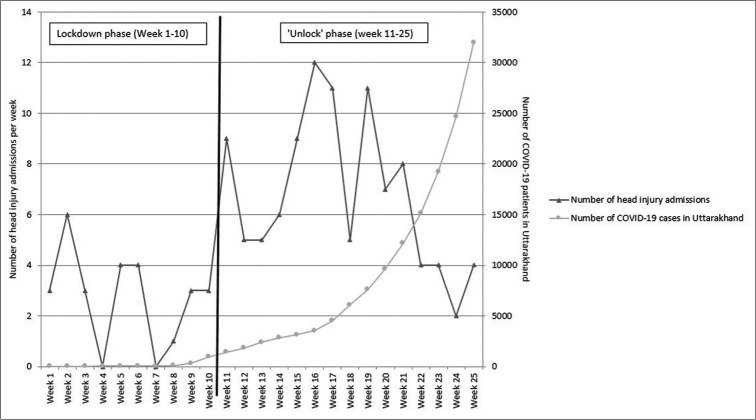
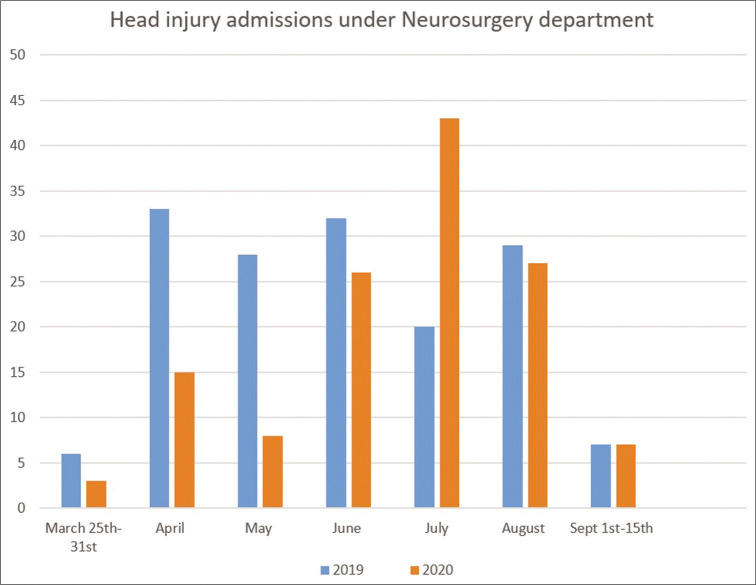
The number of head injuries decreased by 16.8% during the COVID-19 pandemic. Furthermore, during the lockdown period, the number of admissions was 2.7/week while it was 6.8/week during the "unlock" period. RTA was the mode of injury in 29.6% patients during the lockdown, while during the unlock period, it was 56.9% ( = 0.000). Mild and moderate head injuries decreased by 41% and severe head injuries increased by 156.25% during the COVID-19 pandemic ( = 0.000). The mortality among neurotrauma patients increased from 12.4% to 22.5% during the COVID-19 era ( = 0.009).
We observed a decline in the number of head injury admissions during the pandemic, especially during the lockdown. At the same time, there was increase in the severity of head injuries and associated injuries, resulting in significantly higher mortality in our patients during the ongoing COVID-19 pandemic.
在2019冠状病毒病(COVID-19)大流行期间,由于民众被迫居家,这场危机在神经创伤模式方面产生了独特趋势,头部受伤患者的受伤方式、严重程度及预后都发生了变化。
回顾性收集我国自COVID-19大流行开始以来我院神经外科收治的神经创伤患者的详细信息,并在人口统计学特征、受伤方式、入院时的格拉斯哥昏迷评分(GCS)、头部损伤严重程度、放射学诊断、治疗方式(手术/保守治疗)及预后等方面与去年同期进行比较。根据患者入院时处于大流行的哪个阶段进行研究——“封锁”期(2020年3月25日至5月31日)或“解封”期(2020年6月1日至9月15日)。
COVID-19大流行期间头部受伤患者数量减少了16.8%。此外,在封锁期,每周入院人数为2.7人,而在“解封”期为每周6.8人。在封锁期,29.6%的患者受伤方式为道路交通伤(RTA),而在解封期,这一比例为56.9%(P = 0.000)。COVID-19大流行期间,轻度和中度头部损伤分别减少了41%,重度头部损伤增加了156.25%(P = 0.000)。COVID-19时期,神经创伤患者的死亡率从12.4%升至22.5%(P = 0.009)。
我们观察到在大流行期间,尤其是封锁期间,头部受伤入院患者数量有所下降。与此同时,头部损伤及相关损伤的严重程度有所增加,导致在当前COVID-19大流行期间我们的患者死亡率显著升高。