Department of Public Health and Nursing, NTNU, Norwegian University of Science and Technology, Trondheim, Norway.
Children's Clinic, St. Olavs Hospital, Trondheim University Hospital, Trondheim, Norway.
Hum Mol Genet. 2021 Feb 25;29(24):3966-3973. doi: 10.1093/hmg/ddaa256.
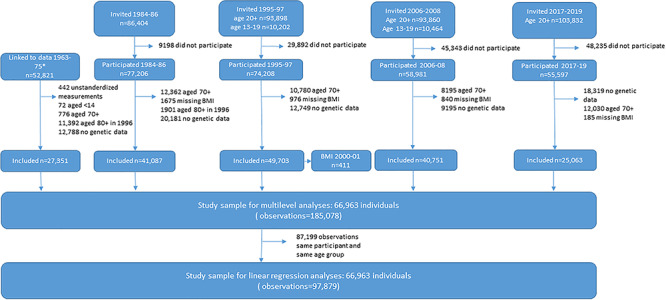
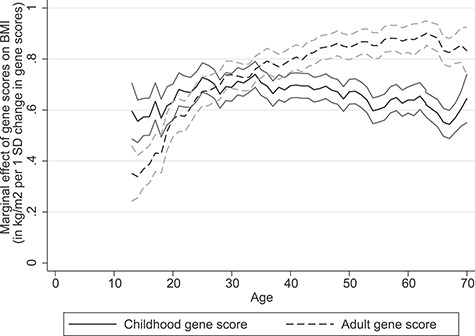
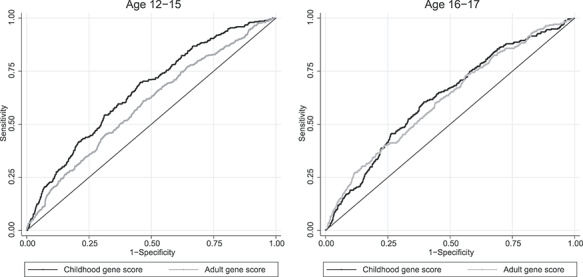
From a life-course perspective, genetic and environmental factors driving childhood obesity may have a lasting influence on health later in life. However, how obesity trajectories vary throughout the life-course remains unknown. Recently, Richardson et al. created powerful early life and adult gene scores for body mass index (BMI) in a comprehensive attempt to separate childhood and adult obesity. The childhood score was derived using questionnaire-based data administered to adults aged 40-69 regarding their relative body size at age 10, making it prone to recall and misclassification bias. We therefore attempted to validate the childhood and adult scores using measured BMI data in adolescence and adulthood among 66 963 individuals from the HUNT Study in Norway from 1963 to 2019. The predictive performance of the childhood score was better in adolescence and early adulthood, whereas the predictive performance of the adult score was better in adulthood. In the age group 12-15.9 years, the variance explained by the childhood polygenic risk score (PRS) was 6.7% versus 2.4% for the adult PRS. In the age group 24-29.9 years, the variance explained by the adult PRS was 3.9% versus 3.6% for the childhood PRS. Our findings support that genetic factors driving BMI differ at young age and in adulthood. Within the framework of multivariable Mendelian randomization, the validated childhood gene score can now be used to determine the consequence of childhood obesity on later disease.
从生命历程的角度来看,导致儿童肥胖的遗传和环境因素可能对以后的健康产生持久的影响。然而,肥胖轨迹在整个生命历程中是如何变化的仍不清楚。最近,Richardson 等人在一项全面的研究中,为体重指数 (BMI) 创建了强大的早期生活和成年基因评分,以试图将儿童肥胖和成年肥胖分开。该儿童评分是使用基于问卷调查的方法,对 40-69 岁的成年人进行调查,询问他们在 10 岁时的相对身体大小,因此容易受到回忆和分类偏倚的影响。因此,我们试图使用挪威 HUNT 研究在青少年和成年期收集的 66963 个人的 BMI 数据来验证儿童和成年评分。在青少年和成年早期,儿童评分的预测性能更好,而在成年期,成人评分的预测性能更好。在 12-15.9 岁年龄组中,儿童多基因风险评分 (PRS) 解释的方差为 6.7%,而成年 PRS 解释的方差为 2.4%。在 24-29.9 岁年龄组中,成年 PRS 解释的方差为 3.9%,而儿童 PRS 解释的方差为 3.6%。我们的研究结果支持这样的观点,即驱动 BMI 的遗传因素在年轻时和成年时是不同的。在多变量孟德尔随机化的框架内,经过验证的儿童基因评分现在可以用于确定儿童肥胖对以后疾病的影响。