Andreu-Moreno Iván, Bou Juan-Vicente, Sanjuán Rafael
Institute for Integrative Systems Biology (I2SysBio), Consejo Superior de Investigaciones Científicas-Universitat de València, C/ Catedrático Agustín Escardino 9, 46980 Paterna, València, Spain.
Sci Adv. 2020 Dec 4;6(49). doi: 10.1126/sciadv.abd4942. Print 2020 Dec.
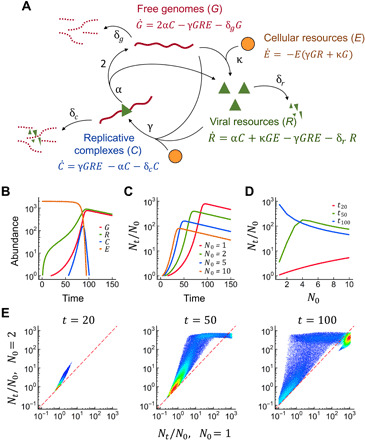
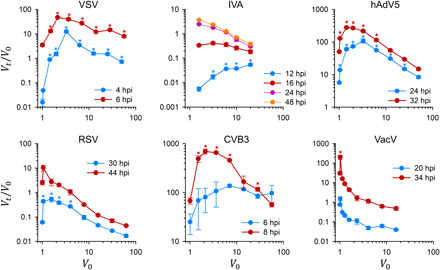
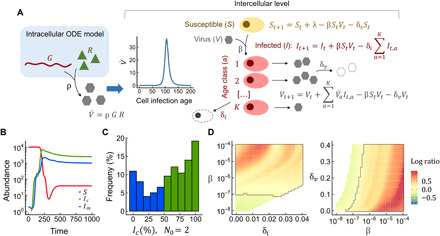
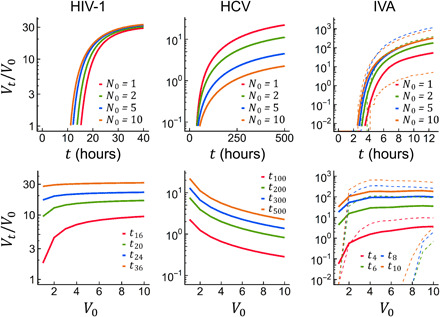
The ability of viruses to infect their hosts depends on rapid dissemination following transmission. The notion that viral particles function as independent propagules has been challenged by recent observations suggesting that viral aggregates show enhanced infectivity and faster spread. However, these observations remain poorly understood. Here, we show that viral replication is a cooperative process, such that entry of multiple viral genome copies into the same cell disproportionately increases short-term viral progeny production. This cooperativity arises from the positive feedback established between replication templates and virus-encoded products involved in replication and should be a general feature of viruses. We develop a simple model that captures this effect, verify that cooperativity also emerges in more complex models for specific human viruses, validate our predictions experimentally using different mammalian viruses, and discuss the implications of cooperative replication for viral fitness.
病毒感染宿主的能力取决于传播后的快速扩散。病毒颗粒作为独立传播单元发挥作用的观点受到了近期观察结果的挑战,这些观察结果表明病毒聚集体具有增强的感染性和更快的传播速度。然而,这些观察结果仍未得到充分理解。在这里,我们表明病毒复制是一个协同过程,即多个病毒基因组拷贝进入同一细胞会不成比例地增加短期病毒子代的产生。这种协同性源于复制模板与参与复制的病毒编码产物之间建立的正反馈,并且应该是病毒的一个普遍特征。我们开发了一个简单的模型来捕捉这种效应,验证了协同性在针对特定人类病毒的更复杂模型中也会出现,使用不同的哺乳动物病毒通过实验验证了我们的预测,并讨论了协同复制对病毒适应性的影响。