MAP Centre for Urban Health Solutions, Li Ka Shing Knowledge Institute, St Michael's Hospital, Unity Health Toronto, Toronto, Ontario, Canada
MAP Centre for Urban Health Solutions, Li Ka Shing Knowledge Institute, St Michael's Hospital, Unity Health Toronto, Toronto, Ontario, Canada.
BMJ Open. 2020 Dec 4;10(12):e038443. doi: 10.1136/bmjopen-2020-038443.
People experiencing homelessness have a high prevalence and incidence of traumatic brain injury (TBI) due to violence. Little is known about the effectiveness of interventions to reduce TBI in this population. This study assessed the effect of Housing First (HF) on violence-related TBI in adults with experiences of homelessness and mental illness.
Pragmatic randomised trial.
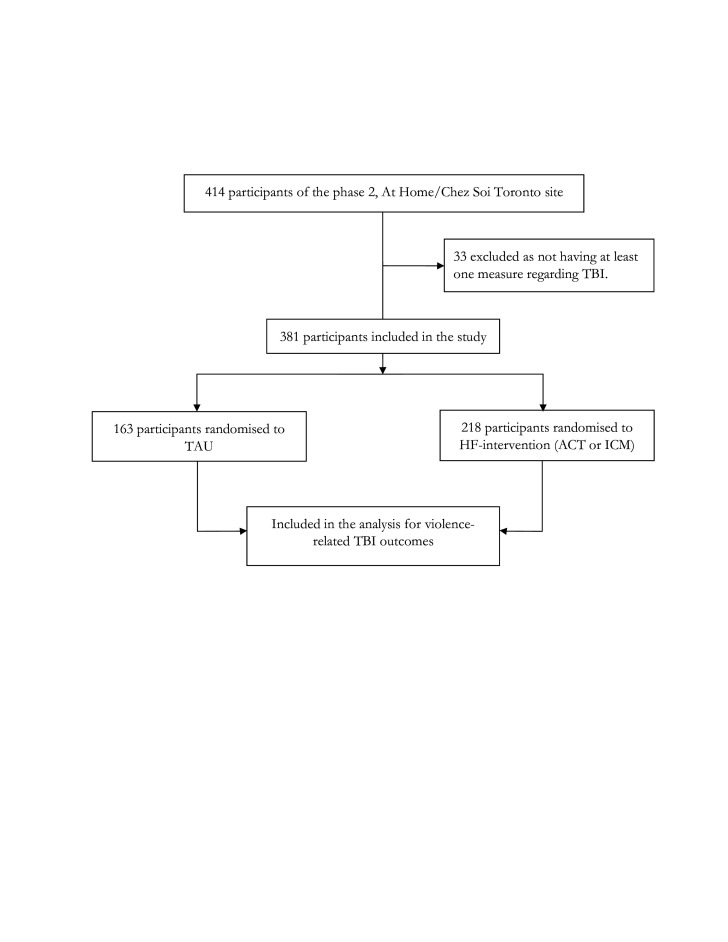
381 participants in the Toronto site of the At Home/Chez randomised trial.
HF participants were provided with scattered-site housing using rent supplements and supports from assertive community treatment or intensive case management teams (n=218, 57.2%). Control participants had access to treatment as usual (TAU) in the community (n=163, 42.8%).
Primary outcomes were an incident physical violence-related TBI event and the number of physical violence-related TBI events during the follow-up period (January 2014 to March 2017). Interval-censored survival time regression and zero-inflated negative binomial regression were used to assess the effect of HF on primary outcomes.
Among study participants, 9.2% (n=35) had an incident physical violence-related TBI event, and the mean physical violence-related TBI events was 0.16 (SD ±0.6). Compared with TAU participants, HF participants did not have a significantly lower risk of an incident violence-related TBI event (adjusted HR : 0.58 (95% CI, 0.29 to 1.14)), but they had a significantly lower number of physical violence-related TBI events (unadjusted incidence rate ratio (IRR): 0.22 (95% CI, 0.06 to 0.78); adjusted IRR: 0.15 (95% CI, 0.05 to 0.48)).
HF may be a useful intervention to reduce the burden of TBI due to physical violence among homeless individuals with mental illness.
ISRCTN42520374.
由于暴力,无家可归者群体中创伤性脑损伤(TBI)的患病率和发生率都很高。对于减少这一人群中 TBI 的干预措施的效果知之甚少。本研究评估了优先安置(HF)对有精神病史的无家可归成年人与暴力相关的 TBI 的影响。
实用随机试验。
多伦多地点的 At Home/Chez 随机试验中的 381 名参与者。
为 HF 参与者提供了分散式住房,使用租金补贴和从积极社区治疗或强化病例管理团队获得支持(n=218,57.2%)。对照组参与者可以在社区获得常规治疗(TAU)(n=163,42.8%)。
主要结果是发生的与身体暴力相关的 TBI 事件和随访期间(2014 年 1 月至 2017 年 3 月)发生的与身体暴力相关的 TBI 事件的数量。间隔censored 生存时间回归和零膨胀负二项式回归用于评估 HF 对主要结果的影响。
在研究参与者中,9.2%(n=35)发生了与身体暴力相关的 TBI 事件,与身体暴力相关的 TBI 事件的平均数量为 0.16(SD±0.6)。与 TAU 参与者相比,HF 参与者发生与暴力相关的 TBI 事件的风险没有显著降低(调整后的 HR:0.58(95%CI,0.29 至 1.14)),但他们发生与身体暴力相关的 TBI 事件的数量显著减少(未调整的发病率比(IRR):0.22(95%CI,0.06 至 0.78);调整后的 IRR:0.15(95%CI,0.05 至 0.48))。
HF 可能是一种有用的干预措施,可以减少有精神病史的无家可归者中因身体暴力导致的 TBI 负担。
ISRCTN42520374。