Department of Neurology and Stroke Center, Hospital La Paz Institute for Health Research-IdiPAZ. La Paz University Hospital. Universidad Autónoma de Madrid, Madrid, Spain
Department of Neurology, Complexo Hospitalario Universitario A Coruña. Biomedical Research Institute of A Coruña, A Coruña, Spain.
Stroke Vasc Neurol. 2021 Jun;6(2):267-273. doi: 10.1136/svn-2020-000678. Epub 2020 Dec 4.
Spain has been heavily affected by COVID-19. Reallocation of resources for managing the outbreak might have caused a disruption in stroke care. This study analyses the impact on stroke care of reorganising the healthcare system in response to the first COVID-19 outbreak peak in Spain and the strategies adopted by Spanish stroke units to deal with this impact.
We obtained data from a structured survey sent to the responsible of stroke units across the country. We recorded the number of strokes, stroke code activations, intravenous thrombolysis treatments and mechanical thrombectomies during February and March 2019 and 2020. We also collected information on the impact on workflow metrics and on the availability of specialised neurological care and rehabilitation treatments, the characteristics of stroke care for patients with SARS-CoV-2 infection and the impact on human resources. We compared the activity data between 2019 and 2020 and the information on activity and impact on stroke care between regions classified according to the disease incidence rate.
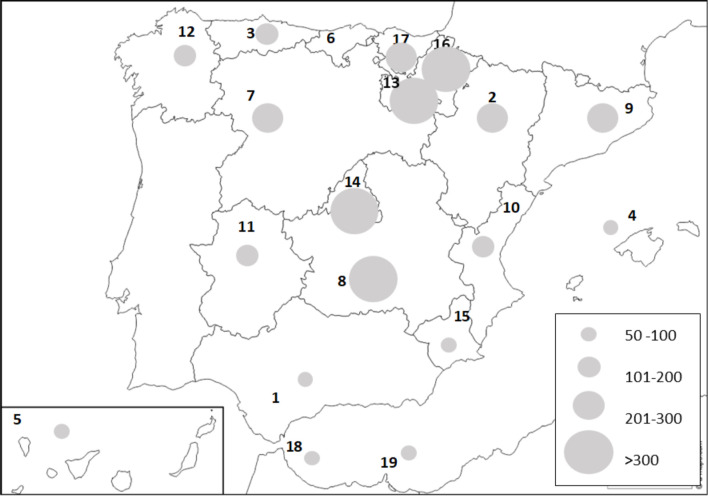
Fifty-seven (75%) of all stroke units in Spain responded to the survey. There was an overall reduction in admissions for all stroke types during the outbreak's peak and in the number of stroke code activations and intravenous thrombolysis treatments, results that were independent of the COVID-19 incidence rate. Participants reported a delay in workflow metrics and a reduction of admissions to stroke units, outpatient clinics and rehabilitation therapies. Specific pathways and protocols for managing stroke patients with SARS-CoV-2 infection have been established.
The COVID-19 outbreak has jeopardised all phases of stroke care. As a consequence, some patients with stroke did not receive adequate treatment.
西班牙深受 COVID-19 疫情的影响。为应对疫情而重新配置资源可能导致脑卒中治疗中断。本研究分析了西班牙为应对第一次 COVID-19 疫情高峰而重新调整医疗体系对脑卒中治疗的影响,以及西班牙脑卒中治疗单位采取的应对策略。
我们从全国脑卒中治疗单位负责人处获得了一份结构化调查问卷的数据。我们记录了 2019 年 2 月和 2020 年 2 月和 3 月期间的脑卒中发病数、脑卒中代码激活数、静脉溶栓治疗数和机械取栓术数。我们还收集了有关工作流程指标、专业神经科护理和康复治疗的可及性、COVID-19 感染患者的脑卒中治疗特点以及对人力资源影响的信息。我们比较了 2019 年和 2020 年的活动数据,以及根据疾病发病率对各地区脑卒中治疗活动和影响的信息。
西班牙所有脑卒中治疗单位中有 57 家(75%)对调查做出了回应。在疫情高峰期,所有类型脑卒中的住院人数以及脑卒中代码激活数和静脉溶栓治疗数均有所减少,这一结果与 COVID-19 发病率无关。参与者报告工作流程指标延迟,脑卒中治疗单位、门诊和康复治疗的住院人数减少。已制定了管理 COVID-19 感染脑卒中患者的特定途径和方案。
COVID-19 疫情危及脑卒中治疗的各个阶段,导致部分脑卒中患者未得到充分治疗。