
2019冠状病毒病大流行对卒中护理组织的影响。马德里卒中护理计划。
Impact of the COVID-19 pandemic on the organisation of stroke care. Madrid Stroke Care Plan.
作者信息
Fuentes B, Alonso de Leciñana M, Calleja-Castaño P, Carneado-Ruiz J, Egido-Herrero J, Gil-Núñez A, Masjuán-Vallejo J, Vivancos-Mora J, Rodríguez-Pardo J, Riera-López N, Ximénez-Carrillo Á, Cruz-Culebras A, Gómez-Escalonilla C, Díez-Tejedor E
机构信息
Servicio de Neurología y Centro de Ictus, Hospital Universitario La Paz, Universidad Autónoma de Madrid, Instituto de Investigación IdiPAZ, Madrid, España.
Servicio de Neurología y Centro de Ictus, Hospital Universitario La Paz, Universidad Autónoma de Madrid, Instituto de Investigación IdiPAZ, Madrid, España.
出版信息
Neurologia (Engl Ed). 2020 Jul-Aug;35(6):363-371. doi: 10.1016/j.nrl.2020.05.007. Epub 2020 May 21.
INTRODUCTION
The overload of the healthcare system and the organisational changes made in response to the COVID-19 pandemic may be having an impact on acute stroke care in the Region of Madrid.
METHODS
We conducted a survey with sections addressing hospital characteristics, changes in infrastructure and resources, code stroke clinical pathways, diagnostic testing, rehabilitation, and outpatient care. We performed a descriptive analysis of results according to the level of complexity of stroke care (availability of stroke units and mechanical thrombectomy).
RESULTS
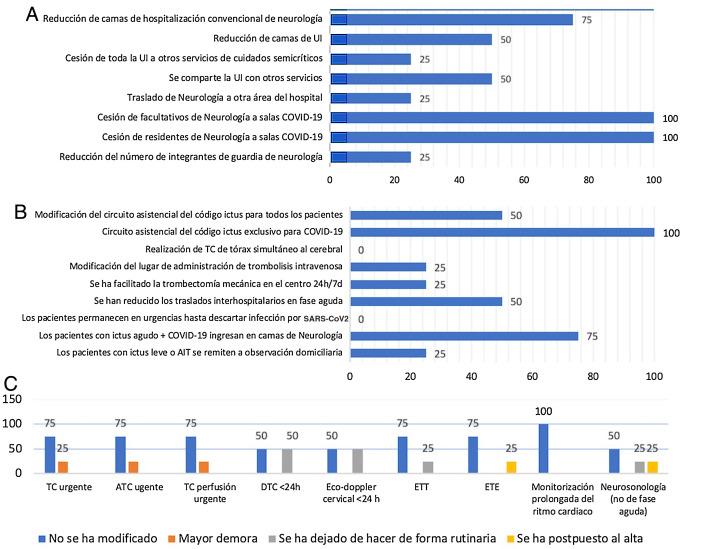
The survey was completed by 22 of the 26 hospitals in the Madrid Regional Health System that attend adult emergencies, between 16 and 27 April 2020. Ninety-five percent of hospitals had reallocated neurologists to care for patients with COVID-19. The numbers of neurology ward beds were reduced in 89.4% of hospitals; emergency department stroke care pathways were modified in 81%, with specific pathways for suspected SARS-CoV2 infection established in 50% of hospitals; and SARS-CoV2-positive patients with acute stroke were not admitted to neurology wards in 42%. Twenty-four hour on-site availability of mechanical thrombectomy was improved in 10 hospitals, which resulted in a reduction in the number of secondary hospital transfers. The admission of patients with transient ischaemic attack or minor stroke was avoided in 45% of hospitals, and follow-up through telephone consultations was implemented in 100%.
CONCLUSIONS
The organisational changes made in response to the SARS-Co2 pandemic in hospitals in the Region of Madrid have modified the allocation of neurology department staff and infrastructure, stroke units and stroke care pathways, diagnostic testing, hospital admissions, and outpatient follow-up.
引言
医疗系统的超负荷运转以及为应对新冠疫情而进行的组织变革,可能正在对马德里地区的急性中风护理产生影响。
方法
我们开展了一项调查,内容涉及医院特征、基础设施和资源的变化、中风急救临床路径、诊断检测、康复以及门诊护理。我们根据中风护理的复杂程度(中风单元和机械取栓术的可及性)对结果进行了描述性分析。
结果
2020年4月16日至27日期间,马德里地区卫生系统中接待成人急诊的26家医院中的22家完成了该调查。95%的医院重新调配了神经科医生去护理新冠患者。89.4%的医院减少了神经科病房床位;81%的医院修改了急诊科中风护理路径,50%的医院制定了针对疑似SARS-CoV2感染的特定路径;42%的医院不将急性中风的SARS-CoV2阳性患者收治到神经科病房。10家医院改善了机械取栓术的24小时现场可及性,这使得二级医院转诊数量减少。45%的医院避免收治短暂性脑缺血发作或轻度中风患者,100%的医院实施了电话咨询随访。
结论
马德里地区医院为应对SARS-CoV2疫情而进行的组织变革,改变了神经科人员和基础设施的配置、中风单元和中风护理路径、诊断检测、住院收治以及门诊随访。


 Zotero 插件