Physik Department, Technische Universität München, Garching, Germany.
MRC Laboratory of Molecular Biology, Cambridge, UK.
Nat Commun. 2020 Dec 4;11(1):6229. doi: 10.1038/s41467-020-20020-7.
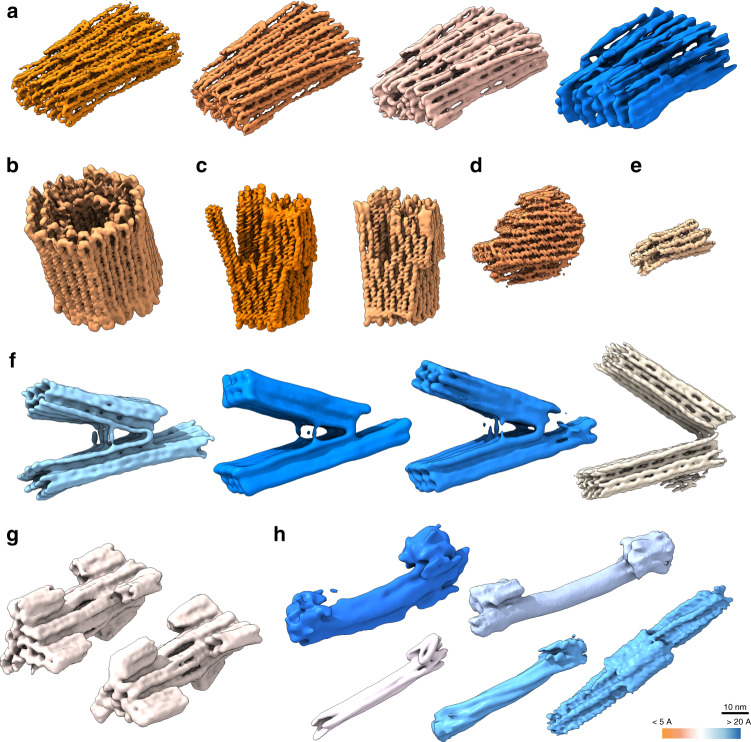
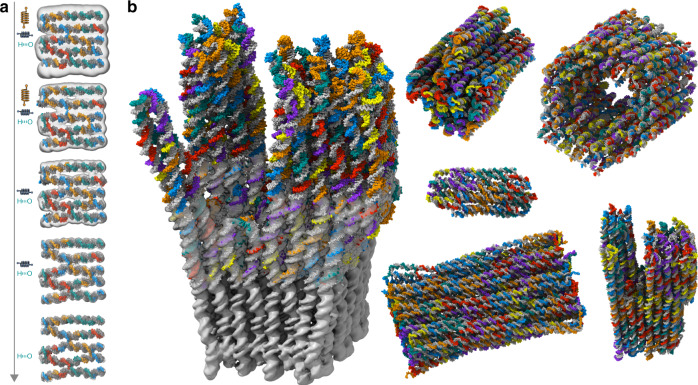
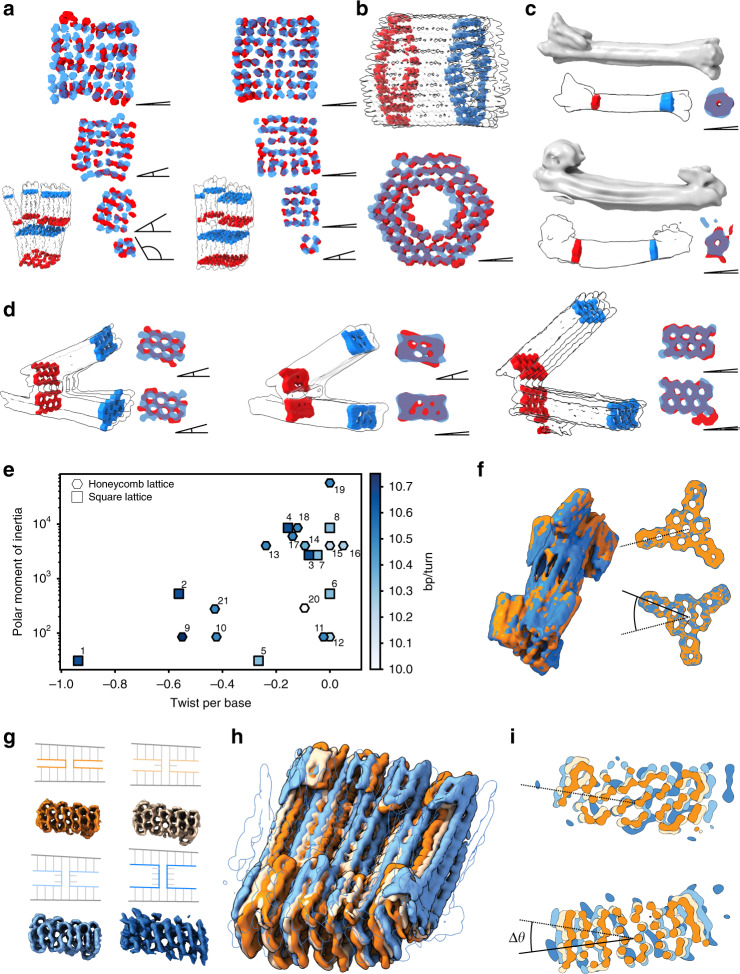
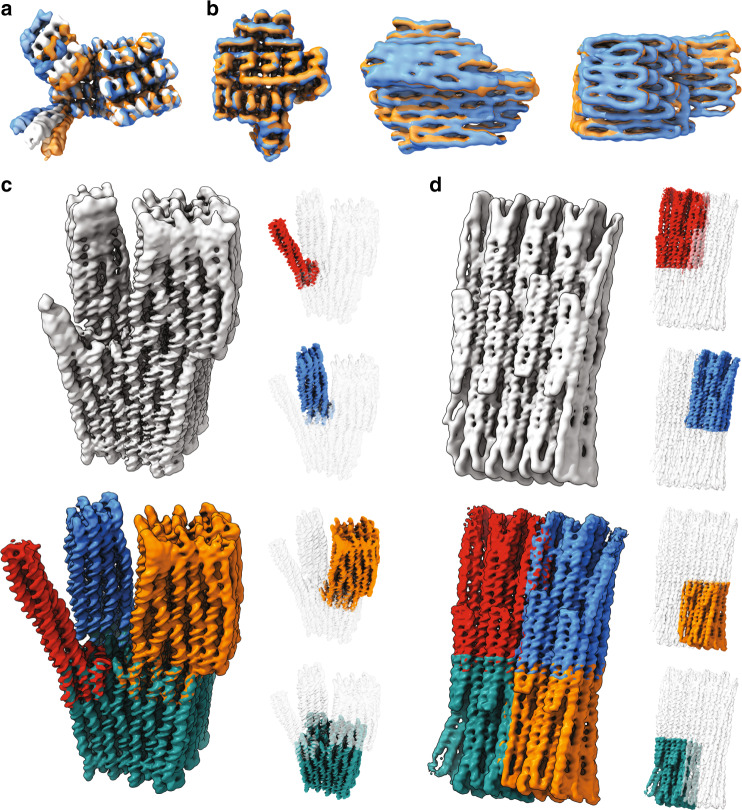
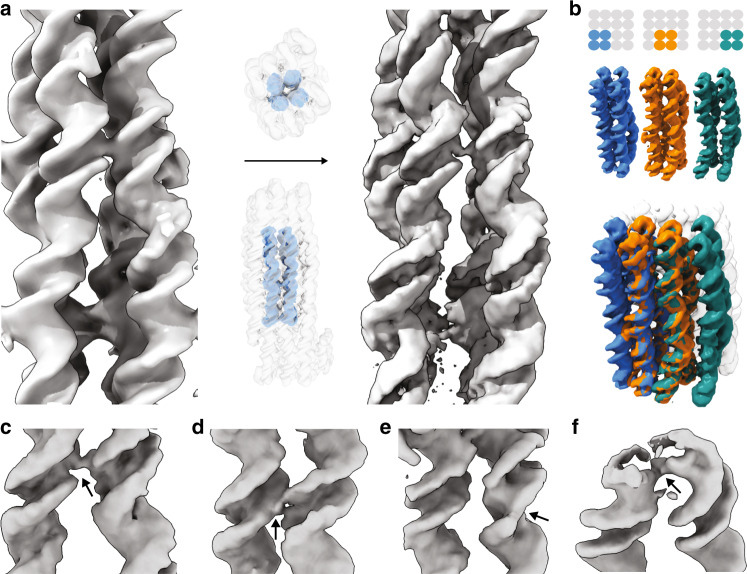
The methods of DNA nanotechnology enable the rational design of custom shapes that self-assemble in solution from sets of DNA molecules. DNA origami, in which a long template DNA single strand is folded by many short DNA oligonucleotides, can be employed to make objects comprising hundreds of unique DNA strands and thousands of base pairs, thus in principle providing many degrees of freedom for modelling complex objects of defined 3D shapes and sizes. Here, we address the problem of accurate structural validation of DNA objects in solution with cryo-EM based methodologies. By taking into account structural fluctuations, we can determine structures with improved detail compared to previous work. To interpret the experimental cryo-EM maps, we present molecular-dynamics-based methods for building pseudo-atomic models in a semi-automated fashion. Among other features, our data allows discerning details such as helical grooves, single-strand versus double-strand crossovers, backbone phosphate positions, and single-strand breaks. Obtaining this higher level of detail is a step forward that now allows designers to inspect and refine their designs with base-pair level interventions.
DNA 纳米技术的方法能够实现从 DNA 分子集合中自组装定制形状的合理设计。通过许多短的 DNA 寡核苷酸折叠长模板 DNA 单链的 DNA 折纸术,可以用来制造包含数百个独特的 DNA 链和数千个碱基对的物体,从而为建模具有明确定义的 3D 形状和大小的复杂物体提供了许多自由度。在这里,我们通过基于 cryo-EM 的方法解决了溶液中 DNA 物体的准确结构验证问题。通过考虑结构波动,我们可以确定比以前的工作具有更高细节的结构。为了解释实验 cryo-EM 图谱,我们提出了基于分子动力学的方法,以半自动的方式构建伪原子模型。除其他特征外,我们的数据允许辨别细节,如螺旋槽、单链与双链交叉、骨架磷酸位置和单链断裂。获得这种更高的细节水平是向前迈进的一步,现在允许设计人员检查和改进他们的设计,进行碱基对水平的干预。