Baptist Anna V, Heuer-Jungemann Amelie
Max Planck Institute of Biochemistry, Am Klopferspitz 18, 82152 Martinsried, Bavaria, Germany.
Center for NanoScience, Ludwig-Maximilians University, 80539 Munich, Germany.
ACS Omega. 2023 May 11;8(20):18225-18233. doi: 10.1021/acsomega.3c01680. eCollection 2023 May 23.
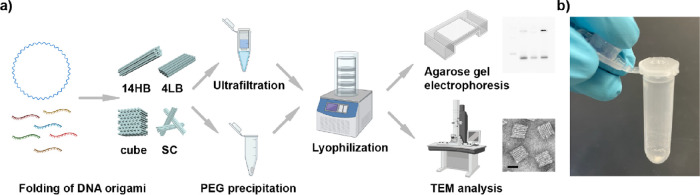
Although for many purposes, low concentrations of DNA origami are sufficient, certain applications such as cryo electron microscopy, measurements involving small-angle X-ray scattering, or applications require high DNA origami concentrations of >200 nM. This is achievable by ultrafiltration or polyethylene glycol precipitation but often at the expense of increasing structural aggregation due to prolonged centrifugation and final redispersion in low buffer volumes. Here, we show that lyophilization and subsequent redispersion in low buffer volumes can achieve high concentrations of DNA origami while drastically reducing aggregation due to initially very low DNA origami concentrations in low salt buffers. We demonstrate this for four structurally different types of three-dimensional DNA origami. All of these structures exhibit different aggregation behaviors at high concentrations (tip-to-tip stacking, side-to-side binding, or structural interlocking), which can be drastically reduced by dispersion in larger volumes of a low salt buffer and subsequent lyophilization. Finally, we show that this procedure can also be applied to silicified DNA origami to achieve high concentrations with low aggregation. We thus find that lyophilization is not only a tool for long-term storage of biomolecules but also an excellent way for up-concentrating while maintaining well-dispersed solutions of DNA origami.
尽管在许多情况下,低浓度的DNA折纸就足够了,但某些应用,如冷冻电子显微镜、涉及小角X射线散射的测量,或其他应用需要大于200 nM的高DNA折纸浓度。这可以通过超滤或聚乙二醇沉淀来实现,但由于长时间离心以及在低缓冲液体积中最终再分散,往往会增加结构聚集。在这里,我们表明冻干并随后在低缓冲液体积中再分散可以实现高浓度的DNA折纸,同时由于低盐缓冲液中最初非常低的DNA折纸浓度而大幅减少聚集。我们针对四种结构不同类型的三维DNA折纸证明了这一点。所有这些结构在高浓度下都表现出不同类型的聚集行为(头对头堆叠、并排结合或结构互锁),通过在更大体积的低盐缓冲液中分散并随后冻干,可以大幅减少这些聚集行为。最后,我们表明该方法也可应用于硅化的DNA折纸,以实现高浓度且低聚集。因此,我们发现冻干不仅是一种用于生物分子长期储存的工具,也是一种在保持DNA折纸溶液良好分散的同时进行浓缩的绝佳方法。