Mukaino Masahiko, Tatemoto Tsuyoshi, Kumazawa Nobuhiro, Tanabe Shigeo, Katoh Masaki, Saitoh Eiichi, Otaka Yohei
Department of Rehabilitation Medicine I, School of Medicine, Fujita Health University, Toyoake, Japan.
Faculty of Rehabilitation, School of Health Sciences, Fujita Health University, Toyoake, Japan.
JMIR Rehabil Assist Technol. 2020 Dec 10;7(2):e24960. doi: 10.2196/24960.
Isolation due to a COVID-19 infection can limit activities and cause physical and mental decline, especially in older adults and people with disabilities. However, due to limited contact, adequate rehabilitation is difficult to provide for quarantined patients. Telerehabilitation technology could be a solution; however, issues specific to COVID-19 should be taken into consideration, such as strict quarantine and respiratory symptoms, as well as accessibility to deal with rapid increases in need due to the pandemic.
This study aims to develop and to investigate the feasibility of a telerehabilitation system for patients who are quarantined due to COVID-19 by combining existing commercial devices and computer applications.
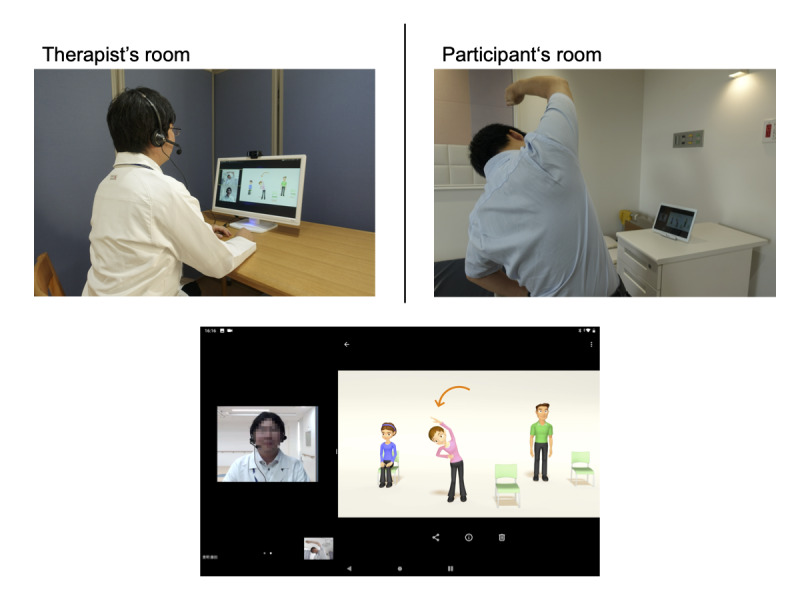
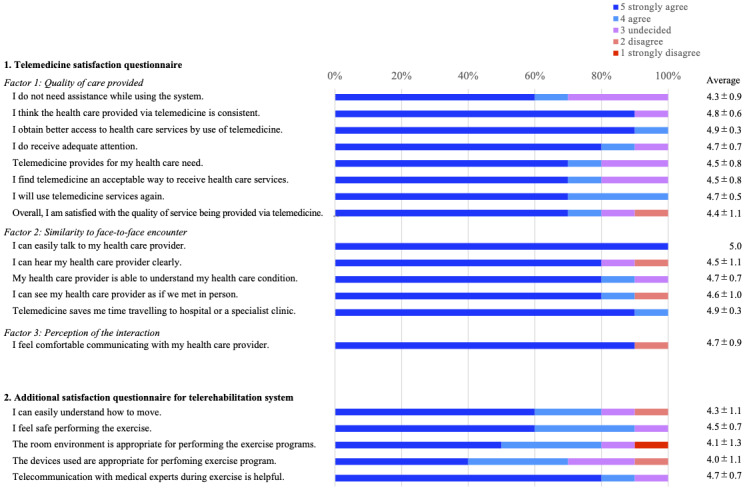
A multidisciplinary team has identified the requirements for a telerehabilitation system for COVID-19 and developed the system to satisfy those requirements. In the subsequent feasibility study, patients diagnosed with COVID-19 (N=10; mean age 60 years, SD 18 years) were included. A single session of telerehabilitation consisted of stretching exercises, a 15-minute exercise program, and a video exercise program conducted under real-time guidance by a physical therapist through a video call. The system included a tablet computer, a pulse oximeter, videoconferencing software, and remote control software. The feasibility of the system was evaluated using the Telemedicine Satisfaction Questionnaire (TSQ; 14 items) and an additional questionnaire on the telerehabilitation system (5 items). Each item was rated from "1 = strongly disagree" to "5 = strongly agree."
The telerehabilitation system was developed by combining existing devices and applications, including a pulse oximeter and remote control mechanism, to achieve user-friendliness, affordability, and safety, which were determined as the system requirements. In the feasibility study, 9 out of 10 patients were able to use the telerehabilitation system without any on-site help. On the TSQ, the mean score for each item was 4.7 (SD 0.7), and in the additional items regarding telerehabilitation, the mean score for each item was 4.3 (SD 1.0).
These findings support the feasibility of this simple telerehabilitation system in quarantined patients with COVID-19, encouraging further investigation on the merit of the system's use in clinical practice.
因新型冠状病毒肺炎(COVID-19)感染而被隔离会限制活动,并导致身体和精神衰退,尤其是在老年人和残疾人中。然而,由于接触受限,难以对被隔离患者提供充分的康复治疗。远程康复技术可能是一种解决方案;但是,应考虑到COVID-19的特定问题,如严格隔离和呼吸道症状,以及应对因疫情导致的需求迅速增加的可及性。
本研究旨在通过结合现有的商业设备和计算机应用程序,开发并研究一种针对因COVID-19而被隔离患者的远程康复系统的可行性。
一个多学科团队确定了针对COVID-19的远程康复系统的要求,并开发了满足这些要求的系统。在随后的可行性研究中,纳入了被诊断为COVID-19的患者(N = 10;平均年龄60岁,标准差18岁)。一次远程康复治疗包括伸展运动、一个15分钟的锻炼计划,以及由物理治疗师通过视频通话进行实时指导的视频锻炼计划。该系统包括一台平板电脑、一个脉搏血氧仪、视频会议软件和远程控制软件。使用远程医疗满意度问卷(TSQ;14项)和一份关于远程康复系统的附加问卷(5项)对该系统的可行性进行评估。每个项目的评分从“1 = 强烈不同意”到“5 = 强烈同意”。
通过结合现有的设备和应用程序,包括脉搏血氧仪和远程控制机制,开发了远程康复系统,以实现用户友好性、可承受性和安全性,这些被确定为系统要求。在可行性研究中,10名患者中有9名能够在没有任何现场帮助的情况下使用远程康复系统。在TSQ上,每个项目的平均得分为4.7(标准差0.7),在关于远程康复的附加项目中,每个项目的平均得分为4.3(标准差1.0)。
这些发现支持了这种简单的远程康复系统在被隔离的COVID-19患者中的可行性,鼓励进一步研究该系统在临床实践中使用的优点。