D'Souza Arnold Fredrick, Rebello Sydney Roshan
Department of Physiotherapy, Father Muller College of Allied Health Sciences, Mangaluru, India.
Int J Telerehabil. 2021 Dec 16;13(2):e6425. doi: 10.5195/ijt.2021.6425. eCollection 2021.
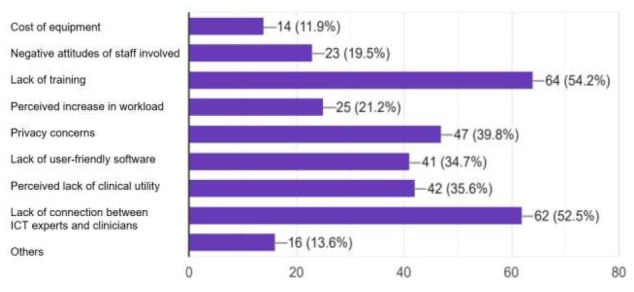
The COVID-19 pandemic and ensuing lockdowns have restricted regular clinical physiotherapy services. This has necessitated a sudden shift to the use of telerehabilitation to prevent disruption in the delivery of physiotherapy interventions. This survey investigates the perceptions of physiotherapists in India and their willingness to use telerehabilitation during the pandemic. An electronic questionnaire was sent to 176 physiotherapists around India, and 118 completed questionnaires were received (acceptance rate of 67.04%). A majority of the respondents (n=67; 77%) had used telerehabilitation for the first time during the pandemic, and 72.9% (n=86) found telerehabilitation to be a viable option for healthcare delivery during the pandemic. Some of the barriers identified were lack of training (n=64; 52%) and a lack of connection between information and communication technology experts and clinicians (n=62; 52.5%). Overall, physiotherapists in India expressed a positive perception of telerehabilitation and are willing to use such services.
新冠疫情及随之而来的封锁措施限制了常规的临床物理治疗服务。这使得不得不突然转向使用远程康复,以防止物理治疗干预的提供中断。本次调查旨在探究印度物理治疗师的看法以及他们在疫情期间使用远程康复的意愿。一份电子问卷被发送给印度各地的176名物理治疗师,共收到118份完整问卷(接受率为67.04%)。大多数受访者(n = 67;77%)在疫情期间首次使用远程康复,72.9%(n = 86)的受访者认为远程康复是疫情期间医疗服务提供的可行选择。所确定的一些障碍包括缺乏培训(n = 64;52%)以及信息通信技术专家与临床医生之间缺乏联系(n = 62;52.5%)。总体而言,印度的物理治疗师对远程康复表达了积极看法,并愿意使用此类服务。